
The Fear: The “Whiteboard Challenge” Nightmare

In 2026, navigating a digital design file with Color Vision Deficiency (CVD) is largely a solved problem. You have your “fail-safe” tech stack: Figma plugins like Stark, OS-level filters like Color Oracle, and you know how to “design by numbers” using HEX codes and luminance values.
But what happens when you step away from the screen? For colorblind designers, the ultimate nightmare is the Analog Whiteboard Challenge during a high-stakes job interview.
- “What if they hand me a physical marker without a label?”
- “How do I color-code physical Post-it notes for a UX mapping session?”
- “What if the Creative Director asks me to review a physical CMYK print proof and tells me the reds look ‘too muddy’?”
Without your digital safety nets, “Imposter Syndrome” kicks in. You worry that one wrong hue choice with a physical marker will cost you the job offer.
The Reality: Your Vision is an “Accessibility Superpower”
The myth that colorblindness is a career-killer in design is dead. Today, 1 in 12 men and 1 in 200 women have CVD. In a market where strict WCAG 3.0 accessibility compliance is a legal requirement, having a colorblind designer on the team is a massive competitive advantage. You are the ultimate “Accessibility First-Responder.”
Because you don’t get distracted by aesthetic “fluff,” you are naturally hyper-sensitive to structural hierarchy, texture, and luminance contrast.
How ColorKinds® Supports Graphic Designer Careers
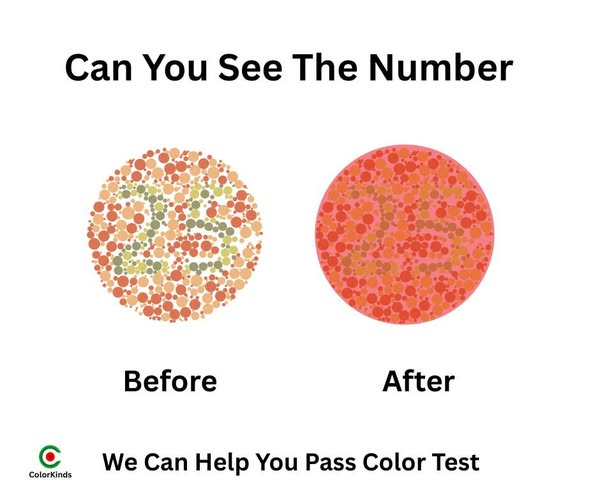
While your digital tech stack protects your files, ColorKinds® corrective lenses protect you in the physical world. Our spectral notch filters bridge the gap between your digital precision and analog reality.
1. Conquering the Analog Interview (Whiteboard Tests)
Don’t rely on the stressful trick of asking the interviewer, “Is this the red marker?” ColorKinds lenses filter out the overlapping “confusion wavelengths” between red and green. When you are handed unlabelled markers or sticky notes during a UX mapping session, our lenses provide the immediate, real-time contrast you need to confidently map out user flows without hesitation.
2. Physical Print & Packaging Proofing
If you work in branding or print design, monitors (even high-CRI ones) can only do so much. When reviewing physical CMYK proofs, packaging mockups, or fabric swatches, you can’t use a digital eyedropper tool. Our contacts allow you to visually verify the vibrancy of reds, greens, and browns with your naked eye, ensuring the physical product matches your digital intent.
3. Real-Time Client Confidence
Clients rarely speak in HEX codes; they speak in “vibes” (e.g., “Can we make this brand feel a little warmer?”). Wearing discreet ColorKinds contacts allows you to interpret these visual nuances in real-time during physical presentations, reducing anxiety and increasing your authority in the room.
High-Growth Design Careers for Colorblind Professionals
According to 2026 career suitability data, the highest-paying niches for colorblind designers rely on logic and systems rather than pure aesthetic “vibe-based” color matching:
| Design Specialization | CVD Suitability | Primary Skillset | Why it works for Colorblind Professionals |
|---|---|---|---|
| Design Systems Architect | Highest | Logic, Naming, Tokens | Relies on defining variables (e.g., brand-primary-500) rather than visual matching. |
| UX Researcher | High | Data, Empathy, Flow | Focuses on user behavior and psychological friction where color is secondary to function. |
| UI Engineer | High | Code, Math, Systems | Combines code and design; allows for “mathematical” color implementation (HSB/Luminance). |
| Branding Specialist | Medium | Vibes, Nuance, Hues | Requires ColorKinds contacts for physical proofing, but heavily benefits from CVD-first accessibility. |
Design Without Limits.
Don’t let an analog whiteboard challenge stand between you and a Senior Designer title. Equip yourself with the visual clarity you need to own the room.
Frequently Asked Questions for Designers
Should I disclose my colorblindness to an employer? Yes, but strategy matters. Research suggests the Offer Stage is the best time to disclose. Frame it not as a limitation, but as an Accessibility Audit Skill. (e.g., “I use a system-first workflow to ensure our designs meet WCAG 3.0 standards for the 300 million users worldwide with CVD.”)
Do ColorKinds contacts replace my Figma accessibility plugins? No. They work together as the ultimate 2026 Tech Stack. Use plugins like Stark or Able for exact mathematical WCAG contrast ratios in your digital files. Use ColorKinds contacts for the physical world: whiteboard interviews, checking printed proofs, and daily lifestyle safety.
Can I wear them while staring at a monitor all day? Yes. ColorKinds contacts are made from highly breathable hydrogel materials designed to maintain moisture, making them comfortable even during long 8-hour sessions in front of a high-CRI monitor.
Can a colorblind person work as a graphic designer? Yes, colorblindness is not a disqualifier for a design career. Successful designers with Color Vision Deficiency (CVD) rely on technical workflows rather than visual “intuition.” By mastering HEX codes, using HSB (Hue, Saturation, Brightness) values, and leveraging accessibility plugins, you can produce work that is often more inclusive and technically accurate than sighted peers who rely on uncalibrated vision.
Is color blindness a problem in graphic design careers? While it presents unique challenges—such as identifying subtle mid-tones or passing analog whiteboard challenges—it is largely a solved problem in digital environments. Many modern employers view colorblindness as an asset for accessibility. Because you are naturally sensitive to contrast and luminance, you are better equipped to ensure designs meet WCAG 3.0 standards, a high-priority business requirement.
Can I become a UI/UX designer if I am colorblind? Absolutely. UI/UX is often considered the best design niche for those with CVD. Unlike branding or traditional art, UI/UX relies heavily on structure, hierarchy, and usability. Modern tools like Figma offer robust simulation plugins that allow you to “see” your work through multiple vision profiles, ensuring your interface is functional for all 300 million people worldwide with color deficiencies.
Will employers actually hire a colorblind designer? Yes. In the current market, diversity of perspective is a competitive advantage. Most employers prioritize your portfolio, logic, and problem-solving skills over your clinical vision. Companies like Airbnb and Shopify have successful colorblind designers in leadership roles who advocate for inclusive design systems.
What design jobs are best for colorblind people? Logic-based and system-oriented roles are the highest-growth paths for CVD professionals. High-suitability careers include:
- Design Systems Architect: Focuses on naming tokens and variables.
- UX Researcher: Focuses on user behavior, psychology, and wireframe flow.
- UI Engineer: Combines design with mathematical color implementation.
Which design careers should colorblind people avoid? Roles that require high-precision manual color matching under varied lighting—such as high-end photo retouching, print prepress technicians, or physical paint colorists—tend to be more difficult. However, even these are possible if you work within a team where a “color buddy” can perform final verification.
Are there design jobs where someone else handles color matching? Yes. In larger agencies or in-house tech teams, “Visual Designers” or “Brand Specialists” typically set the palette and style guides. Product Designers and UX Designers then apply those pre-verified colors to functional layouts, essentially “painting by numbers” using an established design system.
How can a colorblind designer learn color theory effectively? Focus on the physics and math of color. Instead of trying to “feel” a hue, learn the HSL (Hue, Saturation, Lightness) model. Understanding that Hue 0 is Red and Hue 240 is Blue allows you to build palettes mathematically. Mastering tonal contrast is also vital; if a design works in grayscale, it will work for everyone.
Should I tell employers I am colorblind as a designer? Strategic disclosure is generally recommended during the Offer Stage. Framing CVD as a commitment to accessibility turns a potential concern into a specialized skill. During the interview, you can focus on your “system-first” logic, demonstrating how you build structural hierarchy before adding color.
How do I professionally mention CVD on my website or portfolio? You can add a subtle badge or a line in your “About” section: “Designed for WCAG 3.0: I leverage my color vision deficiency to build high-contrast, universally accessible products.” This frames your vision profile as a quality assurance benefit for the employer.
How can I prove my design skills if I can’t see specific colors? Let your portfolio prove your precision. Include a grayscale pass for each case study to show that your visual hierarchy works independently of color. Label your color palettes with HEX codes and luminance values to demonstrate a data-driven, technical approach to design.
How do colorblind designers avoid color mistakes at work? The “fail-safe” professional workflow includes:
- Contrast Plugins: Using tools like Stark or Able to verify readability.
- OS-Level Filters: Using Color Oracle to check the entire screen (including notifications).
- Semantic Tokens: Relying on named variables (e.g.,
brand-danger-red) rather than a color picker. - The Color Buddy System: Having a designated peer do a 5-minute final check on critical brand assets.