
The Fear: The “Category A” Disqualification
For every recruit entering the fire academy, the medical exam based on NFPA 1582 is the final hurdle.
- The Rule: Section 6.4.1 often lists “color perception deficiency” as a Category A medical condition (which effectively means disqualification).
- The Nightmare: You have the strength, the cardio, and the courage, but you fail the Ishihara plate test, and the department doctor marks you as “Unfit for Duty.”
The Reality: The “Functional Test” Loophole
The fire service is evolving. The NFPA 1582 standard does allow for exceptions if a candidate can demonstrate the ability to perform essential job tasks safely.
This is where the “Functional Field Test” comes in. Instead of reading dots in a book, many departments will take you out to the bay and ask you to:
- Identify color-coded hydrants.
- Read the pressure gauges on the pump panel (Red vs. Green zones).
- Identify HazMat placards (NFPA 704 Diamonds).
This is where you can save your career. You don’t need perfect book vision; you need perfect functional vision.
How ColorKinds® Saves Lives (The Science of Smoke)
Color vision isn’t just a requirement; it’s a survival tool. Experienced firefighters use “Smoke Reading” to predict building collapse and flashovers.
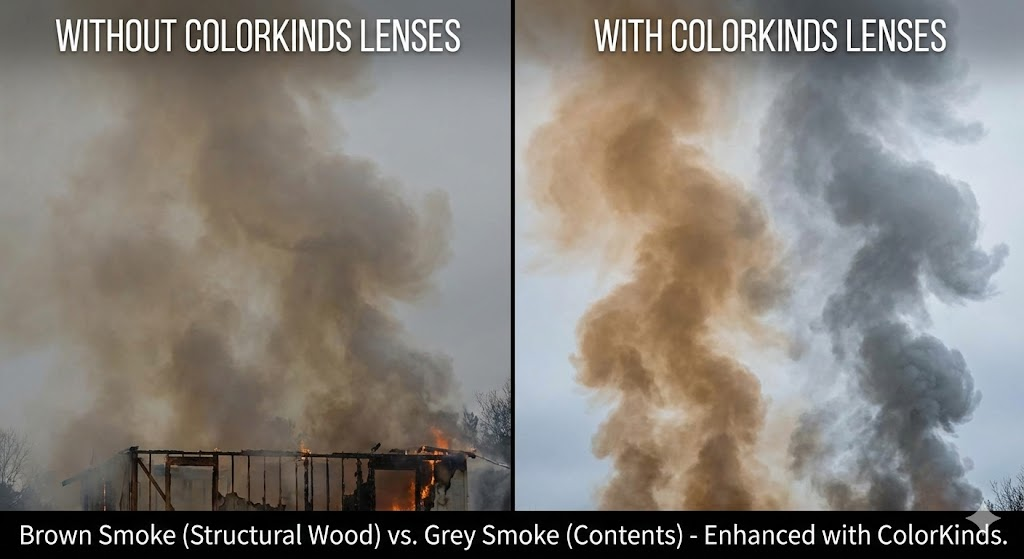
1. Brown Smoke vs. Grey Smoke
- The Danger:
- Brown/Tan Smoke = Unfinished wood (structural trusses) is burning. Warning: Collapse is imminent.
- Grey Smoke = Plastics or painted surfaces.
- The Solution: To a colorblind eye, brown and grey often look identical. ColorKinds lenses enhance the “warm” tones in the brown smoke, separating it from the “cool” grey smoke. This distinction tells you when to evacuate the roof immediately.
2. HazMat & Placards
- The Danger: You arrive at a tanker spill. Is the diamond Red (Flammable) or Green (Non-Flammable Gas)?
- The Solution: Our spectral filter makes the Red diamond “pop” with high contrast, ensuring you pull the correct hose line and don’t spray water on a reactive chemical.
3. Thermal Imaging Cameras (TICs)
- The Danger: Modern TICs use color palettes (Yellow $\to$ Orange $\to$ Red) to show heat intensity.
- The Solution: By enhancing the contrast between yellow and red wavelengths, our lenses help you interpret the thermal screen faster, locating victims or hotspots in zero-visibility conditions.
Firefighter Testimonial:
“I failed the Ishihara plates during my entrance physical. I appealed for a functional test. I wore my ColorKinds lenses and nailed the color-coded hydrant test and the pump panel test 100%. I’ve been a career firefighter for 4 years now, and I still wear them inside my mask.” — Lt. D.M., Career Fire Dept.
Frequently Asked Questions
Can I wear these contacts inside my SCBA mask?
Yes.
Years ago, OSHA prohibited contact lenses with respirators (SCBA). However, OSHA has updated its regulations (Standard 1910.134(g)(1)(ii)). You are permitted to wear corrective contact lenses with a full-facepiece respirator, provided they do not cause discomfort. ColorKinds lenses are soft hydrogels that fit comfortably under the face seal.
Will they melt?
No. Soft contact lenses are hydrated (made of water and polymer). They will not melt or fuse to your eye in high-heat environments any faster than your own cornea would. If the heat is high enough to damage a contact lens behind a polycarbonate SCBA mask, you have much bigger problems (mask failure).
How do I ask for a functional test?
If you fail the Ishihara plates, respectfully quote NFPA 1582 Annex A, which suggests that candidates who fail color testing should be evaluated on their ability to perform specific color-dependent tasks.
Reference: Authority Sources
Cite these standards to your Medical Officer if needed.
- NFPA 1582 (Comprehensive Occupational Medical Program):
- Details: Chapter 6.4.1 outlines vision requirements and the distinction between “Monochromatic” vision (total color blindness, unsafe) and “Color Deficiency” (often manageable).
- Source: NFPA 1582 Standard Overview
- OSHA Respiratory Protection Standard (1910.134):
- Details: The ruling that allows contact lenses to be worn with SCBA masks.
- Source: OSHA Regulation 1910.134
- Fire Engineering (Reading Smoke):
- Details: Expert articles on why distinguishing Brown vs. Grey smoke is critical for structural stability assessment.
Stay Safe. Stay Sworn.
Don’t let a vision test keep you off the rig. Equip yourself with the tool that helps you read the fire and protect your crew