
Why Can’t Pilots Be Colorblind? The Safety Rules
If you have spent your life looking up at the sky, dreaming of the cockpit, discovering that you have a color vision deficiency can feel like a devastating blow. You have probably typed the question into a search engine in frustration: why cant pilots be color blind? Let’s start with a direct, factual answer: Pilots actually can be colorblind. Having a color vision deficiency does not mean your aviation dreams are over. You can absolutely get a pilot’s license if you are colorblind. However, if you fail the initial color vision tests and cannot pass the approved alternatives, the Federal Aviation Administration (FAA) will issue your medical certificate with a strict limitation: “Not valid for night flying or by color signal control”.
For a private pilot who just wants to fly on sunny weekends, this restriction is completely manageable. But if you are wondering, can commercial pilots be colorblind? The answer is yes, but only if you can prove to the FAA that your deficiency does not impact your ability to safely identify aviation colors. You cannot hold a commercial airline job with a night-flying restriction.
In this comprehensive guide, we are going to break down exactly why these safety rules exist, how to navigate the bureaucratic maze of the faa color vision test, and the strategies you can use to protect your aviation medical record.

The Safety Factor: Why Color Matters in the Cockpit
The FAA’s strictness regarding color perception is not designed to arbitrarily keep people out of the sky. It is rooted in the fundamental realities of how pilots navigate, communicate, and survive, especially when the sun goes down. The aviation environment is heavily color-coded, and a pilot must be able to instantly differentiate between specific hues without second-guessing.
Runway and Approach Lighting (PAPI/VASI)
When a pilot is preparing to land at night or in low-visibility conditions, they rely heavily on approach lighting systems, primarily the Visual Approach Slope Indicator (VASI) or the Precision Approach Path Indicator (PAPI). These sophisticated lighting arrays sit next to the runway and use a specific combination of red and white lights to indicate the aircraft’s glide path.
- Seeing all white lights means the aircraft is flying too high.
- Seeing all red lights means the aircraft is dangerously low.
- Seeing a mix of red and white indicates a perfect, safe descent path.
If a pilot cannot instantly differentiate between the faint glow of a red light and a white light from several miles away, the results can be catastrophic.
The 2002 FedEx Crash Case Study
The FAA’s firm stance on color vision is grounded in historical tragedy. In 2002, the rules surrounding color blindness were put under intense national scrutiny following the crash of FedEx Flight 1478.
During a night approach into Tallahassee Regional Airport, the First Officer—who had a known color vision deficiency—was navigating the visual descent. He descended dangerously below the safe glide path, and the aircraft crashed half a mile short of the runway, destroying the Boeing 727. The National Transportation Safety Board (NTSB) official accident report cited the First Officer’s severe color vision deficiency, and his inability to properly interpret the colored VASI approach lights, as a contributing cause of the crash.
Aircraft Navigation Lights & ATC Signals
Aviation relies on color to communicate direction and intent in the dark. Every aircraft is equipped with standard navigation lights: a red light on the left wing, a green light on the right wing, and a white light on the tail. By seeing these colors at night, a pilot can instantly determine which direction another aircraft is traveling and maneuver to avoid a mid-air collision.
Furthermore, if an aircraft experiences a total radio failure, the Air Traffic Control (ATC) tower will use a highly focused light gun to shine red, green, and white signals to the pilot. You must be able to read these signals to know if you are cleared to land or if you need to abort your approach.
Complex VFR Sectional Charts
Color perception is non-negotiable even during daytime flights. Pilots navigate using highly detailed Visual Flight Rules (VFR) sectional charts. These are not your standard road maps; they use very specific shades of magenta, blue, and green to dictate different classes of airspace, military operation areas, and terrain elevation. Misinterpreting a faded magenta line for a blue line could easily lead a pilot into restricted airspace.
The “Unofficial” Pre-Test Strategy (Don’t Ruin Your FAA Record)
CRITICAL ADVICE: If you suspect you have a color vision deficiency, never take your very first color vision test during your official Aviation Medical Examiner (AME) appointment.
When you schedule an official FAA medical exam, you are required to fill out a MedXPress application. Once that application is open and the AME begins the exam, your results are official and legally binding. If you fail the pilot color blind test during this exam, that failure is permanently etched into your FAA record. The AME will have no choice but to issue your medical certificate with the dreaded restriction: “Not valid for night flying or by color signal control.”
The Unofficial Pre-Test Strategy:
- Delay the MedXPress: Do not fill out your official FAA MedXPress application yet.
- Book a Standard Eye Exam: Schedule a routine appointment with a local, civilian optometrist or ophthalmologist.
- Request the Pilot Tests: Ask the eye doctor to administer the standard Ishihara color plate test.
- Assess Your Options Off the Record: If you pass easily, you can confidently book your AME appointment. If you fail, you now know about your deficiency off the record.
Knowing you have an issue before the FAA knows allows you to proactively research faa approved color blind tests, find alternative testing centers, and locate an AME who has the specific equipment you need to pass.
Demystifying the FAA Color Vision Tests
If you are navigating the medical certification process, understanding the specific tests you will face can greatly reduce your anxiety.
The Dreaded Ishihara “Dot” Test
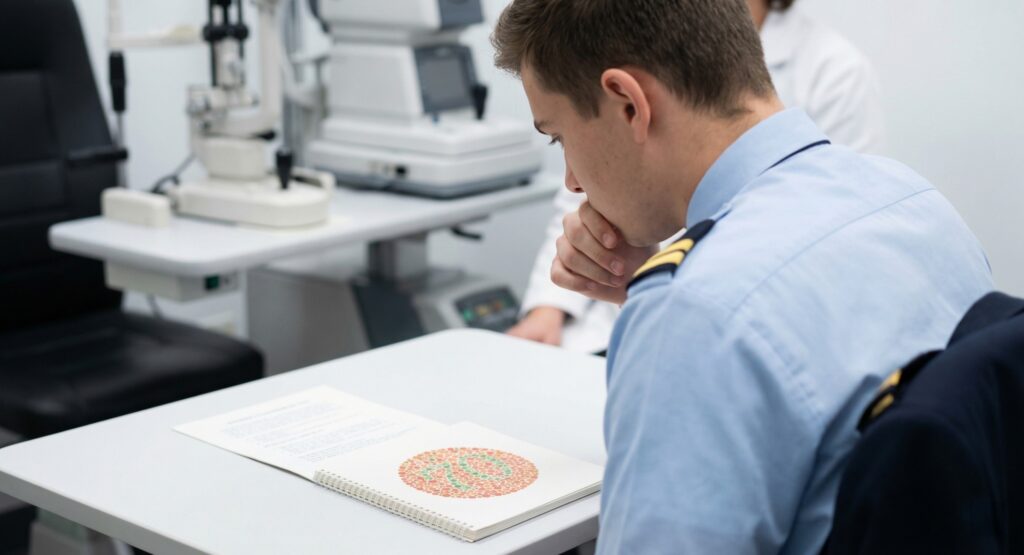
If you take a standard FAA vision screening, you will almost certainly be given the Ishihara pseudoisochromatic plate test. This test consists of a booklet of pages featuring circles made of randomized colored dots. Hidden within the dots are numbers in contrasting colors.
Why it causes so much panic: The Ishihara test is notoriously unforgiving. The standard is extremely strict, often requiring near-perfect scores. Because of its extreme sensitivity, many people with very mild color anomalies—who have absolutely no problem seeing real-world traffic lights or runway lights—will fail the Ishihara test.
The Approved Alternative Tests
If you fail the “dot” test, do not panic. The FAA explicitly approves a variety of alternative testing methods. Instead of struggling to see tiny printed dots on paper, these alternative tests evaluate your ability to see functional, real-world aviation colors (red, green, and white).
- The Farnsworth Lantern (FALANT): Historically the most popular alternative test, the FALANT is a machine that displays two vertical lights (red, green, or white) for two seconds at a time. Because it uses bright, distinct lights rather than pastel dots, many pilots with mild red-green deficiencies easily pass this test.
- The OPTEC 900: Considered the modern equivalent of the Farnsworth Lantern, the OPTEC 900 operates on the exact same principles, showing pairs of functional aviation lights.
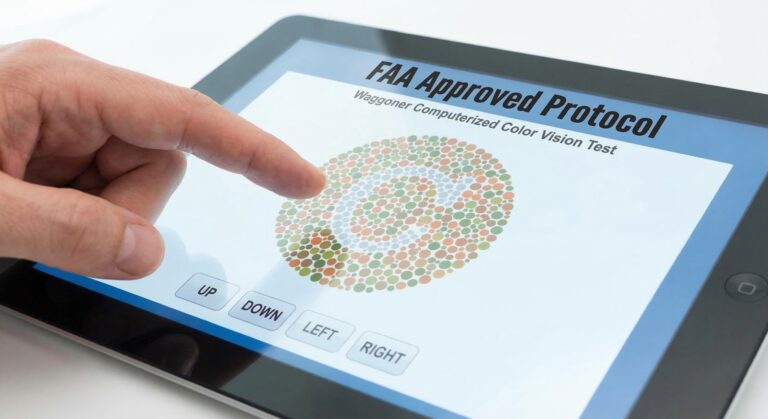
- Computer-Based Testing: The landscape of the new faa color vision test is shifting toward computerized diagnostics. Tests like the Color Assessment and Diagnosis (CAD) test are becoming more prevalent, especially in European (EASA) jurisdictions. These tests can precisely measure the exact severity of your deficiency.
If you pass any of these approved alternative tests, you meet the FAA standard and will be issued an unrestricted medical certificate.
Surviving the OCVT & SODA: The Light Gun Signal Test
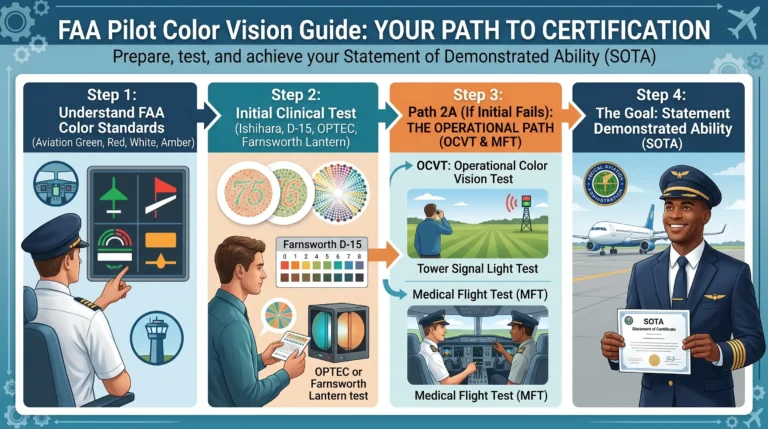
If your color vision deficiency is severe enough that you cannot pass the Ishihara plates or any of the alternative clinical tests, you still have one final, definitive option to save your commercial aviation career: The Operational Color Vision Test (OCVT) and the Medical Flight Test (MFT).
What is the Operational Color Vision Test (OCVT)?
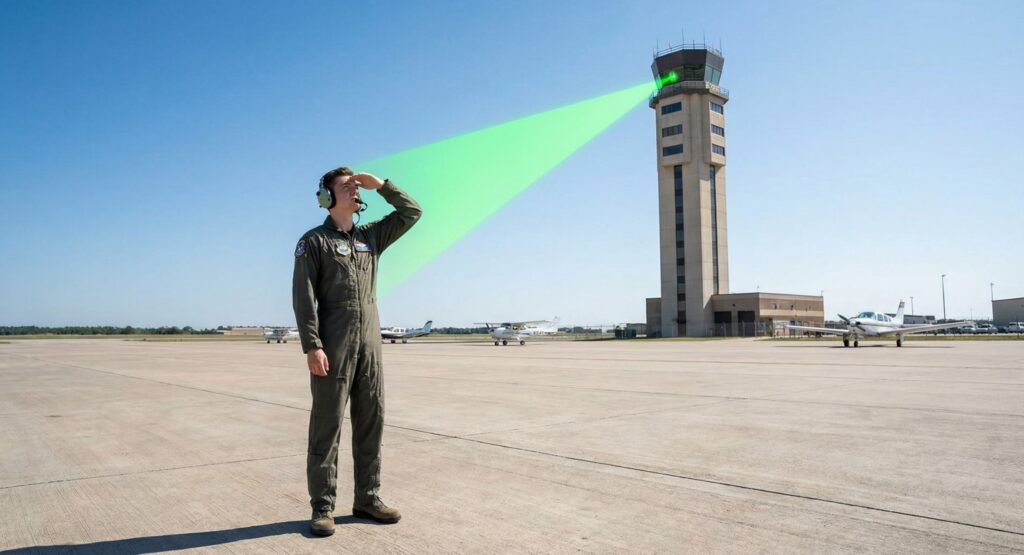
If you are asking how to pass FAA light gun test, you are asking about the OCVT. This is a practical, real-world field test administered by an FAA aviation safety inspector.
During the OCVT, you will stand on the airport tarmac while the control tower shines an aviation light gun at you from a specific distance (usually 1,000 and 1,500 feet). You must correctly identify the red, green, and white flashes. You will also be asked to accurately identify the colored lines and symbols on a VFR sectional chart.
If you pass the OCVT (and the subsequent MFT, which involves flying with an inspector to identify terrain and aircraft lights ), you will be issued a Statement of Demonstrated Ability (SODA). A SODA is a permanent administrative waiver. Once you earn your faa soda color blindness waiver, you never have to take a clinical color vision test again.
The “One-Shot” Rule and How to Practice
The OCVT is your ultimate trump card, but it comes with immense risk. The FAA strictly enforces a “one-shot” rule for the daytime OCVT. If you fail the daytime portion of the OCVT, you can never take it again, and you will be permanently barred from ever upgrading to a commercial license.
Actionable Advice: Never take the official OCVT blind. Call a local towered airport, explain that you are a student pilot preparing for an OCVT, and ask if you can practice. Stand on the ramp and have the tower shine the light gun at you. Figure out what the lights look like in the real world before your entire career is on the line.
The Legal Way to Use Colorblind Glasses in Aviation
If you are struggling with color perception, you might be researching color blind glasses for pilots. Let’s be incredibly clear about the regulations:
The Strict FAA Ban in the Cockpit
The FAA strictly prohibits the use of color-correcting lenses (such as tinted glasses or X-Chrom contact lenses) during aviation medical exams or while actively operating an aircraft. Attempting to wear these lenses during your AME appointment is grounds for immediate disqualification. There is no magical lens that allows you to bypass the FAA’s medical standards in the air.
Using Lenses for Ground School and Simulators
However, that does not mean colorblind glasses are useless. In fact, they are one of the most powerful study tools available to student pilots. Ground school is highly visual, and falling behind on aviation theory is expensive.
While you must pass your FAA practical tests with your naked eye, you can use color-correcting lenses as a legal, at-home study aid:

- Mastering VFR Sectional Charts: Aeronautical charts are dense. Wearing your colorblind glasses while studying at your desk can help you instantly grasp the spatial layout of complex airspace boundaries.
- Acing the FAA Written Exams: The FAA private pilot written exam includes dozens of questions based on visual figures. Using your glasses during your test prep ensures you fully comprehend the visual theory behind the questions.
- Home Flight Simulators: By wearing colorblind glasses while flying in Microsoft Flight Simulator or X-Plane at home, you can train your brain to recognize the context of PAPI/VASI lights, taxiway layouts, and airport beacons. By intensely studying the difference between aviation red, green, and white with the glasses on, you can better train your brain to recognize the subtle contrasts you will need to spot when the glasses come off for your official OCVT.
Final Thoughts on Color Blindness and Flying
A color vision deficiency is a hurdle, not necessarily a roadblock. While you may have to navigate a maze of medical bureaucracy, alternative testing, and strict safety rules, countless pilots have successfully earned their wings and achieved commercial careers despite failing that initial dot test.
Arm yourself with knowledge, protect your medical record by testing unofficially first, and use every legal study tool at your disposal to master the theory of flight.
To learn more about your career options and specific occupational solutions, explore our complete hub on Aviation Pilots and Color Vision Requirements.
Frequently Asked Questions
Everything you need to know about FAA medicals, color vision tests, and pilot requirements.