
How to Pass the New 2025 FAA Pilot Color Vision Test: What Aspiring Pilots Need to Know
Navigating the medical requirements for an aviation career can be incredibly stressful, especially if you have a color vision deficiency. For years, colorblind pilots have had to navigate a complex web of testing standards to prove they can safely interpret aviation signals.
However, a major shift is here. Effective January 1, 2025, the Federal Aviation Administration (FAA) has implemented strict new protocols for color vision screening. These updates represent a significant modernization of the testing process, shifting away from older printed plates and moving toward precise, computerized diagnostics.
If you are an aspiring color blind pilot or a current aviator looking to upgrade your medical certificate, understanding these new FAA color vision requirements is critical. This comprehensive guide breaks down the 2025 updates, the acceptable test instruments for color vision screening, and exactly what happens if you fail the initial screening.
The Big Change: New FAA Color Vision Test Requirements for 2025
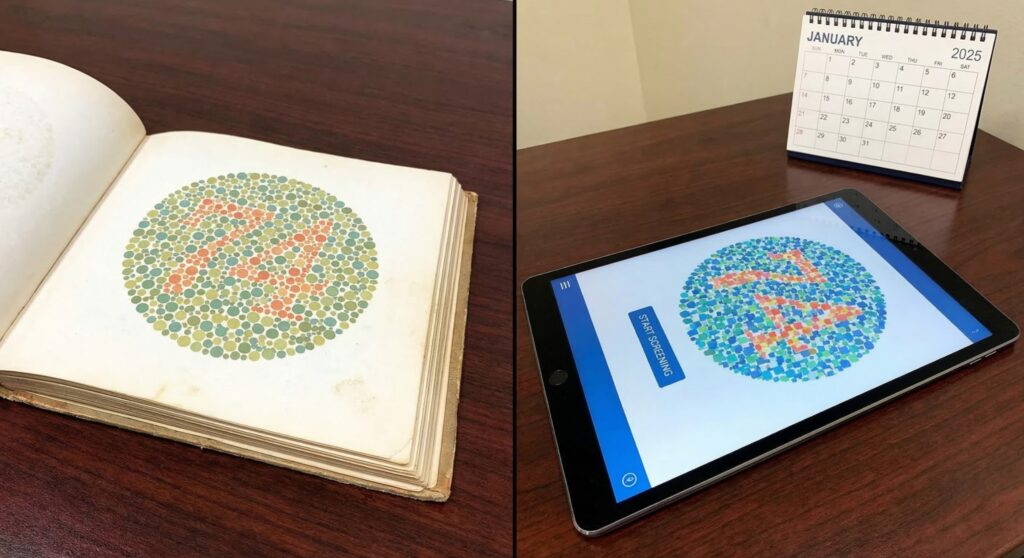
Table : Regulatory Snapshot: The 2025 Update
| Feature | Previous FAA Standard | New 2025 FAA Standard |
| Testing Method | Paper booklets (e.g., Ishihara plates) | Approved computer-based digital tests |
| Frequency | Evaluated at routine medical renewals | One-time screening |
| Effective Date | N/A | Exams on or after January 1, 2025 |
The FAA has fundamentally updated how Aviation Medical Examiners (AMEs) evaluate color vision. Here is what you need to know about the new mandate:
- Computer-Based Testing is Mandatory: For pilot exams performed on or after January 1, 2025, approved computer-based color vision screening tests are explicitly required.
- A “One-Time” Screening: The testing frequency has officially changed to a one-time color vision deficiency screening.
- In-Person Testing Only: Testing must be performed in person. Virtual testing, downloaded versions, or printed versions of color vision tests are strictly prohibited.
These new rules are designed to create a more standardized, objective baseline for color vision across the aviation industry. However, it means that older, non-computerized testing methods are no longer acceptable for routine initial screenings.
Acceptable Test Instruments for Color Vision Screening (Pilots)
To comply with the 2025 regulations, AMEs are required to use specific color vision tests for pilot evaluations. If a test is not explicitly listed by the FAA, it is not an acceptable method of testing for a medical certificate.
Here are the officially approved computerized color vision tests for FAA medical certification purposes:
Table : Approved FAA Color Vision Tests & Passing Scores (Effective Jan 1, 2025)
| Approved Test | Required Version | Passing Criteria |
| Colour Assessment & Diagnosis (CAD) | Certification: “Environment and Aviation (Commercial)” | Pass the “FAST” version. If full test is needed: RG < 1.7 (Normal), < 6 (Deutan), or < 12 (Protan); AND YB < 2.4. |
| Rabin Cone Test (RCCT) | Air Force/Army/Navy/Coast Guard Version | Score 55 or higher for EACH individual color (Red, Green, Blue). |
| Waggoner Computerized Color Vision Test (CCVT) | Adult Diagnostic OR FAA Color Vision Test (Windows, iOS, Android) | General screening score of 21 or higher (out of 25). Specific passing scores apply for isolated deficiencies. |
1. Colour Assessment & Diagnosis (CAD Test)
The CAD test is a highly precise computerized diagnostic tool.
- Approved Version: AMEs must use the Certification: “Environment and Aviation (Commercial)” version.
- How it Works: The applicant takes a “FAST” version first. If the applicant passes the FAST version, no further testing is needed for color. If the applicant fails the FAST version, they must complete the full definitive CAD test.
- Passing Scores: The passing score varies based on the specific type of color vision deficiency. An RG (Red/Green) score of less than 1.7 indicates Normal vision. A score of less than 6 is passing if diagnosed as Deutan (green deficiency), and less than 12 is passing if diagnosed as Protan (red deficiency). The YB (Yellow/Blue) score must be less than 2.4.
2. Rabin Cone Test (RCCT)
- Approved Version: The Air Force/Army/Navy/Coast Guard Version is approved.
- How it Works: Each eye must be tested separately. The “staircase” version of this test is allowed.
- Passing Scores: To pass, the applicant must score 55 or higher for EACH individual color: RED, GREEN, and BLUE.
3. Waggoner Computerized Color Vision Test (CCVT)
- Approved Version: The Adult Diagnostic or FAA Color Vision Test is approved. This test is highly accessible, as it can be administered on Windows, iOS, and Android devices.
- How it Works: The test is broken into sections. Section 1 is a general screening for Protan (red) and Deutan (green) deficiencies. If an applicant does not pass Section 1, Sections 3 and 4 (which quantify the specific red and green deficiencies) will automatically be administered.
- Passing Scores: The General screening requires a score of 21 or higher out of 25.
4. Ishihara Tests No Longer Accepted for New Applicants
Ishihara Plates: These traditional printed dot plates are an older screening method. Starting January 1, 2025, the FAA moved to computerized testing for all new pilot applicants
Who is Affected? First-Time Applicants vs. Returning Pilots
The 2025 updates apply differently depending on your current certification status and your medical history. The FAA has outlined specific pathways for different types of pilots.

Table : How the 2025 Rules Apply to Different Pilots
| Pilot Certification Status | New Computer Test Required? | Next Steps / Outcome |
| First-Time Applicant | Yes | If failed, AME issues 3rd Class with limitation #104 (day VFR only). Can appeal to Federal Air Surgeon. |
| Returning Pilot (Historically Passed) | No | AME marks Item 52 as “PASS” and issues certificate. |
| Holding 3rd Class SODA/LOE (Keeping 3rd Class) | No | AME issues 3rd class certificate with no color vision limitation. |
| Holding 1st or 2nd Class SODA/LOE | No | AME issues 1st or 2nd class certificate with no color vision limitation. |
| Holding 3rd Class SODA/LOE (Upgrading to 1st/2nd) | Yes | If passed, upgrade issued. If failed, 3rd Class issued with day VFR limitation; must appeal to upgrade. |
For First-Time Applicants
If you are applying for your very first medical certificate, you are fully subject to the new computer-based rules.
- A first-time applicant can attempt any (or all) of the approved computer tests that are available at the time of their exam.
For Returning Pilots With a Previous Pass
There is good news for veteran aviators. If you are a returning pilot who has historically passed any previously FAA-approved color vision test, you are grandfathered in.
- A computer-based color vision screening test is NOT required for all medical classes.
- Your AME will simply mark Item 52 as “PASS” and issue your certificate, provided you are otherwise qualified.
For Returning Pilots with a SODA or LOE
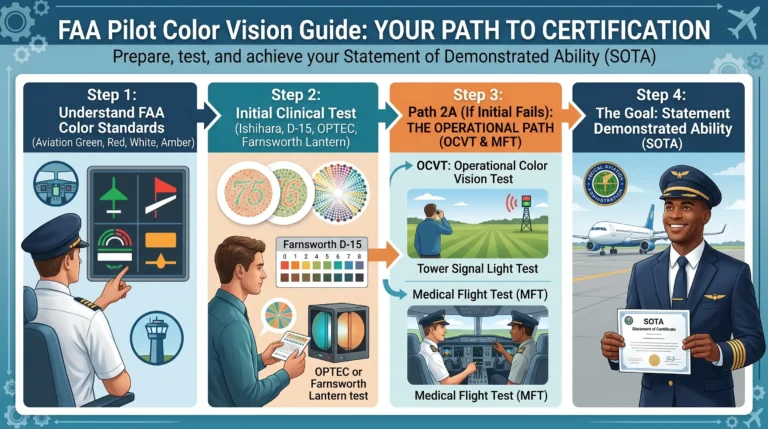
Many colorblind pilots currently fly using a Statement of Demonstrated Ability (SODA) or a Letter of Evidence (LOE) obtained by passing an Operational Color Vision Test (OCVT) or Medical Flight Test (MFT).
- Keeping a 3rd Class: If you hold a 3rd Class SODA or LOE and want to maintain your 3rd Class status, you do not need to take the new computer test. Your AME will issue the 3rd class certificate with no color vision limitation.
- Holding a 1st or 2nd Class: If you already hold a 1st or 2nd class LOE or SODA (having previously passed the OCVT and CV MFT), you do not need the computer test. Your AME will issue your 1st or 2nd class medical certificate with no color vision limitation.
The “Unofficial” Pre-Test Strategy (Crucial for 2025)
Because the testing equipment is entirely new, our most important piece of advice remains unchanged: Do not take your first color vision test during your official FAA medical exam.
To protect your record, schedule an unofficial consultation with a civilian optometrist or an aviation-friendly eye doctor before you apply. Ask them to administer the Waggoner CCVT or a similar digital test. If you pass easily, you can confidently book your AME appointment. If you fail, you now know about your deficiency off the record, giving you time to prepare for alternative options.
Upgrading Your Medical Certificate (3rd Class to 1st or 2nd)
Complications arise if you currently hold a 3rd Class certificate with a SODA/LOE and wish to upgrade to a 1st or 2nd Class medical to pursue commercial pilot careers.
If you request this upgrade, your AME is required to administer one of the newly acceptable computer-based color vision screening tests.
- If you PASS: No limitation is required, and the AME can issue your upgraded certificate if you are otherwise qualified.
- If you FAIL: The AME cannot issue the 1st or 2nd class medical. Instead, they will issue a 3rd class medical certificate with limitation #104: “Valid for day visual flight rules (VFR) only”. To pursue the upgrade after a failure, you must appeal directly to the Federal Air Surgeon.
What Happens If You Fail the Initial Screening?
Failing a pilot color blind test can be disheartening, but it is not necessarily the end of your aviation journey. The FAA has strict protocols for AMEs to follow if a first-time applicant fails.
Table : The Failure & Appeal Pathway
| Step | Action / Outcome | Details |
| 1. The Result | Item 52 Marked “Fail” | The AME logs the failure into your official medical record. |
| 2. The Certificate | 3rd Class Medical Issued | Issued if all other health benchmarks are met. |
| 3. The Limitation | Limitation #104 Applied | Your certificate will state: “Valid for day visual flight rules (VFR) only.” |
| 4. The Appeal | Federal Air Surgeon Review | To upgrade to a 1st or 2nd Class certificate, you must appeal directly to the Federal Air Surgeon. |
If an applicant is unable to pass ANY of the acceptable tests, the AME will mark Item 52 as “Fail”. The AME is required to list the names of the color vision tests attempted and include the scores on your application.
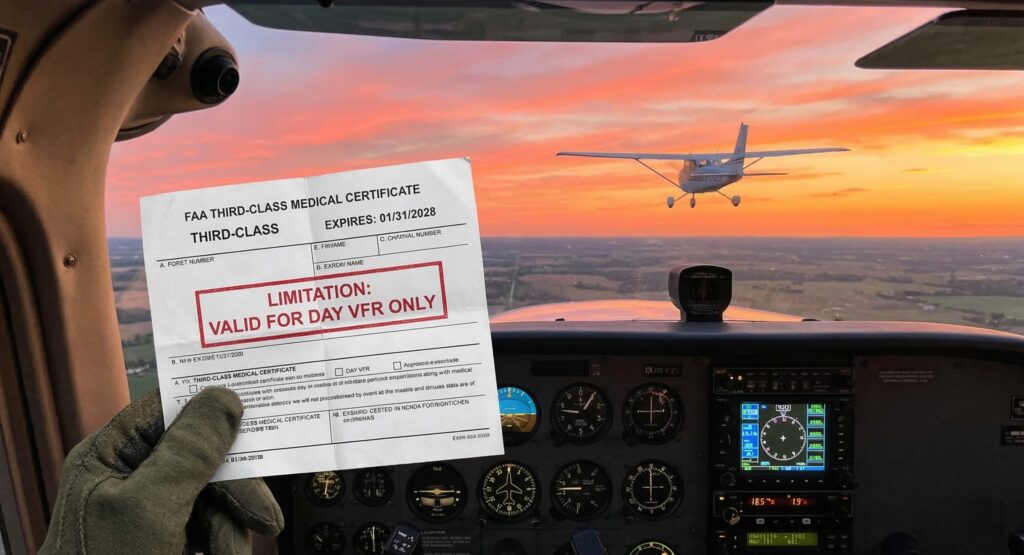
The Resulting Limitation: The AME will still issue a 3rd Class medical certificate (assuming you meet all other health requirements). However, they will add limitation #104: “Valid for day visual flight rules (VFR) only”.
If you wish to remove this limitation or upgrade to a 1st or 2nd class certificate for commercial flying, you will need to appeal to the Federal Air Surgeon. This is typically where alternative, real-world testing—such as the Operational Color Vision Test (OCVT) and the Medical Flight Test (MFT)—comes into play to prove your practical ability to distinguish aviation colors safely.
What if the AME Doesn’t Have the New Computer Tests?
If your AME does not have the required computerized equipment, they cannot defer your application. They must issue a 3rd class medical certification with limitation #104. Alternatively, you can take the computer test at a different clinic; that clinic must provide a printout of the results for your AME to upload to the FAA system.
How to Legally Prepare: Ground School & Study Hacks
The FAA regulations are incredibly strict: You are absolutely prohibited from wearing color-correcting lenses (like Colorkinds contacts or tinted glasses ) during your medical exam, during the OCVT, or while flying an aircraft.
However, that does not mean colorblind glasses are useless. Because failing the clinical tests means you will eventually have to take the naked-eye OCVT, preparation is key. Many student pilots use Colorkinds colorblind glasses as a legal, at-home study aid to accelerate their ground school training.
- Flight Simulators: Wear your glasses while flying in MSFS or X-Plane at home to clearly see the difference between red/white PAPI approach lights and green/blue taxiway lights. Train your brain to understand the context of the airport environment.
- VFR Sectional Charts: Aviation charts are dense with complex magenta and blue airspace lines. Use your glasses at your desk to decipher these maps easily and pass your FAA written exams.
Train your brain on the ground so you are fully prepared when it is time to take your official naked-eye tests.
Navigating the 2025 Updates with Confidence
The FAA’s transition to computer-based color vision testing in 2025 represents a significant modernization of aviation medical standards. While regulatory changes can often feel overwhelming, this update is ultimately designed to create a more accurate and standardized assessment for aspiring aviators.
For returning pilots, the one-time screening rule offers peace of mind—if you have already passed an approved test, your status remains secure. For first-time applicants, understanding these new requirements is your best tool for success. By knowing exactly which digital tests are approved, adhering strictly to the in-person testing rules, and understanding the pathways available even if you don’t pass on the first try, you can approach your AME visit with confidence.
Remember, a color vision deficiency does not automatically ground your dreams of flying. Whether you enjoy the skies under Day VFR limitations or pursue an appeal through the Federal Air Surgeon, there is still a clear flight path forward.