
Can Colorblind People Be Pilots? FAA Requirements, Test Options & Solutions (2026)
You want to fly. Maybe it’s a career — airlines, cargo, corporate. Maybe it’s a lifelong dream of a private pilot certificate. And someone told you that color blindness means you can’t get a medical certificate.
Here’s the direct answer: Yes, colorblind people can be pilots. The FAA does not automatically disqualify you for color vision deficiency. You have multiple testing pathways, alternative tests, and options to demonstrate that your color vision is safe for flight. Thousands of pilots with color blindness hold valid medical certificates.
But here’s the critical truth you need to understand: the process is not automatic, and the FAA does not allow color-correcting contacts or glasses during the medical exam itself. That means preparation matters — and knowing exactly what tests you’ll face and what alternatives exist is the difference between walking away with a medical and walking away with a denial.
This guide covers FAA color vision requirements, every test option available to colorblind pilots, how to prepare, and what to do if you fail the initial screening.
Key Takeaways:
- Yes, colorblind pilots exist and fly commercially, for the military, and as private pilots
- The FAA does NOT allow color-correcting devices (contacts or glasses) during the medical exam — but they can be used for off-duty training
- You have multiple testing pathways if you fail the initial Ishihara: Farnsworth D-15, FAA MCT, OCVT, and Signal Light Gun test
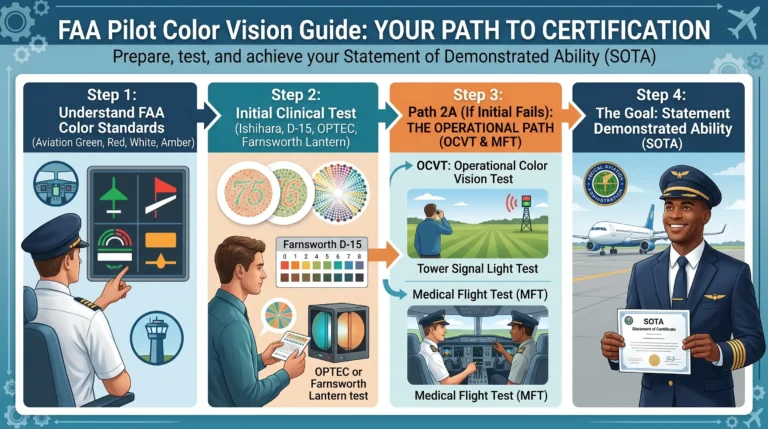
- Passing an alternative test earns a SODA (Statement of Demonstrated Ability) — permanent proof that your color vision is safe
- Colorkinds contacts are an effective off-duty training tool to build color recognition habits before alternative testing
- A failed Ishihara is NOT the end of your pilot career — it’s the beginning of a different testing pathway
Can You Be a Pilot with Color Blindness?
Yes — absolutely. Color blindness (specifically red-green color vision deficiency) is not an automatic disqualification for any class of FAA medical certificate. The FAA evaluates your ability to perceive colors necessary for safe flight operations, and they provide multiple pathways to demonstrate that ability.
The key distinction is between passing the initial screening and qualifying through alternative testing:
| Scenario | Outcome | What Happens Next |
|---|---|---|
| Pass the Ishihara on your first try | Medical issued without restriction | No further testing needed — you’re cleared |
| Fail the Ishihara but pass an alternative test | Medical issued with SODA | SODA is permanent — never retested on color vision |
| Fail all clinical tests but demonstrate safe color perception | May qualify via OCVT | Operational Color Vision Test (flight test) option available |
| Fail the OCVT or choose not to pursue it | Medical limited to operations not requiring color vision | Restrictions may apply to night flying or signal light recognition |
The data supports this: across multiple aviation keywords, colorblind pilots are a well-established reality. The question is not “can you fly?” — it’s “which testing pathway applies to you?”
FAA Color Vision Requirements for Pilots
Medical Certificate Classes
The FAA issues three classes of medical certificates, each with different color vision standards:
| Class | Required For | Color Vision Standard | Renewal |
|---|---|---|---|
| First Class | Airline Transport Pilot (ATP) — scheduled airline operations | Must demonstrate ability to perceive colors required for safe flight | Every 6 months (under 40) or 12 months (40+) |
| Second Class | Commercial pilot — charter, cargo, corporate, flight instruction | Same standard — ability to distinguish aviation signal colors | Every 12 months |
| Third Class | Private pilot, recreational pilot | Same standard — ability to distinguish aviation signal colors | Every 60 months (under 40) or 24 months (40+) |
Important: the color vision standard is the same across all three classes. The FAA does not have a higher color vision bar for airline pilots than for private pilots. If you can pass the color vision requirement for a Third Class medical, you can pass it for a First Class.
What the FAA Actually Tests
The FAA tests your ability to perceive colors used in aviation operations:

- Aviation signal red and green — the colors of runway lights, airport beacons, and navigation lights
- Aviation signal white — the color of landing lights, taxiway lights, and collision lights
- Aviation signal blue — the color of taxiway edge lights
- Aviation signal yellow — the color of runway guard lights and some hazard marking
The underlying question is operational: can you distinguish the color of a red signal light from a green one when it matters? The FAA does not care about theoretical color vision scores — they care about safe flight operations.
What Tests Do Pilots Face?
The FAA accepts several color vision tests. The specific test used depends on your Aviation Medical Examiner (AME) and what equipment they have available.
The Ishihara Color Plate Test
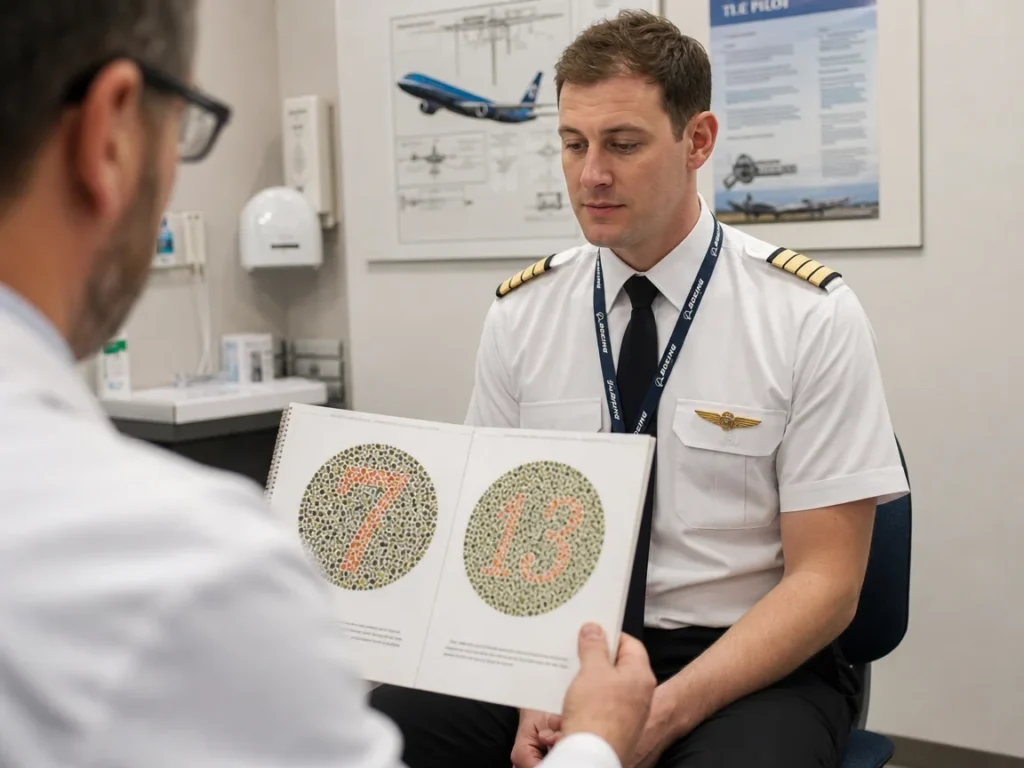
This is the most common screening test. You’ll be shown a series of plates with colored dots forming numbers or shapes. If you have red-green color deficiency, some numbers will be invisible or hard to read.
If you pass the Ishihara (typically 10-13 out of 14 plates), your color vision is considered satisfactory and your medical is issued without restriction.
If you fail, the FAA does not consider that the end of the process — it triggers the next step.
Alternative Clinical Tests
If you fail the Ishihara, your AME may administer one of these alternative tests during the same exam:
| Test | Format | What It Measures | Colorblind Contacts Help? |
|---|---|---|---|
| Farnsworth D-15 | Arrangement — 15 colored caps to sort | Ability to distinguish subtle color differences and arrange by hue | Yes — contrast enhancement helps with arrangement |
| FAA MCT (Medical Certificate Test) | Computerized — color discrimination tasks | Detection of aviation signal light colors | Yes — enhanced contrast aids signal recognition |
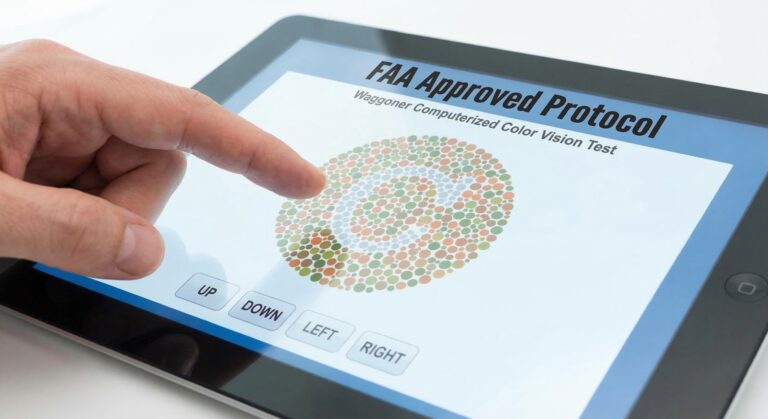
| OPTEC 900 | Digital vision tester with color plates | Pseudoisochromatic plate test similar to Ishihara | Yes — improved discrimination on color plates |
| Waggoner CCVT | Computerized color vision test | Color discrimination using computerized plates | Yes — enhanced contrast benefits performance |
Passing any of these alternative tests earns you a SODA (Statement of Demonstrated Ability) — a permanent notation on your medical record that means your color vision has been proven and you will never be retested on it.
The OCVT — Your Safety Net

If you fail all clinical tests (both the Ishihara and every alternative), the FAA offers one more option: the Operational Color Vision Test (OCVT) . This is an actual flight test with an FAA aviation safety inspector where you demonstrate that you can correctly identify aviation signal lights in real-world conditions.
The OCVT tests:
- Signal light gun recognition — identify red, green, and white light signals from the control tower
- Navigation light identification — distinguish wingtip navigation lights (red left, green right, white aft)
- Airport light recognition — identify runway and taxiway lighting colors
If you pass the OCVT, you receive a SODA. If you fail, you may still qualify for a medical certificate with operational limitations (such as “Not valid for night flying” or “Must have available second pilot”).
Can Colorblind Contacts Help Pilots?
This is a critical question with a nuanced answer.
No, the FAA does not allow you to wear color-correcting contacts during the medical exam itself. Using them during the official color vision screening would be considered using an auxiliary aid, which is not permitted under current FAA policy. The FAA wants to test YOUR natural color vision, not a corrected version.
However, colorblind contacts are extremely valuable as an off-duty training tool. Here’s why:
- Build color recognition habits — Wearing Colorkinds contacts during daily life helps you learn what the correct color responses look like. Your brain builds a connection between what you see through the contacts and the names of colors. This “muscle memory” persists even without the contacts.
- Practice for alternative tests — The Farnsworth D-15, MCT, and other alternative tests benefit from training. Wearing contacts while practicing these tests helps you understand the color sequences and patterns.
- Prepare for the OCVT — The signal light test requires distinguishing red from green quickly. Training with contacts helps you internalize those color differences.
For after you get your medical: Some pilots with color blindness use Colorkinds contacts during actual flight operations to improve their color discrimination. Since contacts are discreet (no one can tell you’re wearing them), they don’t interfere with uniform requirements or cockpit procedures.
The Right Strategy for Colorblind Pilots
- Do NOT wear contacts to your FAA medical exam — this is an integrity violation and could jeopardize your medical
- Use contacts as a training tool — wear them in the weeks and months before your exam to build color recognition skills
- Practice alternative tests — use contacts while practicing the Farnsworth D-15 and MCT so you understand the color sequences
- If you fail the Ishihara, request an alternative test — you have the right to take the D-15, MCT, or OCVT
- Train for the OCVT — if alternative tests aren’t available, practice signal light recognition with contacts
What Happens When You Fail the Ishihara at Your FAA Medical?
Many pilots worry that failing the Ishihara means their aviation career is over. It’s not. Here is exactly what happens:
- Your AME notes the failure on your medical application
- You request an alternative test (D-15, MCT, OPTEC 900, or Waggoner CCVT) — your AME may have these on hand or can refer you to a specialist
- If you pass an alternative test, your AME issues the medical with a SODA — permanent, never retested
- If you fail all alternative tests, your AME defers your application to the FAA’s Aerospace Medical Certification Division in Oklahoma City
- The FAA may offer you an OCVT — a practical flight test with an FAA inspector
- Pass the OCVT, get your SODA and your medical certificate
The entire process takes longer when deferred to the FAA (typically 4-12 weeks), but the outcome is the same: thousands of pilots with color blindness have successfully navigated this exact pathway.
Aviation Testing Pathway Summary
| Step | Test | Result | Timeframe |
|---|---|---|---|
| 1. Initial screening | Ishihara color plate test | Pass = medical issued. Fail = move to step 2. | During AME exam (~5 min) |
| 2. Alternative test | Farnsworth D-15, MCT, OPTEC 900, or Waggoner CCVT | Pass = SODA + medical. Fail = move to step 3. | Same day or next visit |
| 3. FAA deferral | Application sent to Oklahoma City | FAA reviews file, may offer OCVT | 4-12 weeks for processing |
| 4. OCVT | Operational Color Vision Test with FAA inspector | Pass = SODA + medical. Fail = operational restrictions. | Scheduled after FAA review |
How to Prepare for Your FAA Color Vision Test
Step 1: Know Your Color Blindness Type
Before your medical exam, confirm whether you have protan (red-deficient) or deutan (green-deficient) color blindness. Both respond to Colorkinds contacts, but knowing your type helps you understand which colors you’ll struggle with most.
Step 2: Train with Colorblind Contacts
Order Colorkinds CCG-088 contacts and start wearing them 30-60 days before your exam. Use them during daily activities to build color recognition habits. This training effect — where your brain learns what to look for — carries over even when you’re not wearing the contacts.
Step 3: Practice the Tests
Familiarize yourself with the Ishihara plates, Farnsworth D-15 arrangement, and signal light colors. Many of these are available online or through aviation medical resources. Practice identifying the correct responses so you know what to look for.
Step 4: Choose Your AME Wisely
Find an Aviation Medical Examiner who has experience with colorblind pilots. Some AMEs carry alternative tests (Farnsworth D-15, MCT) in their office. Ask before booking your appointment: “If I fail the Ishihara, do you have alternative tests available?”
Step 5: Have a Backup Plan
If your AME doesn’t have alternative tests, you can be referred to an optometrist who does. Or you can proceed with the FAA deferral and OCVT pathway. Either way, know your options before you walk into the exam room — so you don’t panic if you fail the Ishihara.
Real Talk: What Colorblind Pilots Need to Know
The biggest mistake colorblind pilots make is wearing contacts to their FAA medical. This is not just against the rules — if discovered, it can result in enforcement action, including certificate revocation. The FAA’s policy is clear: color-correcting devices are not permitted during the medical examination.
The second biggest mistake is not preparing. Pilots who train with Colorkinds contacts before their exam are dramatically more likely to pass their alternative tests. The training effect is real — your brain learns color discrimination patterns that persist even without the lenses.
The third biggest mistake is giving up after failing the Ishihara. A failed Ishihara is a standard event that thousands of pilots have experienced. The FAA has built multiple pathways specifically for this situation. It is not the end of your pilot career — it’s the beginning of a different testing pathway.
For a complete walkthrough of every FAA testing option with step-by-step preparation guidance, visit our comprehensive FAA Pilot Color Vision Test Guide.
Frequently Asked Questions
Yes. Color blindness is not an automatic disqualification for any class of FAA medical certificate. The FAA provides multiple testing pathways including alternative tests (Farnsworth D-15, MCT) and the Operational Color Vision Test (OCVT). Thousands of colorblind pilots hold valid medical certificates.
No. The FAA does not allow color-correcting contacts or glasses during the medical examination. Using them during the exam is an integrity violation that could jeopardize your medical certificate. However, Colorkinds contacts are valuable as an off-duty training tool to build color recognition habits before your exam.
Failing the Ishihara triggers alternative testing options, not a disqualification. Your AME can administer the Farnsworth D-15, FAA MCT, OPTEC 900, or Waggoner CCVT. If you pass any alternative test, you receive a SODA (permanent). If you fail all clinical tests, the FAA may offer an Operational Color Vision Test (OCVT).
SODA stands for Statement of Demonstrated Ability. It is a permanent notation on your medical certificate that proves you have demonstrated adequate color vision for safe flight. Once you earn a SODA, the FAA will never retest your color vision — it is valid for the life of your medical certificate.
The Operational Color Vision Test (OCVT) is a practical flight test administered by an FAA aviation safety inspector. You demonstrate your ability to identify aviation signal light colors (red, green, white) using signal light gun, navigation lights, and airport lighting in real-world conditions. Passing earns you a SODA.
Yes. Colorkinds CCG-088 contacts use spectral notch filter technology to enhance red-green discrimination. While they cannot be worn during the FAA exam itself, they are highly effective as a training tool. Wearing them for 30-60 days before your exam helps your brain build color recognition habits that persist without the lenses.
Yes. Colorblind pilots fly commercially for airlines, cargo operations, and corporate aviation. The color vision standard is the same for all medical certificate classes. If you can pass the color vision requirement for a Third Class medical, you can pass it for a First Class. Many professional pilots have SODAs.
The initial screening is the Ishihara color plate test. Alternative tests include the Farnsworth D-15, FAA Medical Certificate Test (MCT), OPTEC 900, and Waggoner CCVT. The final option is the Operational Color Vision Test (OCVT), an in-person flight test with an FAA inspector.
Start preparing 30-60 days before your exam: (1) Confirm your color blindness type, (2) Train with Colorkinds contacts to build color recognition habits, (3) Practice with Ishihara plates and Farnsworth D-15 arrangements, (4) Find an AME who carries alternative tests, (5) Have a backup plan if you fail the initial screening.
Absolutely not. A failed Ishihara does not mean the end of your pilot career. It simply triggers a well-established alternative testing pathway. Thousands of pilots have failed the Ishihara and gone on to earn their medical certificates through the D-15, MCT, or OCVT. It’s a detour, not a dead end.
Ready to prepare for your FAA medical? Colorkinds CCG-088 contacts are the most effective off-duty training tool for colorblind pilots. Try them risk-free with a 60-day guarantee.
Complete FAA guidance: FAA Pilot Color Vision Test Guide — Step-by-Step Preparation
Related guides: