
Contacts for Deuteranomaly: The Secret to Passing the Colorblind Test
If you’re reading this, you likely already know you have deuteranomaly. It’s the most common type of red-green color blindness, and while it might not drastically affect your everyday life—aside from the occasional mismatched pair of socks or an argument over whether a shirt is gray or green—it becomes a massive roadblock when a career is on the line.
Whether you are applying to be a pilot, a police officer, an electrician, or enlisting in the military, the barrier to entry is almost always the same: The Ishihara Test.
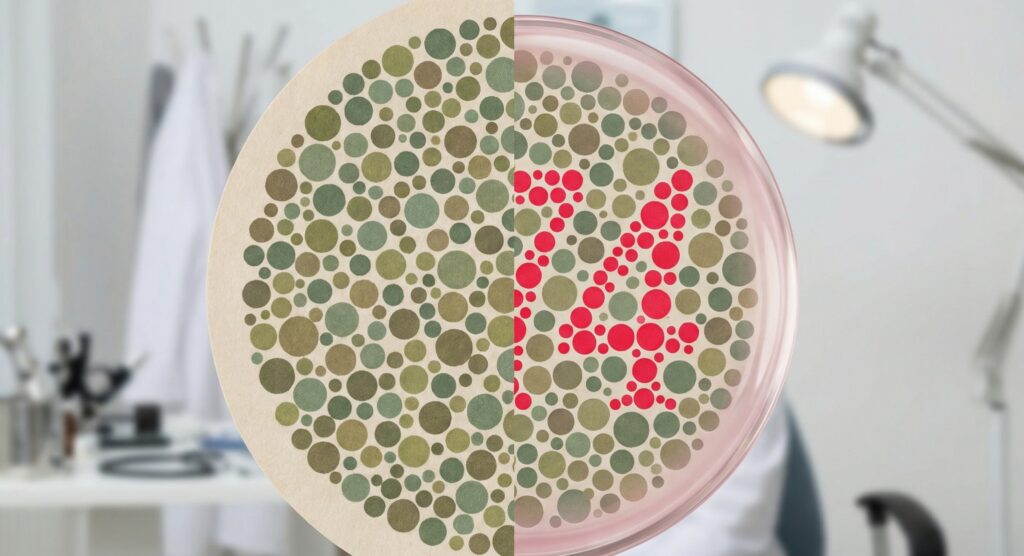
Those circles filled with colored dots have ended countless dreams.
But what if you could finally pass it? What if there was a discreet, effective way to see the hidden numbers?
Enter contacts for deuteranomaly. Here is everything you need to know about how red-green colorblind contacts work and how they can help you pass the Ishihara test.
What is Deuteranomaly (And Why Do You Fail the Test)?
Deuteranomaly is a type of anomalous trichromacy. To put it simply: the green-sensitive cones in your eyes don’t work exactly as they should. Their sensitivity shifts too close to the red cones.
Because the signals from your red and green cones overlap too much, your brain struggles to differentiate between certain shades of red, green, brown, and orange.
When you look at an Ishihara plate, the test is specifically designed to exploit this overlap. The dots making up the “hidden number” are carefully selected colors that blend perfectly into the background for someone with deuteranomaly, making the number invisible.
Why Colorblind Glasses Usually Aren’t Enough
You’ve probably seen the viral videos of people putting on colorblind glasses and crying as they see a sunset or purple flowers for the first time. Those glasses (like EnChroma or Pilestone) are fantastic for lifestyle enhancement.
However, colorblind glasses are almost always banned during official medical exams.
When you sit down for an aviation medical, a DOT physical, or a military MEPS exam, the examiner will require you to remove your tinted glasses before taking the Ishihara test. They are incredibly obvious, and examiners are trained to spot them.
This is where the game changes.
How Contacts for Deuteranomaly Work
Unlike bulky glasses, colorblind contact lenses—like those offered by Colorkinds—are designed to be virtually undetectable while providing the exact optical correction you need to pass the test.
The Science Behind the Lenses
Colorkinds contacts utilize a highly specialized, built-in spectral filter. This filter targets the specific wavelengths of light where the red and green cones overlap (typically between 590 and 700 nanometers).
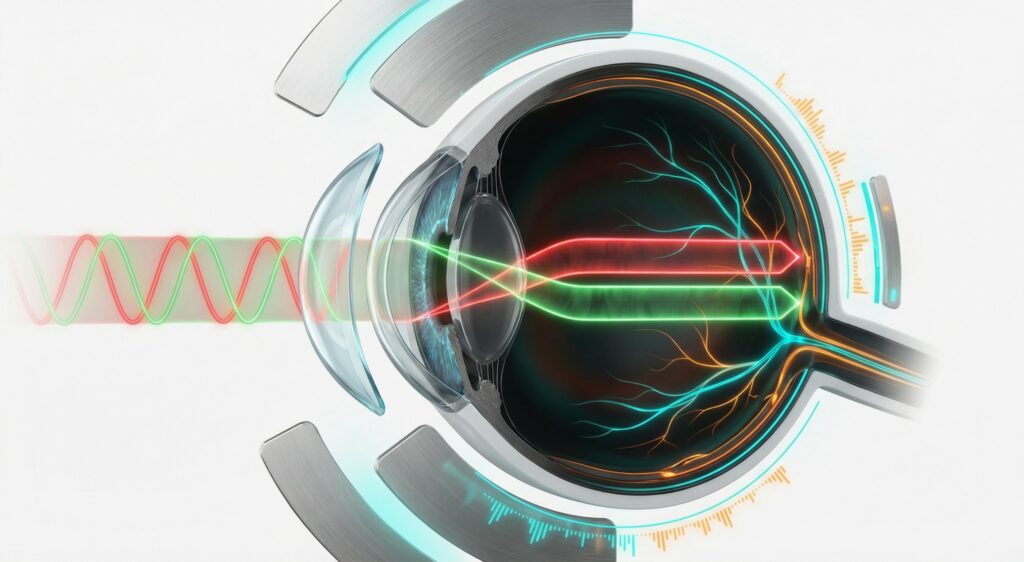
By blocking or absorbing a narrow band of light in that exact overlap zone, the lenses artificially create separation between the red and green signals before they ever reach your brain.
The Result on the Ishihara Test
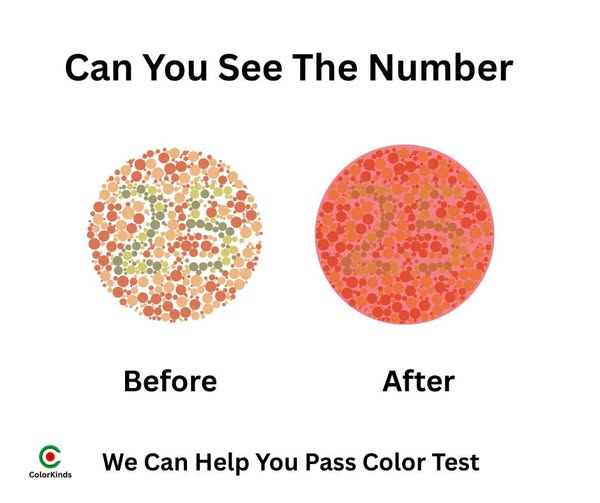
When you wear these contacts and look at an Ishihara plate, the contrast is suddenly restored. The dots making up the hidden number will “pop” out from the background colors. Numbers that were completely invisible to you moments before will become starkly obvious.
Why Choose Colorkinds Contacts for the Test?
If you are serious about passing your exam, you need a solution that is both effective and discreet. Here is why Colorkinds contacts are the preferred choice for people with deuteranomaly:
- 100% Pass Rate on the Ishihara: Our lenses are specifically engineered to provide the high-contrast separation needed to pass the standard dot tests used by medical examiners worldwide.
- Virtually Undetectable: The specialized filter is built directly into the center of the contact lens (covering your pupil). To an examiner sitting across a desk from you, they simply look like regular clear contact lenses or natural eye color.
- No Prescription Required: Even if you have perfect 20/20 vision and have never worn contacts before, you can use plano (non-prescription) Colorkinds contacts solely for color correction.
- Targeted for Deuteranomaly: Our lenses are optimized for red-green color vision deficiencies, making them highly effective for the vast majority of people struggling with the Ishihara test.
How to Prepare for Your Exam with Contacts
If you have a medical exam coming up, preparation is key:
- Order Early: Give yourself time to receive your contacts and get used to wearing them.
- Practice Inserting Them: If you’ve never worn contacts, the first few times can be tricky. Practice putting them in and taking them out so you are comfortable on the day of the exam.
- Test Yourself at Home: Don’t wait for the examiner’s office. Pull up the Ishihara test on your phone or computer, put the contacts in, and watch the numbers appear. (Note: always ensure your screen brightness is turned up for accurate testing).
- Wear Them In: Put the contacts in before you arrive at the clinic so your eyes are adjusted to the new color spectrum.
Where Can I Get Colorblind Contacts? (Global Availability)
No matter where your medical exam is located, Colorkinds has you covered. Whether you are taking a DOT physical in Texas, a MEPS exam in California, applying for a police academy in London, or pursuing an aviation medical in Sydney, our contacts for deuteranomaly are available to you.
We offer fast, secure worldwide shipping to the United States, Canada, the UK, Australia, Europe, and beyond. Because medical exams often come with tight deadlines, we recommend ordering your lenses well in advance to ensure they arrive before your testing date.
Don’t Let the Dots Define Your Future
Deuteranomaly shouldn’t dictate what career you can pursue. Whether you want to fly planes, wire commercial buildings, or serve your community, the Ishihara test is just an obstacle—and obstacles can be overcome.
With the right optical tools, you can level the playing field.
Ready to see the hidden numbers?
Explore Colorkinds discreet colorblind contacts today and take the first step toward passing your exam and launching your career.
## Frequently Asked Questions (FAQ)