CAD Color Vision Test: Complete Guide to the Colour Assessment & Diagnosis Test (2026)
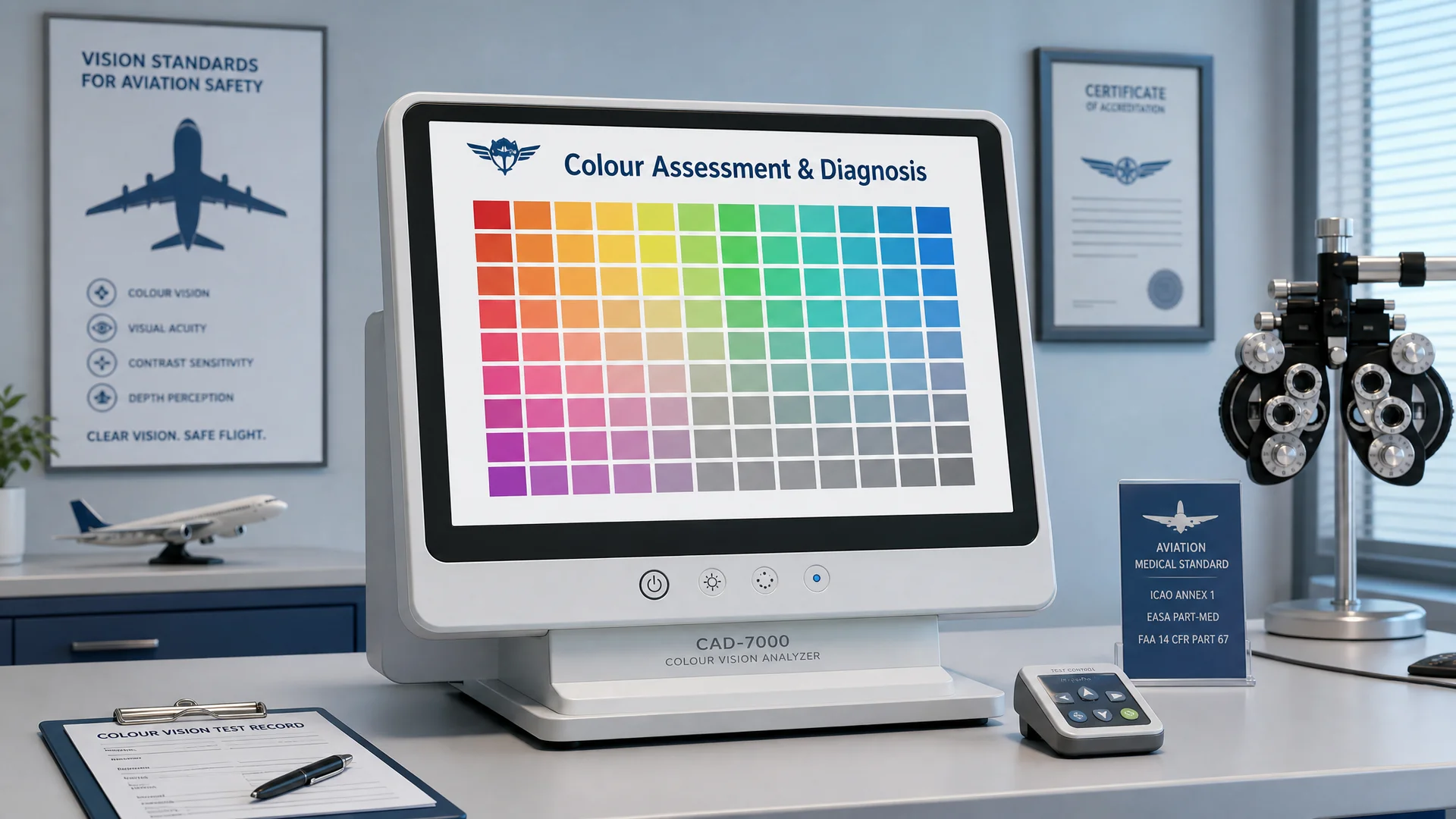
If you’re pursuing an aviation career or a color-critical role, you may encounter the CAD (Colour Assessment and Diagnosis) test — a modern, highly sensitive color vision assessment that’s becoming the new gold standard in aviation and occupational testing.
Here’s the direct answer: The CAD (Colour Assessment and Diagnosis) test is a computerized color vision test that measures your sensitivity along the red-green and blue-yellow color axes with exceptional precision. It’s increasingly adopted by aviation authorities (including the UK CAA) and occupational health providers because it provides reliable, quantitative results that classify color vision deficiency more accurately than the Ishihara.
This guide covers how the CAD test works, who uses it, how it compares to other tests, and what your results mean.
Key Takeaways:
- The CAD test is a computerized assessment that measures color vision along two specific axes
- It provides a quantitative “CAD score” rather than a simple pass/fail
- The UK CAA and increasingly international aviation authorities accept the CAD test
- It’s more sensitive than Ishihara for detecting mild color vision deficiencies
- The test takes approximately 10-15 minutes to complete
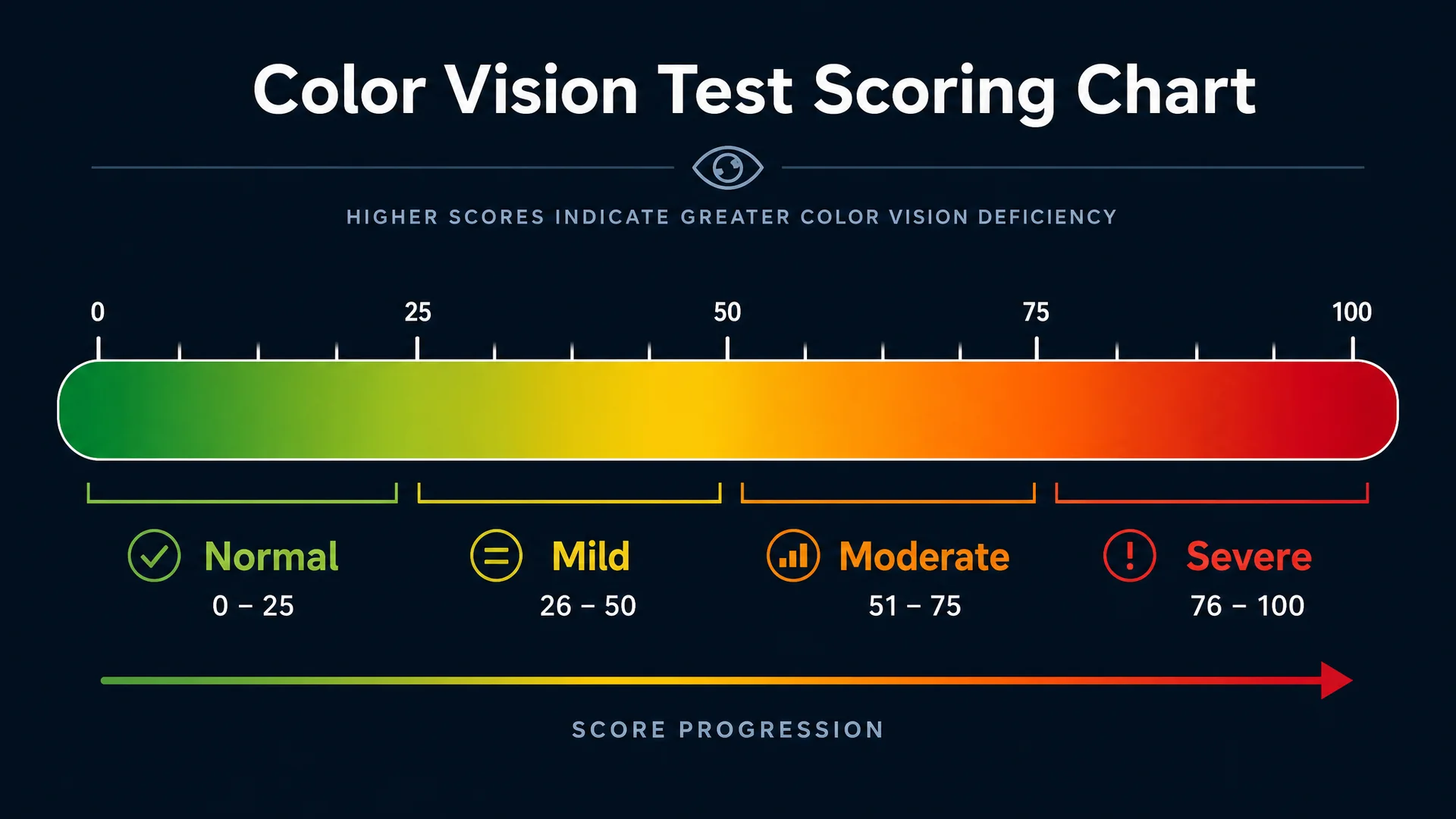
- Results classify color vision as normal, mild, moderate, or deficient
What Is the CAD Test?
The Colour Assessment and Diagnosis (CAD) test was developed at City, University of London. It represents a significant advancement over traditional color vision tests because it measures your color discrimination ability along two independent axes and provides a quantitative score rather than a simple pass/fail.
How It Works
The CAD test presents colored stimuli moving in a specific direction against a background of randomly moving, luminance-matched dots. Your task is to identify the direction of the colored stimulus. The test gradually reduces the color saturation until you can no longer reliably identify the direction — this is your threshold.
| Component | Description |
|---|---|
| Format | Computer-based with calibrated display |
| Task | Identify the direction of moving colored stimuli against a random dot background |
| Duration | 10-15 minutes |
| Results | Quantitative CAD score for RG (red-green) and BY (blue-yellow) axes |
| Calibration | Requires specific monitor and controlled lighting conditions |
What It Measures
The CAD test measures your sensitivity along two independent color axes:
| Color Axis | What It Tests |
|---|---|
| RG (red-green) | Protan and deutan sensitivity — measured in CAD units |
| BY (blue-yellow) | Tritan sensitivity — measured in CAD units |
Why It’s More Sensitive Than the Ishihara
The Ishihara test uses fixed plates — you either see the number or you don’t. This creates a binary pass/fail result that doesn’t distinguish between mild and severe deficiency. The CAD test, by contrast, uses an adaptive staircase method that finds your exact threshold. This means it can detect:
- Mild deficiencies that the Ishihara might miss entirely
- The specific severity level — mild, moderate, or severe
- Both color axes independently — red-green and blue-yellow
- Subtle changes in color vision over time (useful for monitoring progressive conditions)
This higher sensitivity is why the CAD test is increasingly preferred for aviation medical assessments where knowing the exact degree of deficiency matters more than a simple pass/fail.
CAD Test Scoring: Understanding Your Results
The CAD test reports your color vision ability as a numerical score measured in CAD units. The score represents the minimum color contrast you need to reliably detect the moving stimulus.
How to Read CAD Scores
| Score Range | Classification | What It Means |
|---|---|---|
| Below threshold | Normal color vision | Your color discrimination is within the normal range for both axes |
| Mild elevation | Mild deficiency | Slightly reduced sensitivity on one or both axes — may still pass occupational standards |
| Moderate elevation | Moderate deficiency | Clearly reduced sensitivity — will likely affect occupational test performance |
| High elevation | Severe deficiency | Significantly reduced sensitivity — consistent with dichromacy |
Lower scores indicate better color vision. The specific passing threshold depends on the aviation authority or occupational standard being applied.
Who Uses the CAD Test
The CAD test is gaining adoption across multiple sectors:
Aviation (Primary Use Case)
The UK Civil Aviation Authority (CAA) actively uses the CAD test for pilot medical certification. It’s one of the most advanced color vision assessments accepted for aviation purposes. International aviation authorities are increasingly evaluating the CAD test as a replacement or supplement to traditional Ishihara screening.
Why Aviation Authorities Prefer the CAD Test
| Reason | Explanation |
|---|---|
| Quantitative results | Provides a precise score rather than pass/fail — useful for borderline cases |
| Objective measurement | Computer-administered with no examiner subjectivity |
| Tritan detection | Unlike Ishihara, can detect blue-yellow deficiency |
| Reproducible | Results are consistent across testing sessions |
| Sensitive | Can detect mild deficiencies that Ishihara misses |
Occupational Health
Corporate and government occupational health providers are also adopting the CAD test for color-critical roles beyond aviation — including rail, maritime, and electrical utilities.
CAD Test vs. Other Color Vision Tests
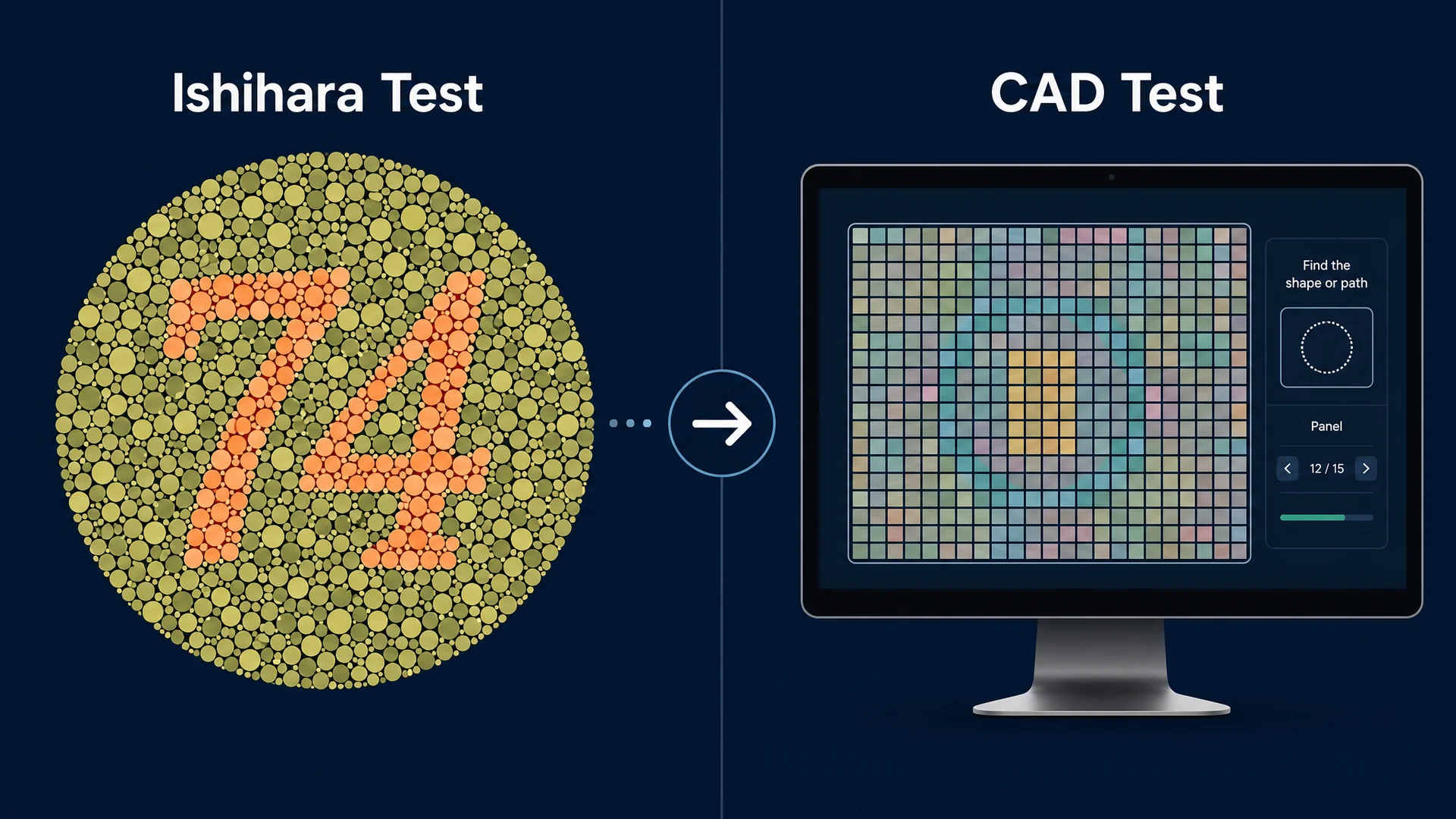
The CAD test differs from traditional tests in several important ways:
| Feature | CAD Test | Ishihara | Farnsworth D-15 | Anomaloscope |
|---|---|---|---|---|
| Quantitative score | Yes — CAD units | No — pass/fail | Semi-quantitative | Yes — matching range |
| Sensitivity | Very high | Moderate | Moderate | High |
| Tritan detection | Yes | No | Yes | No |
| Time | 10-15 min | 2-5 min | 5-10 min | 10-15 min |
| UK CAA accepted | Yes | Yes (initial) | Previously | Yes |
Key Advantage: Quantitative Measurement
The biggest difference between the CAD test and the Ishihara is that the CAD test gives you a number. If you score just below the pass threshold, you know exactly how close you are. With the Ishihara, you simply fail — with no indication of whether you missed by one plate or ten plates.
This quantitative nature also means the CAD test can track changes in your color vision over time, which is useful for both medical monitoring and evaluating the effectiveness of color vision correction tools.
How to Prepare for the CAD Test
Unlike the Ishihara, the CAD test cannot be “practiced” by memorizing plates. However, you can prepare effectively:
| Preparation Step | Why It Helps |
|---|---|
| Get adequate sleep | Fatigue reduces color discrimination ability |
| Take the test at the right time of day | Color perception is sharpest in mid-morning |
| Ensure proper lighting | The test requires controlled lighting conditions |
| Bring your normal vision correction | Wear glasses or contacts if you need them |
| Be honest | The adaptive methodology detects guessing |
| Use Colorkinds contacts for training | Off-duty practice can help build color recognition habits |
FAQ: CAD Test
The CAD (Colour Assessment and Diagnosis) test is a computerized color vision test that measures your sensitivity along red-green and blue-yellow color axes. It provides a quantitative CAD score rather than a simple pass/fail, making it more precise than traditional screening tests.
The CAD test is more sensitive than the Ishihara, meaning it can detect milder deficiencies that the Ishihara might miss. However, because it provides a graded score rather than a binary pass/fail, it also offers more pathways to demonstrate adequate color vision.
The CAD test is increasingly accepted internationally, but FAA acceptance is limited as of 2026. The UK CAA actively uses the CAD test. Check with your specific aviation authority for current accepted test lists.
The CAD test typically takes 10-15 minutes to complete. The test involves identifying the direction of colored stimuli moving against a background of random dots, with the test adjusting to find your sensitivity threshold.
CAD scores are measured in CAD units. Lower scores indicate better color vision. The specific passing threshold depends on the authority administering the test. Your examiner will explain your results in the context of the specific occupational standard being applied.
Related guides: