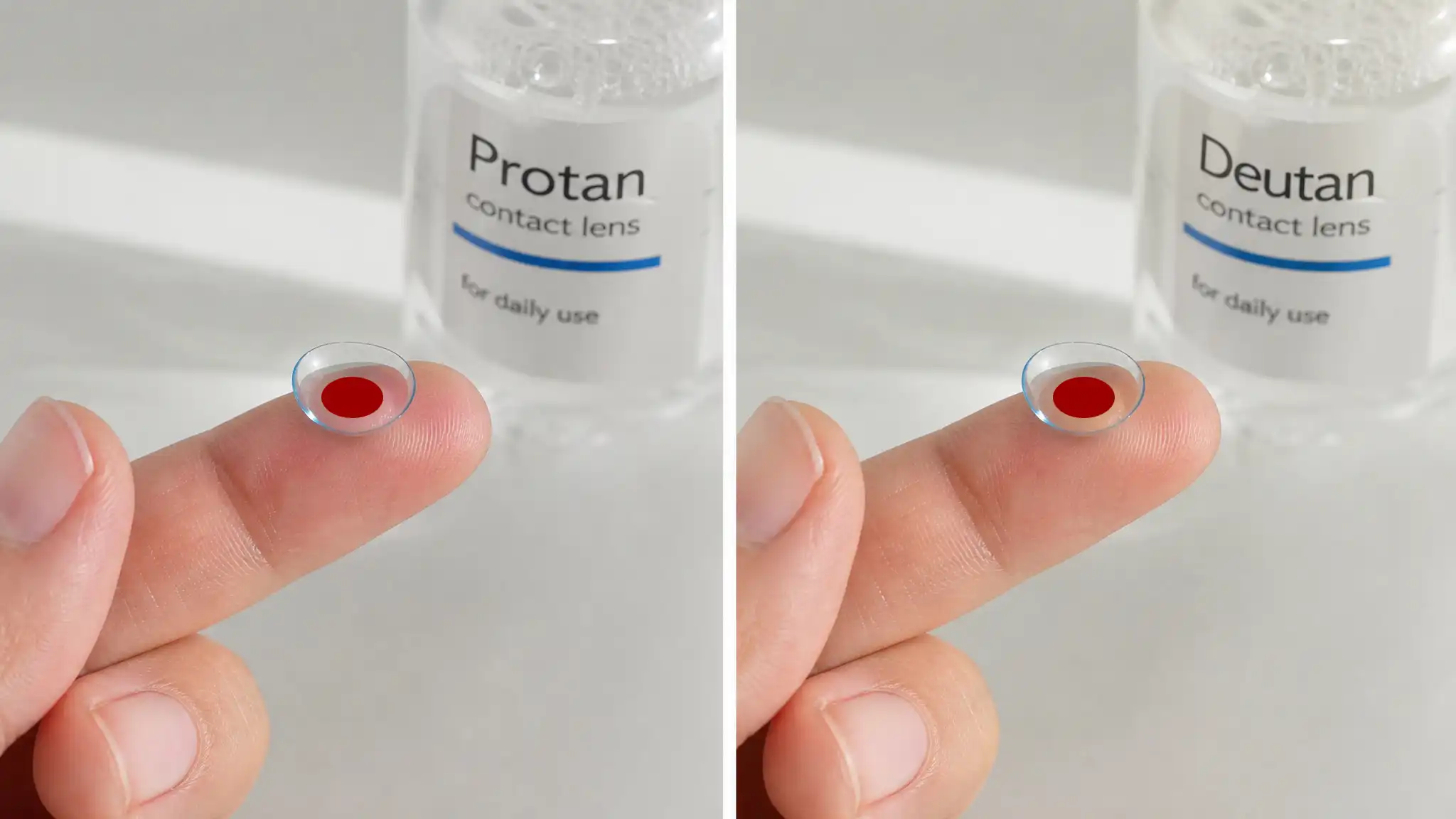
Color blind contacts for protan and deutan: What’s the difference?
If you’ve been told you have “red-green color blindness,” you might not realize there are actually two distinct types: protan (red-deficient) and deutan (green-deficient). And if you’re researching color blind contacts, you’re probably wondering: do you need different contacts for each type?
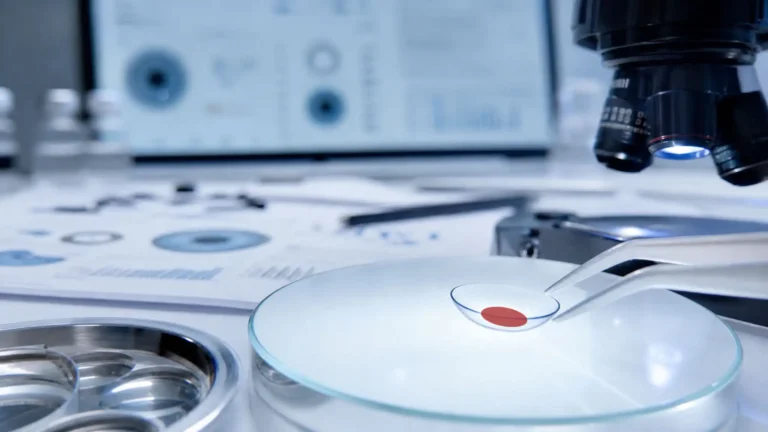
Colorkinds CCG-088 contacts work for both types because the spectral overlap these two conditions create is nearly identical in the wavelength range that matters for color vision testing.
This guide explains the difference between protan and deutan, how to tell which type you have, and why the same contact lens corrects both.
Key Takeaways:
- Protan (red-deficient, ~25% of CVD cases) and deutan (green-deficient, ~75% of CVD cases) are the two subtypes of red-green color blindness
- The Colorkinds CCG-088 spectral notch filter (590-700nm) corrects both types because it targets the exact wavelength range where red-green confusion happens
- You don’t need to know your exact type to order — one pair of Colorkinds contacts covers both
- Self-assessment is possible through online tests, color arrangement tests, and real-world observation
- Tritan (blue-yellow deficiency) is a separate condition — Colorkinds contacts don’t work for it
What Is Protan Color Blindness?

Protanomaly (mild) and protanopia (severe) affect the L-cones (long-wavelength cones) responsible for perceiving red light. If you have a protan deficiency, your red-sensitive cones are either missing or shifted toward green sensitivity.
How protan affects your vision:
- Red colors appear darker or muted — almost brownish
- You have trouble distinguishing red from green, especially in low-light conditions
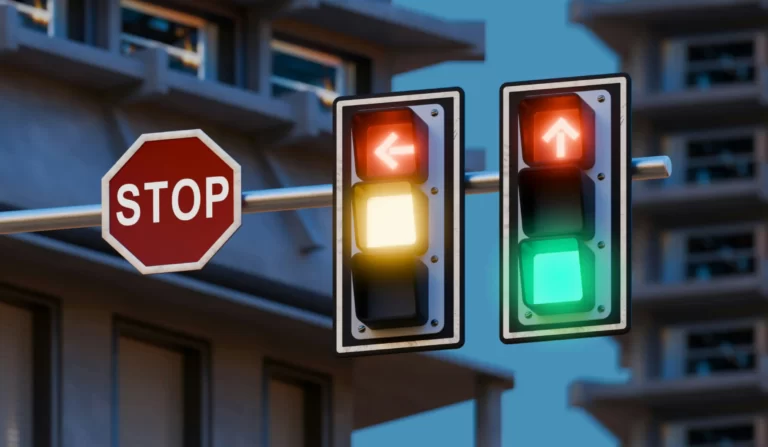
- Red traffic lights may appear dimmer than green ones (a protan-specific clue)
- Pink, purple, and orange can be hard to tell apart from blue or gray
People with protan often report: “I know there’s a red traffic light up there somewhere, but I can barely see it against the sky.”
What Is Deutan Color Blindness?
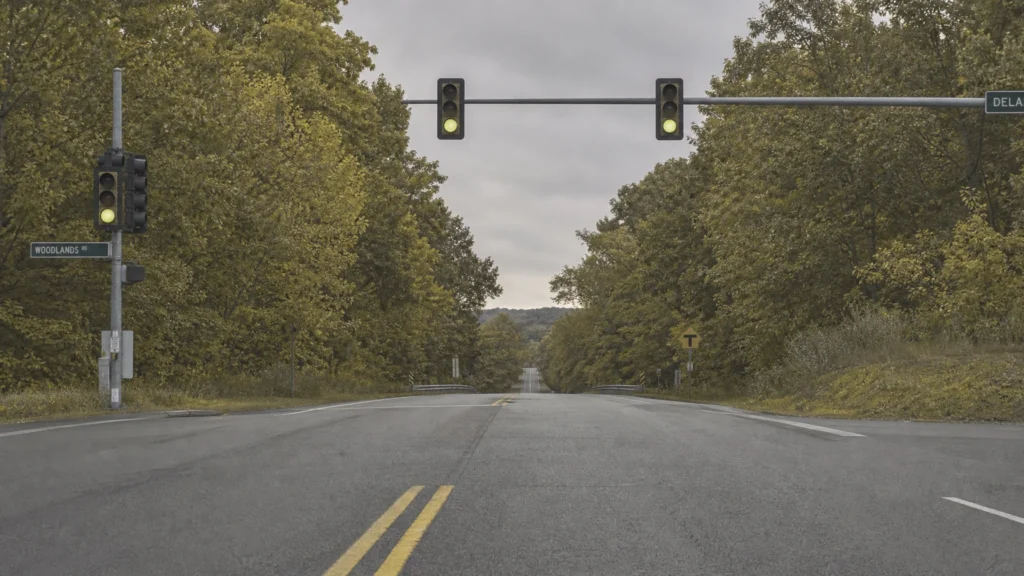
Deutan deficiency affects green-sensitive cones — greens and yellows blend together.
Deuteranomaly (mild) and deuteranopia (severe) affect the M-cones (medium-wavelength cones) responsible for perceiving green light. If you have a deutan deficiency, your green-sensitive cones are either missing or shifted toward red sensitivity.
How deutan affects your vision:
- Green and yellow are hard to distinguish — they blend together
- Red and green look similar, especially in bright conditions
- Traffic lights look similarly bright (unlike protan, where red appears dimmer)
- Green, brown, and orange can be confusing in natural settings
People with deutan often report: “I can see both traffic lights just fine — I just can’t tell which one is on.”
Protan vs Deutan: Side by Side Comparison
| Aspect | Protan (Red-Deficient) | Deutan (Green-Deficient) |
|---|---|---|
| What’s affected | L-cones (red-sensitive) | M-cones (green-sensitive) |
| Prevalence | ~25% of red-green CVD cases | ~75% of red-green CVD cases |
| Traffic light clue | Red light appears dimmer | Both lights look equally bright |
| Color confusion | Red, brown, orange, dark pink | Green, yellow, brown, light pink |
| Primary difficulty | Seeing red as “red” | Separating green from red |
| Affects brightness perception | Yes — reds appear darker | No — brightness perception is normal |
| How Colorkinds helps | Spectral notch filter separates red from green by enhancing contrast | Same filter — the overlap zone is functionally identical |
How to Tell If You’re Protan or Deutan
You don’t need to know your exact type to benefit from Colorkinds contacts (since they work for both). But self-assessment can help you understand your condition better and answer questions from employers or examiners.
Online Color Vision Tests
Several free tests can help you identify your type:
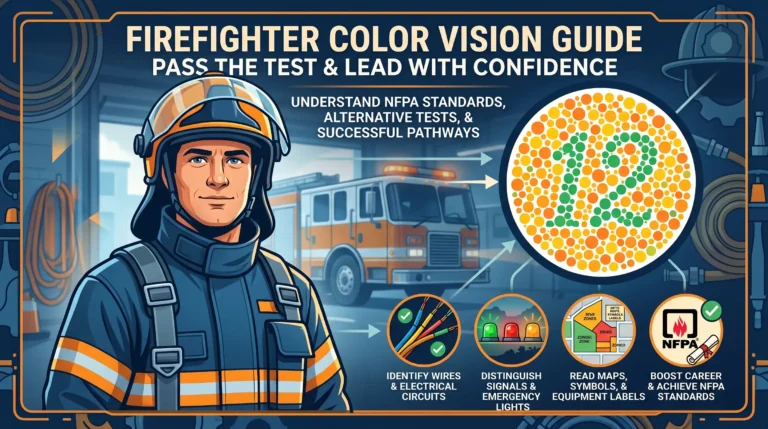
- Ishihara plates — The standard screening. If you can’t read the numbers on certain plates, you have red-green CVD — but Ishihara alone won’t tell you protan vs deutan.
- Farnsworth D-15 — This color arrangement test identifies your confusion axis. Protan and deutan produce different crossing patterns on the score sheet. Read our Farnsworth D-15 color vision test guide for details.
- Anomaloscope — The gold standard for identifying protan vs deutan. It measures exactly where your red-green matching point falls. This requires a specialist visit.
Real-World Self-Assessment
You can also gather clues from everyday experience:
- Traffic light test: If red lights look significantly dimmer than green, you’re likely protan. If both look equally bright but you can’t tell which is which, you’re likely deutan.
- Fruit test: If you struggle with strawberries and tomatoes against green foliage, you could be either type. If red fruit seems to “disappear” against dark backgrounds, lean protan.
- Sunset test: If you see sunsets as primarily yellow and blue with little red/pink/orange, you may be protan. If the sunset looks like a gradient of yellows and dull greens, you may be deutan.
Why the Same Contact Lens Works for Both Types
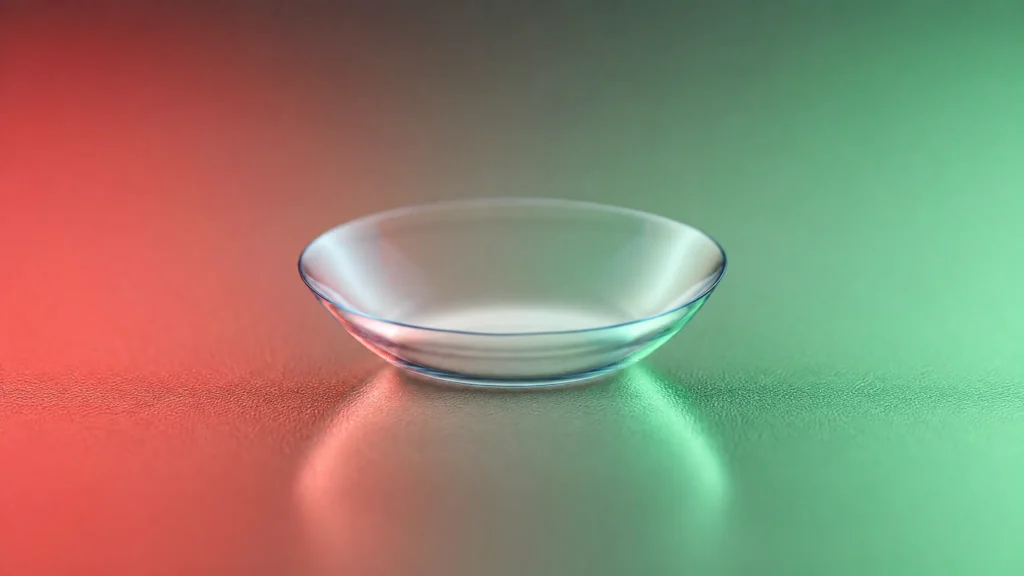
Here’s the key insight: the wavelength overlap that causes red-green confusion is nearly identical for protan and deutan. Both conditions create difficulty distinguishing the same general range of colors — reds from greens, pinks from grays, oranges from yellows. The difference is in which cone type is affected, not where the confusion happens.
Think of red and green on the visible spectrum as two hills with a valley between them. Normal color vision sees two distinct peaks. Protan and deutan both “flatten” that valley — the two hills blur into one. Whether the red side (protan) or the green side (deutan) is flattened, the result is the same: you can’t tell where one color ends and the other begins.
How the Spectral Notch Filter Bridges the Gap
The Colorkinds CCG-088 spectral notch filter targets the 590-700 nanometer range — the exact zone where red and green wavelengths overlap for both protan and deutan eyes. By filtering out this overlapping light, the lens helps your brain see a clearer distinction between red and green signals. It doesn’t “fix” your cones — it changes the light entering your eye so your brain can process the signals more effectively.
Think of it like adjusting the equalizer on a stereo. The 590-700nm range is like a frequency band where two instruments are playing the same notes. The filter turns down that band so your brain can hear each instrument separately. This works the same way whether the problem is on the red side (protan) or the green side (deutan).
This is why Colorkinds doesn’t make separate products for protan vs deutan users. The single CCG-088 design covers both types — plus everything in between, from mild anomalous trichromacy to full dichromacy. You don’t need to diagnose yourself before you order. One pair of contacts, one price, one solution for ~99% of red-green CVD cases.
| Lens Feature | Why It Works for Protan | Why It Works for Deutan |
|---|---|---|
| 590-700nm spectral notch filter | Separates red signals from green in the wavelength range where L-cones are deficient | Separates green signals from red in the same wavelength range where M-cones are deficient |
| 40% water content hydrogel | Comfortable for all-day wear during long shifts or exams | Same — comfort is type-independent |
| Discreet red tint | Blends naturally with any iris color | Same — tint is cosmetic, not functional |
| Plano (non-prescription) | Corrects color vision without affecting visual acuity | Same — works for any prescription need |
What About Tritan?
Tritanomaly and tritanopia (blue-yellow deficiency) are a separate condition entirely. Tritan affects the S-cones (short-wavelength cones) responsible for perceiving blue light. This is much rarer than red-green CVD — affecting roughly 1 in 10,000 people — and is often acquired later in life due to aging or medical conditions rather than being present from birth.
Colorkinds CCG-088 contacts do not work for tritan deficiency. The 590-700nm spectral notch filter is specifically designed for the red-green overlap zone. Blue-yellow confusion happens in a different part of the spectrum (below 500nm) that our lenses don’t target.
If you have tritan deficiency, consult an optometrist for condition-specific solutions.
How Colorkinds Contacts Help You Pass the Ishihara Test
Whether you’re protan or deutan, the occupational color vision test you’ll face is almost certainly the Ishihara color plate test. And here’s the good news: Colorkinds contacts are specifically engineered to help you pass it.
The Ishihara test presents plates covered in colored dots — numbers or patterns hidden against a background of different colors. If you have red-green CVD, those numbers blend into the background. Colorkinds contacts work by:
- Filtering out the overlapping wavelengths that cause the confusion
- Enhancing the contrast between the foreground dots and background dots
- Making the hidden numbers visible — just as they appear to someone with normal color vision
Put the contacts in 30 minutes before your exam. Let your eyes adjust. Take the test with confidence.
Our published data shows a 100% Ishihara pass rate and a 97% success rate for red-green color vision deficiency. And if they don’t work for your specific test? Return them within 60 days — no questions asked.
FAQ
No. Colorkinds CCG-088 contacts work for both protan and deutan. The spectral notch filter targets the 590-700nm range where red-green confusion occurs in both types.
You can self-assess using online tests like the Farnsworth D-15, or by observing real-world clues like traffic light brightness. For a definitive diagnosis, see an optometrist for an anomaloscope test.
Approximately 25% of red-green CVD cases are protan and 75% are deutan. Combined, they represent about 99% of all color vision deficiency cases.
Yes. Colorkinds contacts work for both mild (anomalous trichromacy) and severe (dichromacy) forms of red-green CVD. The 97% success rate covers the full spectrum of severity.
Yes. You don’t need to know whether you’re protan or deutan — the same contacts work for both. Simply order one pair for either type.
No. Colorkinds contacts are specifically designed for red-green CVD only. They do not work for tritan deficiency.
Most careers use the Ishihara test as the primary screening. Depending on your field, you may also take the Farnsworth D-15, Waggoner CCVT, or CAD test. Colorkinds contacts are designed to help with all of these.
Put them in at least 30 minutes before your exam to allow your eyes to adjust. For best results, wear them for a few days before the test to build comfort and familiarity.
Yes. They’re made from soft hydrogel with 40% water content, designed for 12+ hours of wear. You can put them in before your shift and forget about them.
Yes. Colorkinds offers a 60-day money-back guarantee. If the contacts don’t help you pass your test, return them for a full refund.
Ready to try them? Order Colorkinds colorblind contacts — they work for both protan and deutan. Free shipping worldwide.
Related guides: