Best Color Blind Contacts 2026: Comparison Review — Which Is Right for You?
Best Color Blind Contacts 2026:
Comparison Review
Compare the best colorblind contacts and glasses. Find the right solution for test passing, daily wear, or budget.
The Problem
You need a solution that actually works for an Ishihara test, pilot medical, or police academy screening. Every brand claims to be the “best,” with prices ranging wildly from $99 to $800. Glasses often don’t fit under safety gear.
The Solution
You need a discreet, effective aid that specifically targets the red-green color overlap. Colorkinds CCG-088 contacts offer the best combination of test-passing performance, value, comfort, and absolute discretion.
The 30-Second Quick Verdict
| Brand / Product | Type | Price | Best For | Key Feature |
|---|---|---|---|---|
| Colorkinds CCG-088 | Contacts | $99 | Test passing, value | 100% Ishihara pass rate |
| ChromaGen | Contacts | ~$400-800 | Prescription wearers | FDA-cleared, custom tints |
| EnChroma | Glasses | $189-429 | Lifestyle enhancement | Next Gen lens tech |
| Pilestone | Glasses | $100-200 | Budget glasses | Activity-specific lenses |
In-Depth Reviews
1. Colorkinds CCG-088
Best for: Test passing, daily wear, value, and absolute discretion.
Colorkinds CCG-088 are the most effective option for red-green color vision deficiency on the market today. They use a spectral notch filter embedded within the soft hydrogel material to selectively filter overlapping red/green light.
Pros
- 100% Ishihara pass rate
- Invisible & discreet (blends with iris)
- Fits perfectly under workplace PPE/gear
- Highly affordable (~$99/year)
- 60-day money-back guarantee
Cons
- Plano only (no prescription vision correction)
- Does not treat blue-yellow (tritan) blindness
The Bottom Line: If your career depends on passing a color vision test, or you wear occupational safety gear, Colorkinds is your undisputed #1 choice colorblind contact lenses.
2. ChromaGen
Best for: Prescription wearers
The only major brand offering FDA-cleared *prescription* colorblind contact lenses. Customized to your specific deficiency through a doctor consultation.
- Includes vision correction
- FDA-cleared
- Very expensive ($400-$800+)
3. EnChroma
Best for: Lifestyle Enhancement
The most recognized name in glasses. Fantastic for hobbyists and outdoor enthusiasts wanting to see the world in richer hues.
- Great for outdoors & lifestyle
- Highly visible to others
- Conflicts with helmets/work PPE
4. Pilestone
Best for: Budget Glasses
Offers a lower price point ($100-$200) than premium brands, featuring multiple activity-specific lenses (gaming, driving).
- Very affordable
- Less sophisticated tech
- Still bulky for work environments
Experimental Colorblind Contacts — The Future
Several exciting technologies are in development, but none are commercially available as of 2026:
Nanoparticle lenses
Embedded with gold nanoparticles to selectively filter specific wavelengths. Human trials are ongoing, but estimated 3-5 years away.
3D-printed lenses
Custom-shaped lenses with precisely controlled filtering properties. Still heavily in early academic research phases.
Electrochromic lenses
Dynamically adjust filtering properties using a small electrical current. Currently at proof-of-concept level only.
Gene therapy
Exploring viral-vector gene therapy to restore cone function. Currently in early-phase human trials.
The bottom line: These are exciting developments worth watching, but they’re years away from commercial availability. If you need a solution now, existing products are your only realistic option.
Contacts vs. Glasses Showdown
| Feature | Contacts | Glasses |
|---|---|---|
| Discretion | Invisible — No one can tell | Visible — Obvious frames/tint |
| Safety Gear (PPE) | 100% Compatible | Conflicts heavily |
| Test Readiness | High (Engineered for exams) | Low (Built for lifestyle) |
| Fogging | None | High (Temperature changes) |
Which Scenario Are You?
Select the situation that best describes you to find your recommended solution instantly.
“I need to pass the Ishihara for a pilot/medical exam.”
Your Solution: Colorkinds CCG-088 Contacts.
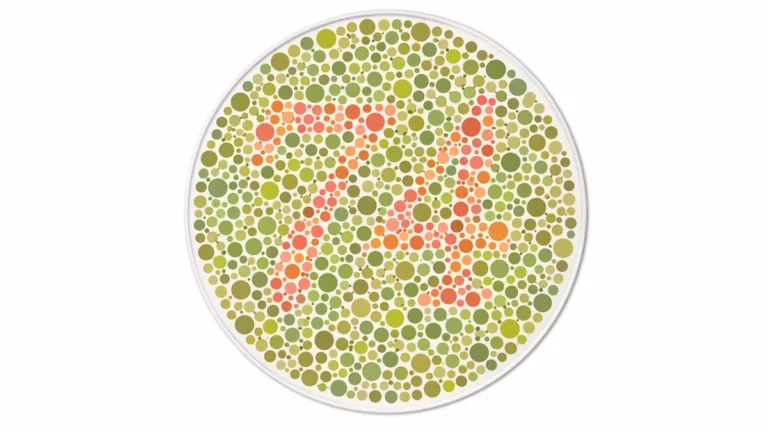
They are explicitly engineered to defeat the Ishihara test. Use them off-duty to train your brain to recognize the hidden numbers.
“I just want to see true colors while hiking and driving.”
Your Solution: EnChroma Glasses or Colorkinds Contacts.
If you don’t mind wearing tinted sunglasses, EnChroma is great. If you want a 24/7 invisible solution, go with Colorkinds.
“I’m an electrician/mechanic and wear safety gear.”
Your Solution: Colorkinds CCG-088 Contacts.
Glasses will fog up, slip down your nose when sweating, or break under safety shields. Contacts are your only viable workplace option.
“I need standard vision correction too.”
Your Solution: ChromaGen Contacts.
Alternatively, wear Colorkinds Contacts underneath your normal clear prescription glasses to save hundreds of dollars.
How to Choose the Right Solution
Decision Matrix
-
1
Do you need to pass an occupational test? Yes → Colorkinds CCG-088
No → Continue to step 2 -
2
Do you need prescription vision correction? Yes → ChromaGen (or consult eye doctor)
No → Continue to step 3 -
3
Can you wear contact lenses? Yes → Colorkinds CCG-088
No → Continue to step 4 -
4
Is discretion important at work? Yes → Contacts are your only discreet option
No → Glasses can work for casual use
Price Comparison
| Solution | Upfront | Annual Cost |
|---|---|---|
| Colorkinds CCG-088 | ~$99 | ~$99 |
| ChromaGen Contacts | $400-800 | $400-800+ |
| EnChroma Glasses | $189-429 | $189-429 |
| Pilestone Glasses | $100-200 | $100-200 |
Note: Glasses are typically one-time purchases replaced every 2-3 years. Contacts have recurring annual replacement costs.