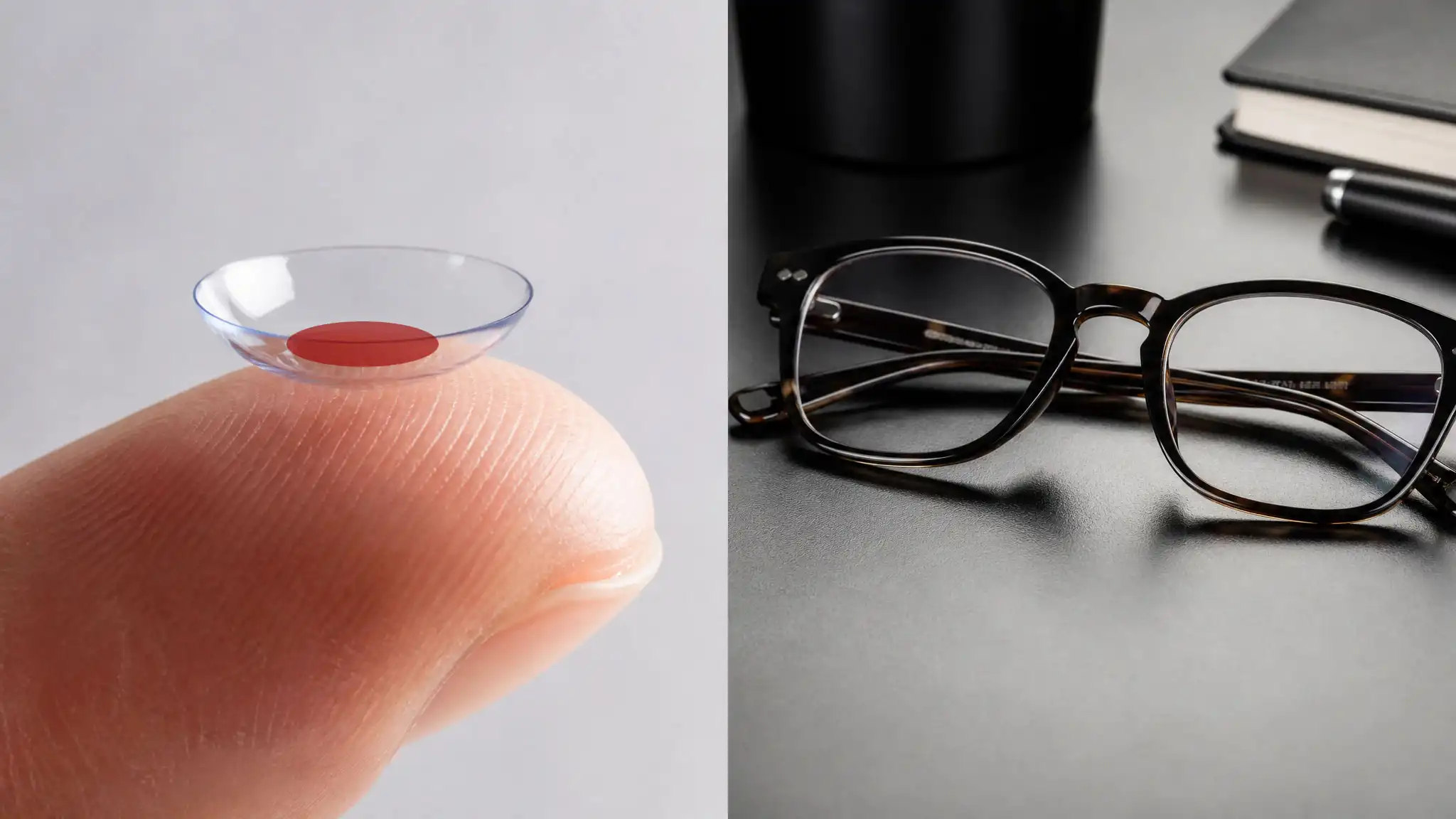
Colorblind Contacts vs Glasses: Head-to-Head Comparison Guide (2026)
You failed the Ishihara. Now you’re staring at two options: colorblind contacts or colorblind glasses. Both claim to help you see red and green more clearly — but which one actually helps you pass your career’s color vision test?
The short answer: Colorblind contacts are typically more effective than glasses for passing occupational color vision screenings. Contacts provide full peripheral vision, work under safety gear, and offer a more discreet correction that lets you take your test without anyone knowing. But glasses have their place — especially for daily life, casual use, and people who can’t wear contacts.
This guide breaks down every factor: test performance, cost, comfort, discreetness, safety gear compatibility, and the specific scenarios where one beats the other.
Key Takeaways:
- Contacts outperform glasses for passing Ishihara and other occupational tests due to full-field correction and no frame interference
- Contacts cost roughly half the annual price of glasses (99 vs 189-$429+)
- Contacts are the only option that works under PPE, helmets, safety glasses, and SCBA masks
- Glasses are a better choice if you cannot tolerate contact lenses or need prescription correction
- Both solutions are legal to own and use — but neither can be worn during most official exams
- Many professionals use contacts for test preparation and daily work, then use glasses for casual weekend wear
How Colorblind Contacts and Glasses Work
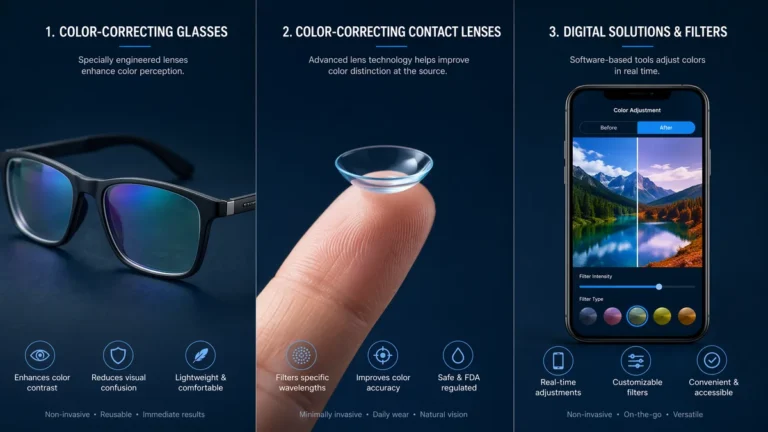
Both technologies use the same underlying principle: spectral filtering. They selectively block overlapping wavelengths in the 590-700 nanometer range — the zone where red and green signals blur together for people with protan or deutan color blindness. By filtering these wavelengths, the brain receives clearer separation between red and green signals.
The difference is in the delivery.
Colorblind contacts sit directly on your eye. The filter is built into the lens material itself — a nano-scale spectral notch filter embedded in Polymacon soft hydrogel. The correction covers your entire field of vision at every angle, tracking with your eye movements naturally.
Colorblind glasses place the filter in the lens of the frame. The correction stays where your face points, not where your eyes point. Peripheral vision is limited by the frame edge, and light enters around the sides of the glasses unfiltered — which can reduce effectiveness in real-world conditions.
Head-to-Head Comparison: Contacts vs Glasses
| Factor | Contacts | Glasses |
|---|---|---|
| Field of view | Full peripheral — nothing in the way | Limited by frame edge |
| Discretion | Invisible — no one can tell | Visible tinted lenses |
| PPE compatibility | Fits under helmets, safety glasses, SCBA | Cannot wear under most safety gear |
| Fogging | Never fogs | Fogs with temperature changes |
| Cost (annual) | ~$99 (Colorkinds) | $189-$429+ |
| Test passing | Excellent for Ishihara, D-15, FALANT | Moderate per studies |
| Daily comfort | 12+ hours, forget you’re wearing them | Can cause pressure points, slipping |
| Prescription option | Plano only (wear with Rx glasses) | Available with prescription |
| Safety risk | Requires proper hygiene | Very low |
| Durability | 12-month yearly disposable | 1-3 years per frame |
Deep Dive: What Actually Matters for Your Career

Field of View — Why Contacts Win for Real-World Use
Colorblind contacts cover your entire visual field. Every angle, every direction, every glance — the correction is there. This matters because color doesn’t only appear in the center of your vision. Traffic signals appear at the periphery. Warning lights flash at the edge of your vision. Wire color coding sits in your lower peripheral view.
With glasses, look to the side and you’re looking around the lens, not through it. The unfiltered light entering around the frame edges can confuse your color perception — especially problematic during practical assessments where identifying a single colored wire or signal matters.
For test taking, this is critical. The Ishihara plates fill most of your visual field when held at the standard 75cm distance. With contacts, every part of the plate passes through the filter. With glasses, your eyes naturally scan and portions of the plate may be viewed through the unfiltered gap between lens and eye.
Discretion — When Invisible Matters
Colorblind contacts have a subtle red tint that blends naturally with your iris. Once placed, nobody can tell you’re wearing them. The red tint layer is visible only under close inspection with bright light — in everyday conversation, on the job, or during a test, you look completely normal.
Glasses are immediately visible. The tinted lenses signal “color correction” to everyone who sees you. While EnChroma and other brands have designed increasingly stylish frames, the tint remains obvious. For professionals who prefer not to disclose their color vision deficiency to colleagues or supervisors, contacts are the clear choice.
Some specific scenarios where discretion matters:
- During your exam: If your examiner is neutral about auxiliary aids (many are), wearing invisible contacts avoids any perception of “special treatment”
- On the job: Colleagues, clients, and supervisors don’t need to know about your color vision deficiency
- In uniform: Contacts don’t alter your professional appearance
PPE and Safety Gear Compatibility
This is a non-negotiable factor for many professionals. Contacts work under everything. Safety glasses, flight goggles, SCBA masks, welding helmets, fire helmets, ballistic eyewear — contacts sit on your eye and interfere with nothing.
Glasses are incompatible with most safety gear:
- Can’t wear under SCBA masks (they break the seal)
- Fog up under safety goggles
- Don’t fit inside fire helmets or welding hoods
- Interfere with binoculars, night vision goggles, and rifle scopes
- May violate uniform codes that prohibit non-issued eyewear
For pilots, firefighters, electricians, and industrial workers, this alone makes contacts the superior choice. Your career likely requires PPE. Colorblind glasses can’t be part of that equation.
Fogging and Temperature
Anyone who’s worn glasses in cold weather knows the struggle: step outside, lenses fog. Walk into a warm building, lenses fog. Take a deep breath under a mask, lenses fog.
Contacts never fog. They sit on your eye at body temperature, unaffected by ambient conditions. For professionals who move between environments — patrol officers getting in and out of cruisers, electricians moving from outdoors to panel rooms, pilots transitioning from cold ramp to warm cockpit — this reliability matters.
Cost Comparison
| Solution | Upfront Cost | Annual Cost | Replacement |
|---|---|---|---|
| Colorkinds contacts | ~$99 | ~$99 | Yearly |
| EnChroma glasses | $189-$429 | $189-$429+ | 1-3 years |
| ChromaGen contacts | ~$400-800 | ~$400-800 | Yearly |
| Pilestone glasses | $100-$200 | $100-$200 | 1-2 years |
| Colorlite glasses | $300-$700+ | $300-$700+ | 1-3 years |
Colorkinds contacts are the most affordable dedicated colorblind correction solution on the market at roughly $99 per year. EnChroma glasses start at nearly double that and may need frame replacement if damaged on the job.
Important caveat: Colorkinds contacts are Plano (non-prescription). If you need vision correction, you’ll need to wear them alongside your regular prescription glasses or contacts. For those with 20/20 vision (or who wear daily contacts), Colorkinds is a simple add-on.
When to Choose Contacts

Contacts are invisible — no one knows you’re wearing color correction. Glasses are immediately obvious.
You should lean toward contacts if:
- You need to pass a color vision test — contacts offer the best chance of passing Ishihara, Farnsworth D-15, and other occupational tests
- You wear PPE on the job — helmets, safety glasses, SCBA, goggles, or any face-mounted gear
- You want discretion — nobody needs to know you’re wearing color correction
- Budget matters — $99 per year is the lowest cost option available
- You work in variable temperatures — no fogging, no condensation
- You need full peripheral color vision — for driving, hazard identification, or situational awareness
When to Choose Glasses
Glasses make more sense if:
- You cannot tolerate contact lenses — some people have dry eyes, sensitive corneas, or trouble inserting contacts
- You need prescription color correction — if you can’t wear separate contacts under your Rx glasses, and you don’t wear daily contacts, glasses combine both corrections
- You want a zero-maintenance option — glasses require cleaning; contacts require hygiene routines
- You’re buying for occasional use — if you only need color enhancement for weekend hobbies, glasses are simpler to grab and go
- Don’t want to touch your eyes — understandable. Contact insertion is a learned skill
Can You Wear Both?
Yes. This is actually the optimal setup for many professionals:
- Use contacts for critical moments: Exams, on-the-job color-critical tasks, shifts where you need full correction
- Use glasses for casual use: Weekend outings, grocery shopping, watching TV — when the stakes are lower
Professionals who wear both report that contacts handle the high-stakes scenarios better, while glasses provide a convenient low-effort option for daily life. There’s no medical reason you can’t own both and switch between them.
What About Wearing Them During Your Exam?
Here’s the honest answer: Most agencies prohibit any color-correcting aids during their official vision screening. This includes both contacts and glasses. Using them covertly during a test is an integrity violation that can result in disqualification.
However, many examiners are neutral about wearing colorblind contacts before the test as a preparation tool. Put them in 30 minutes before your exam, let your eyes adjust, and remove them if required before the screening begins. The adjustment itself can improve your color discrimination even after removal for some individuals.
Always check with your examiner about their specific policy. Some careers (certain police departments, electrical licensing boards, maritime authorities) allow corrective contacts during testing. Others don’t. Know the rules before test day.
The Verdict
For the vast majority of professionals who need to pass a color vision test for their career, colorblind contacts are the superior choice. They cost less, perform better on tests, work under any safety gear, and provide full-field color correction with zero visibility.
Glasses remain a solid backup option — especially for people who can’t wear contacts, need prescription correction combined with color filtering, or want a low-maintenance solution for casual use.
If your goal is passing a test and advancing your career, start with contacts. Add glasses later if you want a convenient option for daily life.
Real-World Performance: How They Compare on Specific Tests
The type of color vision test you’re facing matters when choosing between contacts and glasses.
Ishihara Plate Test
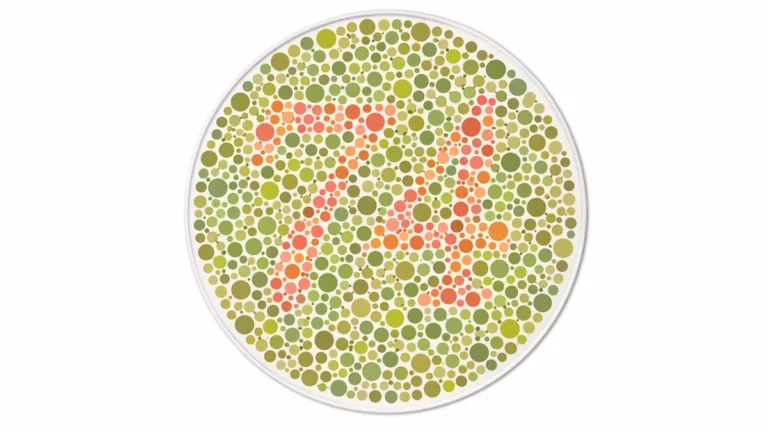
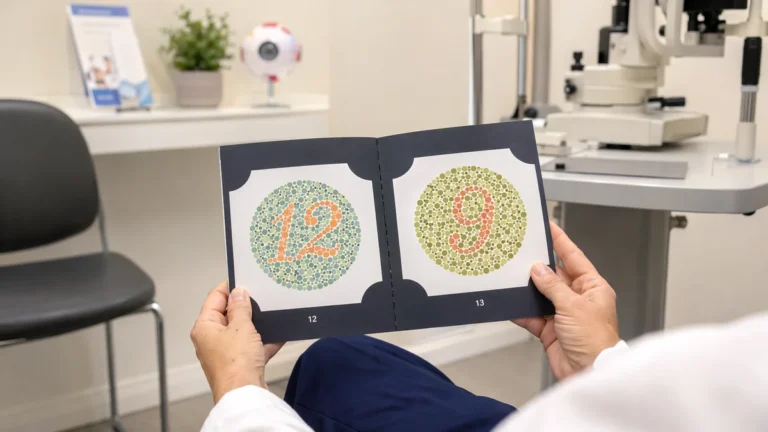
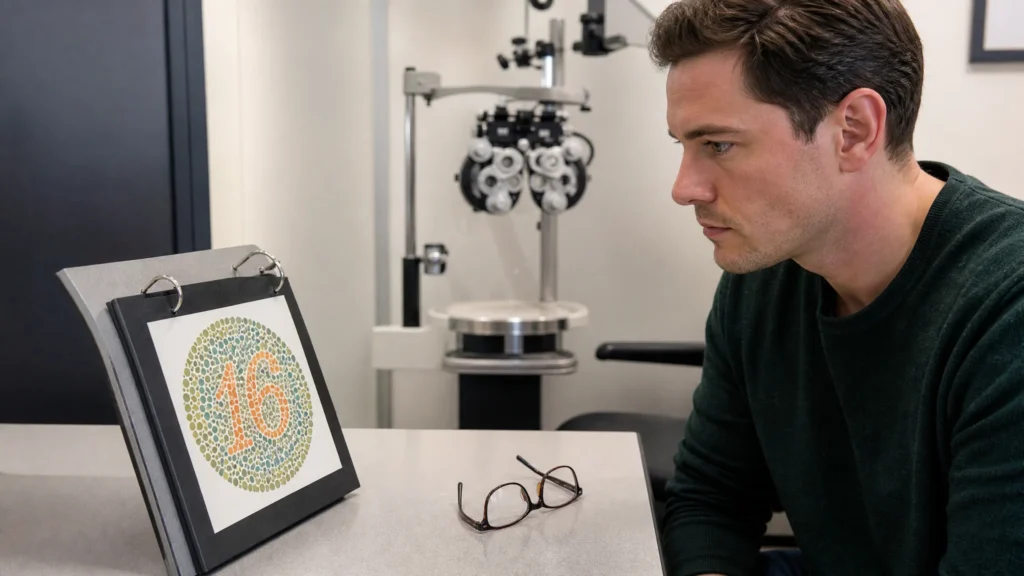
The Ishihara color vision test is the most common occupational screening — used by police departments, fire departments, electrical licensing boards, and many medical programs. The test presents colored plates with hidden numbers made of dots in contrasting colors.
Contacts: Excellent. Because the spectral notch filter covers your full field of vision, every part of the Ishihara plate passes through the correction. Users consistently report that Colorkinds contacts make the hidden numbers “pop” clearly. The 100% Ishihara pass rate applies specifically to contact lens use.
Glasses: Moderate to Good. Glasses can improve Ishihara performance, but the frame-limited field means your eyes may catch portions of the plate through unfiltered peripheral light. Some users report needing to hold their head in specific positions to keep the entire plate within the lens area.
Farnsworth D-15
The Farnsworth D-15 requires arranging 15 colored caps in hue order — a task that demands consistent color perception across your entire visual field.
Contacts: Excellent. Full-field correction ensures every cap you pick up is viewed through the filter. This consistency is critical for avoiding the “major crossings” that cause test failure.
Glasses: Variable. The D-15 involves looking at caps in different positions on the table, then scanning to find the next match. Each head movement shifts the frame position relative to your eyes, creating moments of uncorrected peripheral perception that can introduce errors.
FALANT and Lantern Tests
These tests simulate aviation and maritime signal light identification — requiring you to identify colored lights at a distance.
Contacts: Excellent. No frame interference, no reflection off lens surfaces, no fogging. The correction stays consistent regardless of head position.
Glasses: Good for signal tests. Frame reflections and surface glare can occasionally interfere with distant light source identification, but glasses generally perform better on signal tests than on plate-based tests.
What About Prescription Vision Correction?
One critical factor many people overlook: do you already wear prescription glasses or contacts?
If you have 20/20 vision, the choice is straightforward — contacts or glasses for color correction alone.
If you need vision correction, the equation changes:
- Contacts work for you if: You already wear daily contact lenses for your prescription. You simply add Colorkinds contacts on test days and switch back to your regular contacts on other days. Alternatively, wear Colorkinds contacts under your clear prescription glasses.
- Glasses may be better if: You don’t want to manage two types of contact lenses, or you want a single frame that combines both vision correction and color filtering. Some manufacturers (Colorlite) offer prescription colorblind glasses, though prices run $300-700+.
- The combination approach: Many professionals wear Colorkinds contacts (for color) under their regular clear prescription glasses (for vision) during critical tasks, then switch to standard glasses or contacts for everyday use.
Making Your Final Decision
Still unsure? Answer these three questions:
- Do you need to pass a color vision test for your career? If yes, contacts are the stronger choice. The scientific advantage of full-field correction translates directly to better test performance.
- Do you wear PPE on the job? If yes, contacts are your only option. Glasses simply cannot work under helmets, SCBA masks, safety goggles, or facial PPE.
- Are you comfortable with contact lens hygiene? If yes, contacts offer more advantages at lower cost. If no, glasses are a safer, simpler alternative.
Ready to try colorblind contacts? Colorkinds colorblind contacts are $99 with a 60-day money-back guarantee and free worldwide shipping. Put them in 30 minutes before your exam and see the difference.
FAQ
Yes, generally. Because contacts cover your full field of vision and track with your eye movements, they provide more consistent spectral filtering than glasses. This typically translates to stronger performance on Ishihara and other plate-based tests.
Yes. Colorkinds contacts are Plano (non-prescription), so you can wear them under your regular clear prescription glasses if you need vision correction. You cannot wear them under tinted colorblind glasses — the double filtering can distort vision.
EnChroma and similar glasses primarily target red-green color blindness (protan and deutan). Like contacts, they do not work for tritan (blue-yellow) or complete color blindness. Always verify the specific type of CVD the product addresses.
Contacts, by a wide margin. Colorkinds contacts have a red tint layer that blends with your iris — invisible during wear. Colorblind glasses feature obvious tinted lenses that signal “color correction” to everyone who sees you.
Yes, and this is one of the main advantages over glasses. Contacts sit on your eye and do not interfere with any safety gear, PPE, helmets, goggles, or face masks.
No. Contacts are on your eye at body temperature and never fog, regardless of temperature changes, humidity, or physical activity.
Colorkinds contacts cost ~$99 per year. EnChroma glasses range from $189 to $429+. ChromaGen contacts cost ~$400-800. Pilestone glasses are $100-200. Colorkinds contacts are the most affordable option.
It depends. You would need to alternate between your prescription contacts and Colorkinds contacts — they cannot be worn simultaneously. Many professionals wear Colorkinds on test days and their prescription contacts on other days.
Results vary. Some users report improvement with glasses on the D-15, but studies show contacts tend to produce more consistent results because the filtering covers the full visual field without peripheral light leakage.
Contacts, for several reasons: they fit under flight goggles and headsets, they don’t fog during pre-flight checks, they won’t interfere with night vision goggles, and they provide the most consistent correction for passing FAA medical color vision tests.
Need more guidance? Read our complete guide to colorblind contacts or explore our career-specific color vision solutions for pilots, police, electricians, and more.
Related guides: