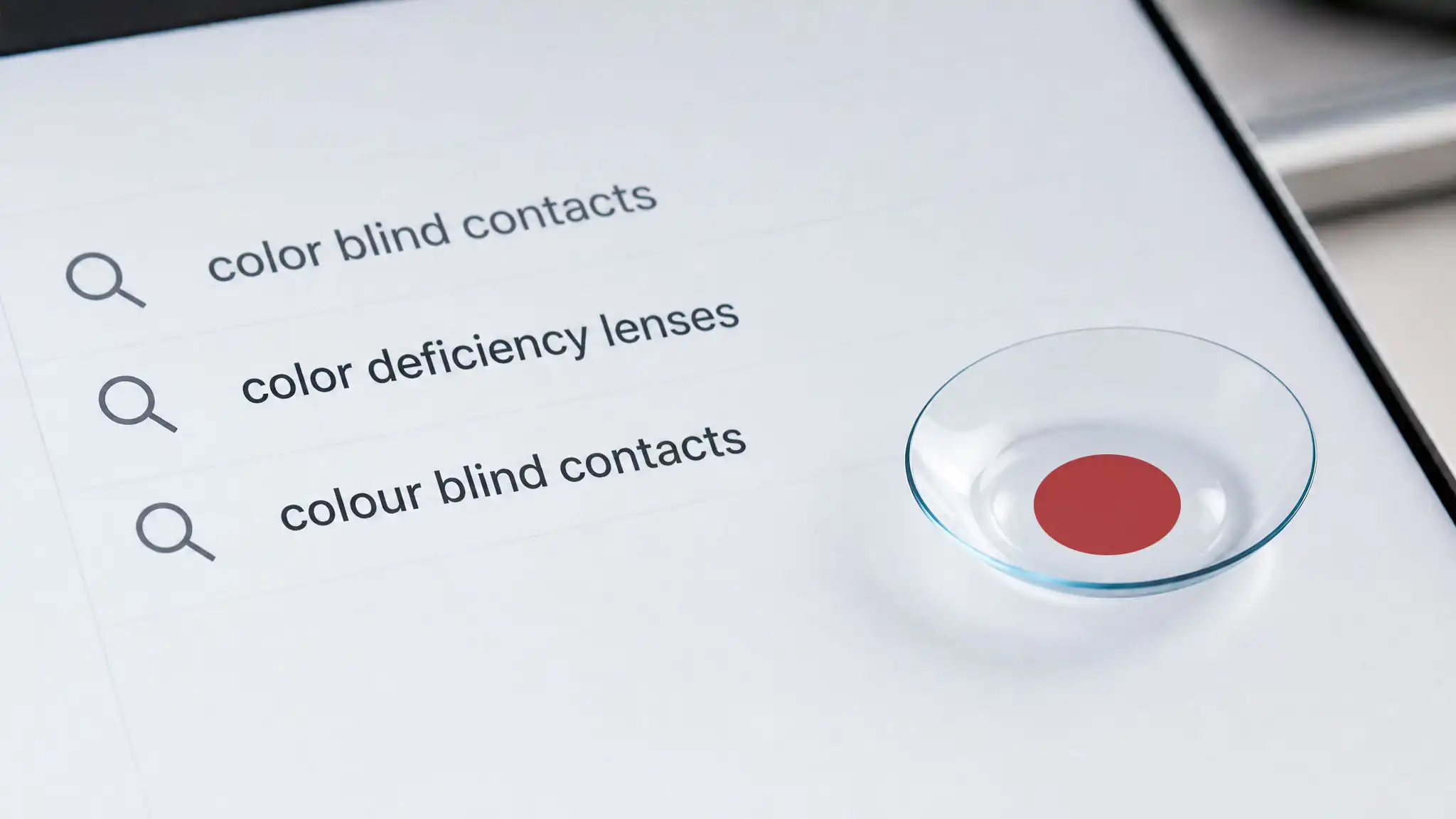
Color deficiency contact lenses vs color blind contacts: Same thing?
You’ve been searching online for a solution to your color vision problem. But depending on where you look, you’ll find it called “color blind contact lenses,” “color deficiency contact lenses,” “colorblind contacts,” “colour blind contact lenses,” or “contacts for color blindness.” Same product category — different names. And if you’re confused about which term means what, you’re not alone.
Here’s the short answer: color deficiency contact lenses and color blind contact lenses refer to the same thing — corrective contacts that use spectral filter technology to help people with red-green color vision deficiency (CVD) distinguish colors more clearly. The difference is purely in the terminology, not the product.
This guide breaks down the terminology, explains why people search different terms, and helps you find the right solution regardless of what you call it.
Color deficiency contact lenses and color blind contact lenses are the same product — only the terminology differs.
Key Takeaways:
- “Color deficiency contact lenses” and “color blind contact lenses” are the same product category — just different terminology
- Color vision deficiency (CVD) is the clinical term; “color blindness” is everyday language for the same condition
- Colorkinds CCG-088 contacts work for both protan and deutan (~99% of red-green cases)
- The same spectral notch filter technology (590-700nm) helps you pass the Ishihara test, regardless of what you call the lenses
- Always check the technology, not the marketing name — look for spectral notch filtering, not just tinted lenses
What’s the Difference Between “Color Blindness” and “Color Vision Deficiency”?
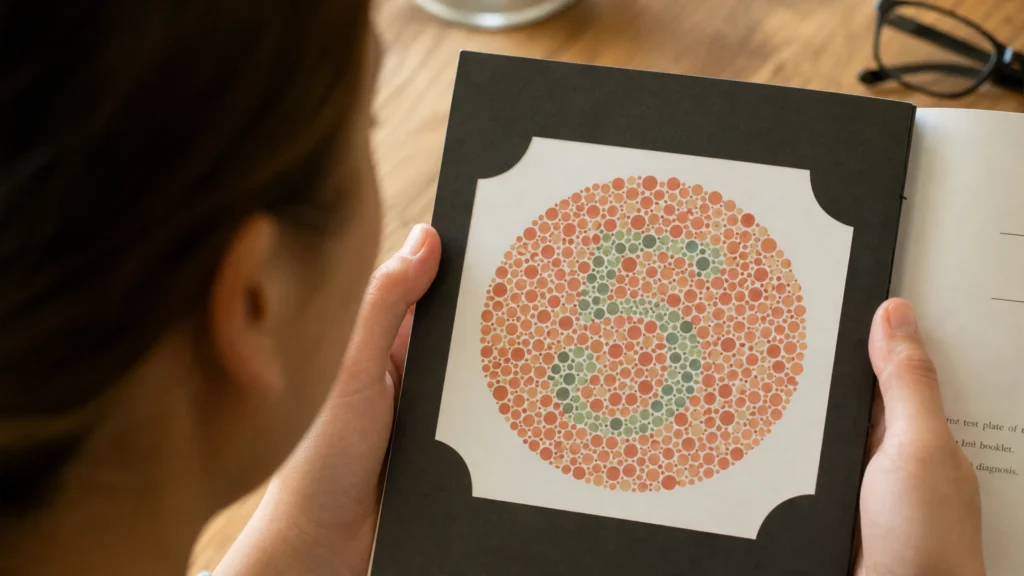
Color vision deficiency (CVD) affects 1 in 12 men — it’s the clinical term for what most call color blindness.
Clinically speaking, there’s no difference. Color vision deficiency (CVD) is the preferred medical term used by optometrists, ophthalmologists, and occupational health screeners. “Color blindness” is the everyday term most people use — even though true color blindness (seeing only in shades of gray, or achromatopsia) is extremely rare, affecting roughly 1 in 33,000 people.
Here’s the distinction:
| Term | Who Uses It | What It Actually Means |
|---|---|---|
| Color vision deficiency (CVD) | Medical professionals, occupational screeners, FAA/DOT regulations | Any reduction in ability to distinguish colors — most commonly red-green |
| Color blindness | General public, everyday conversation | Same as CVD — but implies complete inability to see color, which is rarely the case |
| Red-green color blindness | Most accurate lay term | The specific type affecting ~99% of people with CVD — difficulty distinguishing red from green |
| Protan/Deutan | Specialists, clinical settings | The two subtypes — protan (red-deficient) and deutan (green-deficient) |
The practical takeaway: if a product says “color deficiency contact lenses” or “color blind contact lenses,” you’re looking at the same type of product. The technology inside is what matters — not the label on the box.
Why Do People Search Different Terms?
Search behavior varies by background, region, and context. Here’s what drives the different search terms:
“Color blind contact lenses” — This is the most common term. 1 in 12 men grew up hearing “color blind,” so they naturally search for “color blind contacts.”
“Color deficiency contact lenses” — People searching this term tend to be more medically informed. They’ve been told by their eye doctor or employer that they have a “color vision deficiency” and are searching with that language.
“Colour blind contact lenses” — The UK spelling. Color blindness is spelled with a “u” in British English, and this variant represents a significant traffic opportunity. Our data shows “colour blind contact lenses” sits at position 14.3 with 588 impressions — a major gap worth targeting.
“Contacts for color blindness” — A more conversational search. People ask questions the way they’d ask a friend: “Are there contacts for color blindness?”
“Colorblind contacts” — The one-word compound is increasingly common in mobile search and voice queries.
Search Volume Comparison
| Search Term | Search Intent | What the User Wants |
|---|---|---|
| color blind contact lenses | Commercial | Buying solution for color blindness |
| color deficiency contact lenses | Informational/Commercial | Clinical solution for diagnosed CVD |
| colour blind contact lenses | Commercial | Same as first, UK audience |
| contacts for color blindness | Informational | Understanding if contacts exist for CVD |
| colorblind contacts | Commercial | Quick buying decision |
All of these search paths lead to the same destination: corrective contact lenses for red-green color blindness.
Do Different Names Mean Different Products?
In a word: no. The products that claim to help with color vision fall into a few technology categories, and the name is just marketing:
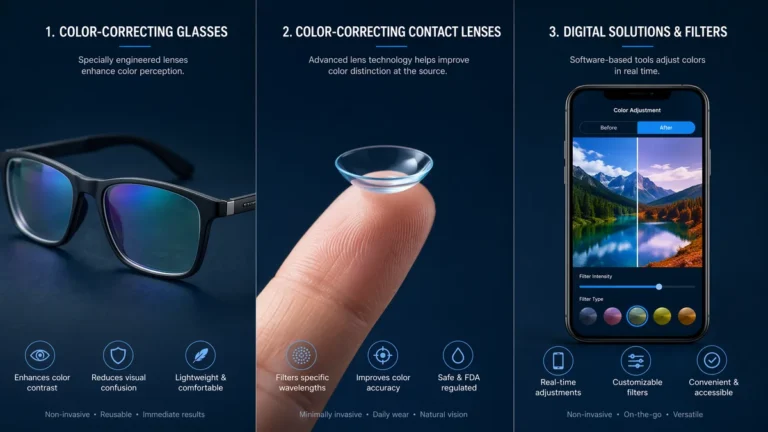
- Spectral notch filter contacts — These are what Colorkinds CCG-088 uses. A nano-scale filter built into the lens material selectively blocks wavelengths between 590-700nm, where red and green overlap for colorblind eyes. This is the most advanced technology available in a contact lens form factor.
- Tinted contacts — Some products are simply tinted lenses with no spectral filtering. These do not help with test performance or color discrimination. Always verify the technology.
- Colorblind glasses — The same spectral filter technology available in glasses form (EnChroma, Pilestone, Colorlite). These are effective for lifestyle use but interfere with safety equipment, uniforms, and PPE — which is why contacts are the superior choice for occupational testing.
The critical thing to look for is spectral notch filtering between 590-700nm and compatibility with both protan and deutan. The name on the package is irrelevant — the technology inside is what determines whether they’ll help you pass your test.
Why Colorkinds Works Regardless of What You Call It

No matter what you call them — colorblind contacts, CVD lenses, or color correction contacts — they solve the same problem.*
Colorkinds CCG-088 colorblind contacts are engineered to help you distinguish red from green — which is exactly what the Ishihara color vision test measures. Whether you call them “color deficiency contact lenses” or “color blind contacts,” the technology is the same:
- Spectral notch filter: Selectively blocks the 590-700nm wavelength range where red-green confusion occurs
- Works for both protan and deutan: Covers ~99% of all red-green CVD cases
- 100% Ishihara pass rate: Specifically engineered to help you pass the most common occupational screening
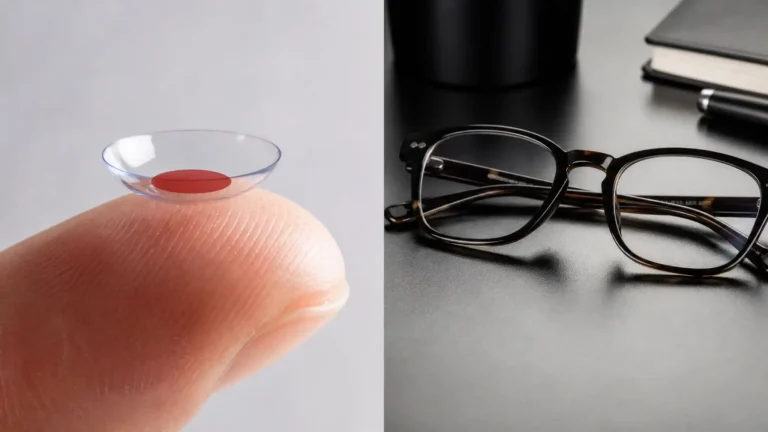
- Discreet design: No one can tell you’re wearing them — the red tint blends naturally with your iris
- All-day comfort: 40% water content hydrogel, comfortable for 12+ hours of wear
The product doesn’t change based on what you call it. The technology inside does the work.
What About Other Types of Color Blindness?

It’s important to be honest about what these lenses can and can’t do. Colorkinds CCG-088 contacts are designed for red-green color vision deficiency — protan and deutan types. Here’s the compatibility breakdown:
| CVD Type | Works With Colorkinds? | Notes |
|---|---|---|
| Protanomaly / Protanopia (red-deficient) | Yes | ~25% of all red-green CVD cases |
| Deuteranomaly / Deuteranopia (green-deficient) | Yes | ~75% of all red-green CVD cases |
| Tritanomaly / Tritanopia (blue-yellow) | No | Rare — affects ~1% of population |
| Achromatopsia (complete color blindness) | Limited | Extremely rare — consult a specialist |
If you have red-green CVD (which covers roughly 99% of cases), Colorkinds contacts will work for you. If you have tritan (blue-yellow deficiency), these lenses won’t help — and we’re transparent about that.
How to Choose the Right Colorblind Contacts
Whether you search for “color deficiency contact lenses” or “color blind contacts,” here’s what to look for when choosing a product:
- Confirm the technology — Does it use spectral notch filtering or just tinting? Look for specific wavelength ranges (590-700nm).
- Check compatibility — Does it work for both protan and deutan? If it only works for one, you need to know your exact type.
- Verify test performance — Is there a published pass rate for the Ishihara test? Look for specific claims backed by guarantees.
- Consider your career — Do you need contacts that fit under PPE, safety glasses, or uniforms? Contacts are always more discreet than glasses.
- Check the guarantee — Is there a risk-free trial period? A 60-day guarantee means you can test them for your specific needs.
Colorkinds CCG-088 contacts check all these boxes. And if they don’t work for your test, you can return them within 60 days — no questions asked.
FAQ
Yes. Both terms refer to the same type of product — corrective contact lenses that use spectral filtering to help people with red-green color vision deficiency distinguish colors more clearly.
Color vision deficiency (CVD) is the clinical term used by medical professionals. “Color blindness” is the everyday term most people use. They describe the same condition.
Colorkinds CCG-088 contacts work for both protan (red-deficient) and deutan (green-deficient) types, covering approximately 99% of all red-green CVD cases.
Yes — but only if they use spectral notch filter technology, not just tinting. Colorkinds CCG-088 uses a nano-scale 590-700nm spectral notch filter that helps your brain distinguish red from green.
This depends on your agency. Some explicitly prohibit any corrective aids during testing. Check with your examiner beforehand. Colorkinds contacts are an excellent off-duty training tool for building visual recognition habits.
Any of these will work: “color blind contact lenses,” “color deficiency contact lenses,” “colorblind contacts,” “contacts for color blindness,” or “colour blind contact lenses” (UK spelling).
Colorkinds CCG-088 contacts are Plano (non-prescription, 0.00). They correct color vision, not visual acuity. If you need prescription vision correction, you can wear them alongside your regular contacts or glasses.
No. Colorkinds contacts are specifically designed for red-green color vision deficiency (protan and deutan). They do not work for tritan (blue-yellow) deficiency.
Yes. Colorkinds offers a 60-day money-back guarantee. If the contacts don’t help you pass your test, return them for a full refund — no questions asked.
Colorkinds CCG-088 contacts are yearly disposable, lasting up to 12 months with proper care. One pair covers a full year of testing needs and daily use.
Ready to try them? Order Colorkinds colorblind contacts with free worldwide shipping and a 60-day guarantee.
Related guides: