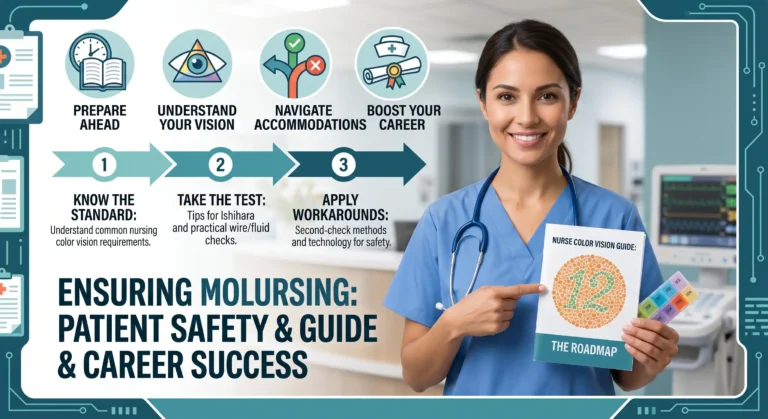

Can You Be a Nurse with Color Blindness? Healthcare Color Vision Guide (2026)
Can You Be a Nurse with Color Blindness? Healthcare Color Vision Guide (2026)
You’re pursuing a career in healthcare — nursing, medicine, or emergency services — and you’re concerned about how color blindness might affect your ability to practice.
Here’s the direct answer: Yes, you can be a nurse or medical professional with color blindness. Color vision deficiency does not automatically disqualify you from nursing school, medical licensing, or clinical practice. However, it’s essential to understand which color-dependent tasks may be challenging and how to develop effective compensation strategies.
This guide covers color vision requirements in healthcare, which specialties are most and least affected, practical strategies for clinical tasks, and how Colorkinds contacts can help.
Key Takeaways:
- Color blindness does not prevent you from becoming a nurse, doctor, EMT, or other healthcare professional
- Many medical tasks rely on position, shape, and context — not just color
- The most affected areas: patient monitoring displays, test strip reading, and skin tone assessment
- Compensation strategies (lighting, partner verification, technology) are well-established
- Colorkinds contacts can enhance color discrimination for clinical tasks
- Some specialties (surgery, dermatology) require more color discrimination than others
Color Vision Requirements in Healthcare
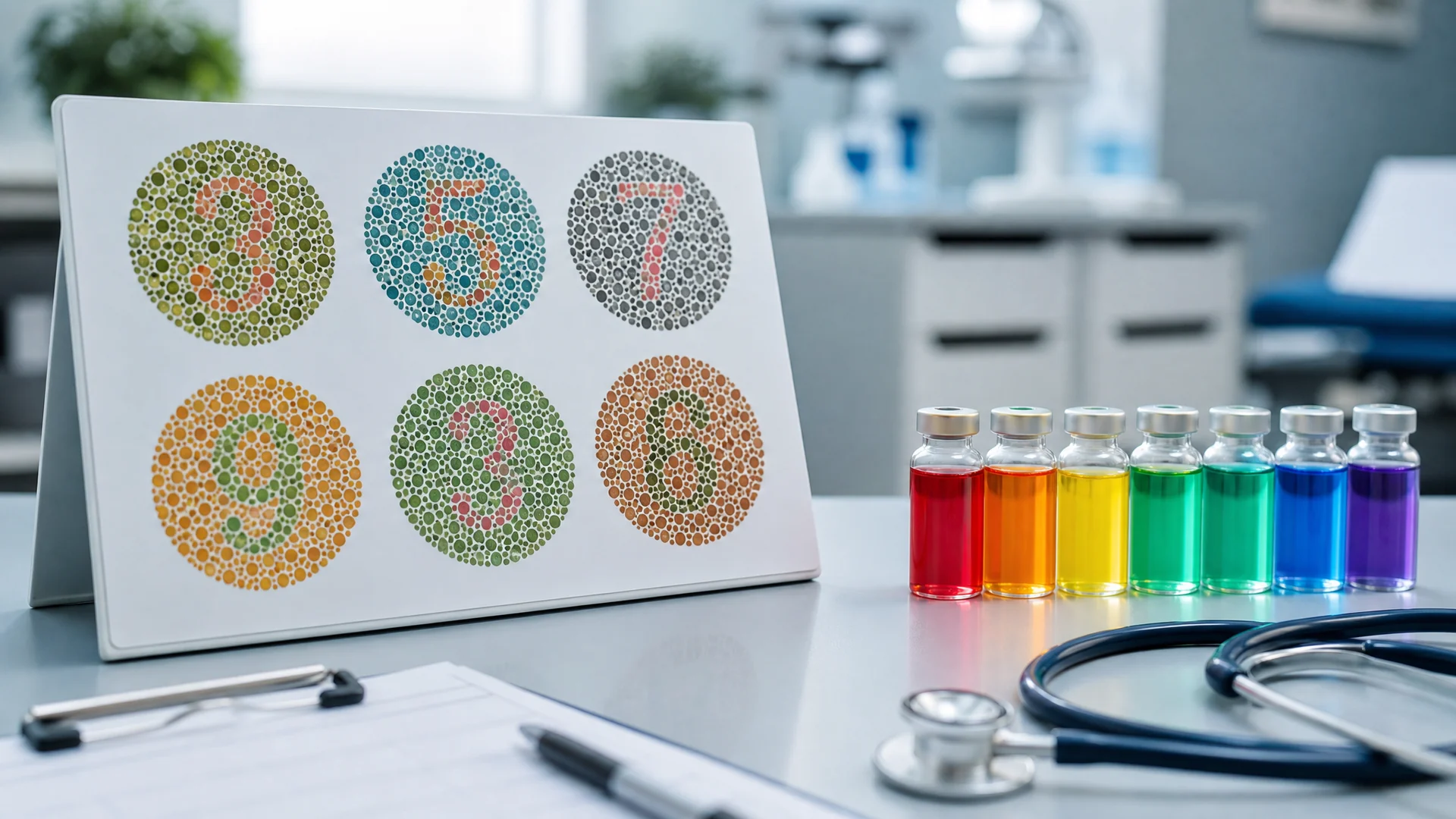
The first question most healthcare professionals ask is whether color vision is tested during the licensing or admissions process. The answer depends on where you are in your career path.
Nursing Programs and Licensing
Nursing programs and state licensing boards take a practical approach to color vision. Here’s the current landscape:
| Stage | Color Vision Testing | What It Means |
|---|---|---|
| Nursing school admission | Not tested | Most schools do not screen for color vision during admissions |
| Clinical placement | Varies by hospital | Some hospitals screen during onboarding — alternative testing usually available |
| NCLEX exam | Not tested | Written exam only — no color vision component |
| State licensure (RN/LPN) | Not required | No state requires color vision testing for nursing licensure |
Medical Programs and Licensing
Physicians, physician assistants, and medical specialists follow a similar pattern:
| Stage | Color Vision Testing | What It Means |
|---|---|---|
| Medical school admission | Not tested | MCAT and admissions do not evaluate color vision |
| Residency placement | Varies by specialty | Some competitive specialties may screen; most don’t |
| Board certification | Not tested | USMLE and specialty boards do not test color vision |
| Hospital privileging | Varies | Some hospitals screen, but alternative tests are usually accepted |
EMT and Paramedic Certification
Emergency medical services follow a similar pattern — no mandatory color vision testing for certification, though individual ambulance services may have their own policies. Most rely on practical skills assessment rather than color plate tests.
Key Clinical Tasks and How Colorblind Professionals Compensate
Color vision deficiency affects certain clinical tasks more than others. The good news: for every color-dependent task, there are established compensation strategies.
Clinical Tasks Affected by CVD
| Clinical Task | Color Dependent? | Compensation Strategy |
|---|---|---|
| Reading test strips | Yes — color change indicates result | Use digital readers or smartphone apps that provide numerical readouts |
| Patient monitor interpretation | Partially — positions and numbers also work | Focus on waveform patterns, numerical values, and alarm priorities rather than color |
| Skin assessment (erythema, jaundice) | Yes — subtle color changes | Use palpation (skin temperature, texture), patient history, and partner verification |
| Medication identification | Partially — labels provide text | Always read medication labels and use barcode scanning systems |
| Lab specimen labeling | Minimal — text-based | Use label printers and color-coded systems that include text labels |
| Color-coded charts and diagrams | Partially — shape and position add redundancy | Cross-reference with text labels and legend keys |
Real Compensation Strategies Used by Healthcare Professionals
Partner verification: In high-stakes situations, asking a colleague to confirm a color-dependent observation is standard practice — for everyone, not just colorblind staff. It’s a safety measure built into healthcare workflows.
Technology aids: Digital blood glucose readers, automated lab analyzers, and barcode medication administration systems all provide numerical or text results that eliminate the need for color interpretation. These are increasingly standard in modern healthcare settings.
Lighting adjustments: Full-spectrum lighting improves color discrimination for everyone. If you need to assess a subtle color change, adjust the lighting first. High-CRI task lights can make a significant difference.
Charting and documentation: Most modern EHR systems display information in multiple formats — color-coded alerts are also accompanied by text labels and priority rankings. You can configure your display preferences to rely on what works for you.
Which Healthcare Specialties Are Most Affected
Color vision matters more in some specialties than others. Here’s how different fields stack up:
| Specialty | Color Demand | Practical Impact | Notes |
|---|---|---|---|
| Surgery | High — tissue color assessment | Most challenging for CVD | Experienced surgeons develop tactile and contextual skills |
| Dermatology | High — skin condition diagnosis | Requires strong compensation strategies | Good lighting and dermoscopy tools help significantly |
| Anesthesiology | Moderate — monitor interpretation | Manageable — waveforms and numbers are primary cues | Color coding is secondary on most monitors |
| Emergency medicine | Moderate — triage, trauma assessment | Manageable with partner verification | Fast-paced but team-based — verification is built-in |
| Internal medicine | Moderate — physical exam | Manageable — established compensation methods | Experience builds pattern recognition skills |
| Radiology | Low to moderate — grayscale primary | Minimal impact | Most reading is grayscale; Doppler flow is secondary |
| Psychiatry | Very low | No significant impact | Minimal color-dependent tasks |
| Pathology | Moderate — stain interpretation | Manageable with technology | Digital pathology systems reduce color reliance |
Surgery and Color Blindness
Surgery is often cited as the most challenging specialty for colorblind physicians. Distinguishing healthy tissue from diseased tissue can depend on subtle color differences. However, experienced surgeons with color blindness develop tactile skills — tissue texture, resistance, and elasticity — that compensate for color cues they may miss.
Dr. John Dalton, the scientist who first described color blindness, was himself colorblind. Many practicing surgeons with color vision deficiency perform successfully by relying on anatomical knowledge, tissue feel, and confirmation from surgical team members.
Dermatology and Color Blindness
Dermatology relies heavily on visual assessment, and color is a significant diagnostic cue. However, modern dermatology tools — dermoscopy, Wood’s lamp examination, and digital imaging — provide additional data beyond what the naked eye sees. Colorblind dermatologists often become experts in pattern recognition and texture assessment.
Colorkinds Contacts for Healthcare Professionals
Colorkinds CCG-088 contacts use spectral notch filter technology to enhance red-green discrimination. For healthcare professionals, this means:
| Clinical Benefit | How It Helps |
|---|---|
| Patient monitor clarity | Red and green waveform channels become more distinguishable |
| Test strip reading | Color change endpoints are easier to identify |
| Skin tone assessment | Erythema (redness) and cyanosis (blueness) are more apparent |
| Medication label colors | Color-coded labels and warnings are clearer |
| Comfort for long shifts | Daily wear design suits 12-hour clinical shifts |
| PPE compatibility | Fit comfortably under safety glasses, face shields, and loupes |
Colorkinds contacts are Plano (non-corrective) and can be worn alongside prescription glasses or contacts if you need vision correction. They’re discreet — no one needs to know you’re wearing color enhancement. The 60-day guarantee makes them risk-free to try for clinical practice.
Related reading: See our Colorblind Solutions for Nurses and Colorblind Solutions for Surgeons.
FAQ: Nurses and Color Blindness
Yes. Color blindness does not prevent you from becoming a nurse. No state nursing board requires color vision testing for licensure, and most nursing schools do not screen for color vision. Many colorblind nurses work successfully across all specialties.
Yes, but it’s more challenging. Surgery requires distinguishing subtle tissue color changes. Many surgeons with color blindness compensate with experience, lighting, and partner communication. Some highly color-critical specialties may be more difficult but not impossible.
Most nursing schools do not require or administer color vision testing for admission. Some may include a general health screening that mentions color vision, but it is rarely a barrier to enrollment or graduation.
Yes. EMTs and paramedics with color blindness work in emergency services. The most critical tasks — reading monitors, identifying medications, and patient assessment — have redundant cues beyond color. Colorkinds contacts can help with ambulance equipment and dashboard displays.
Yes. Colorkinds CCG-088 contacts enhance red-green discrimination, which helps with patient monitoring displays, test strip interpretation, and skin tone assessment. They are comfortable for long shifts and fit under medical PPE without any issue.
Related guides: