590 nm Color: Understanding the Wavelength That Causes Red-Green Confusion (2026)
If you’ve researched color blindness or colorblind contacts, you’ve probably seen the number “590 nm” mentioned. But what does it mean? Why is this specific wavelength so important — and what does 590 nm light actually look like?
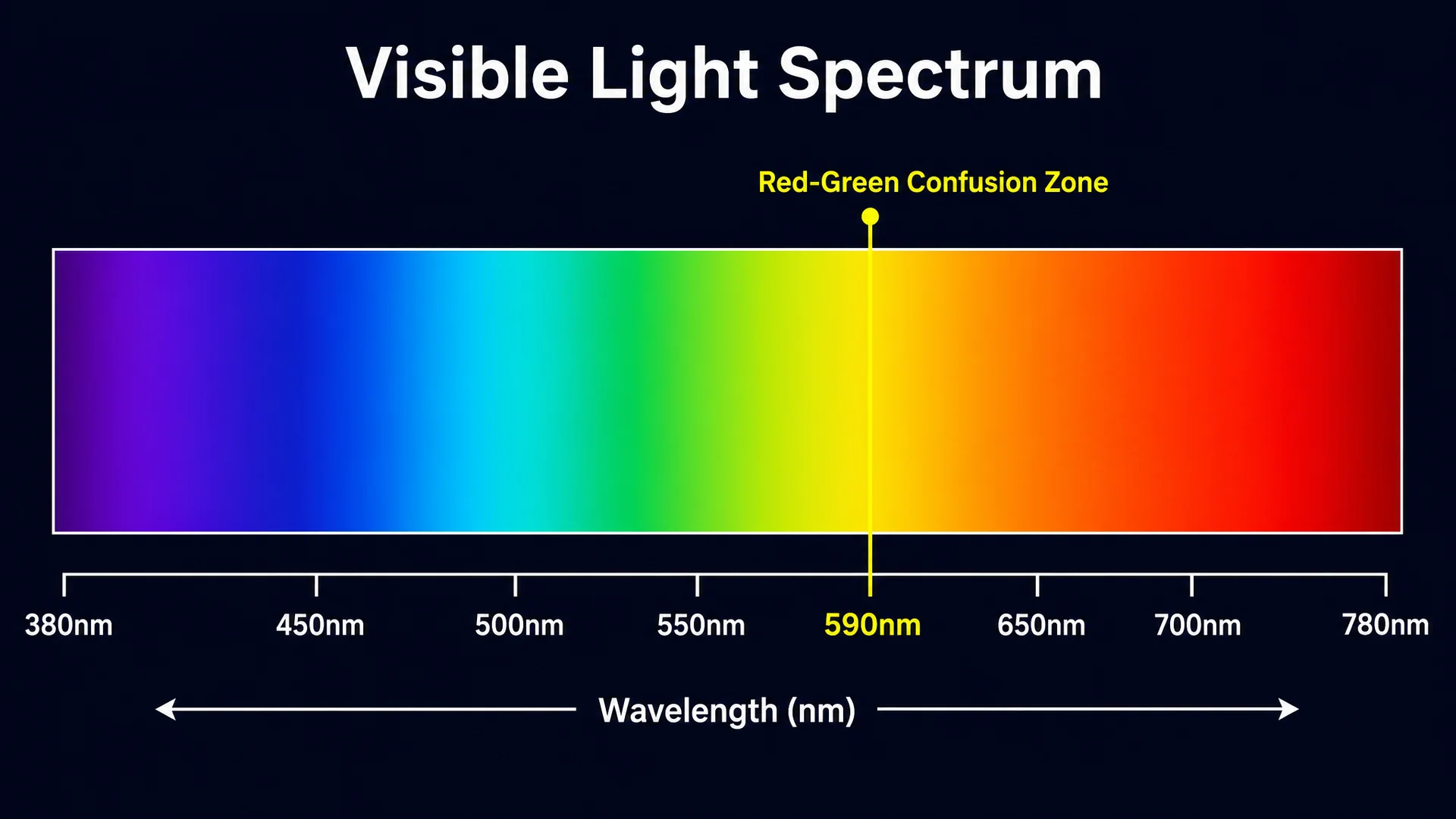
Here’s the direct answer: 590 nm is the wavelength of light that falls in the yellow-orange range of the visible spectrum. It’s significant for color blindness because this is the overlap zone where the red-sensitive (L-cone) and green-sensitive (M-cone) cones in your eye respond almost equally — creating the confusion that makes red and green hard to distinguish.
This guide explains what 590 nm color looks like, why it’s the critical wavelength for red-green color blindness, and how spectral notch filters that target this range can help.
Key Takeaways:
- 590 nm light appears yellow-orange to normal vision — it’s where red and green meet on the spectrum
- The L-cone and M-cone sensitivity curves overlap most significantly around 590-700 nm
- This overlap is the root cause of red-green color confusion
- Colorkinds spectral notch filters specifically target the 590-700 nm range
- Related wavelengths: 570 nm (yellow-green), 450 nm (blue), 700 nm (deep red)
- Understanding these wavelengths helps explain how colorblind contacts work
What Is 590 nm Color?
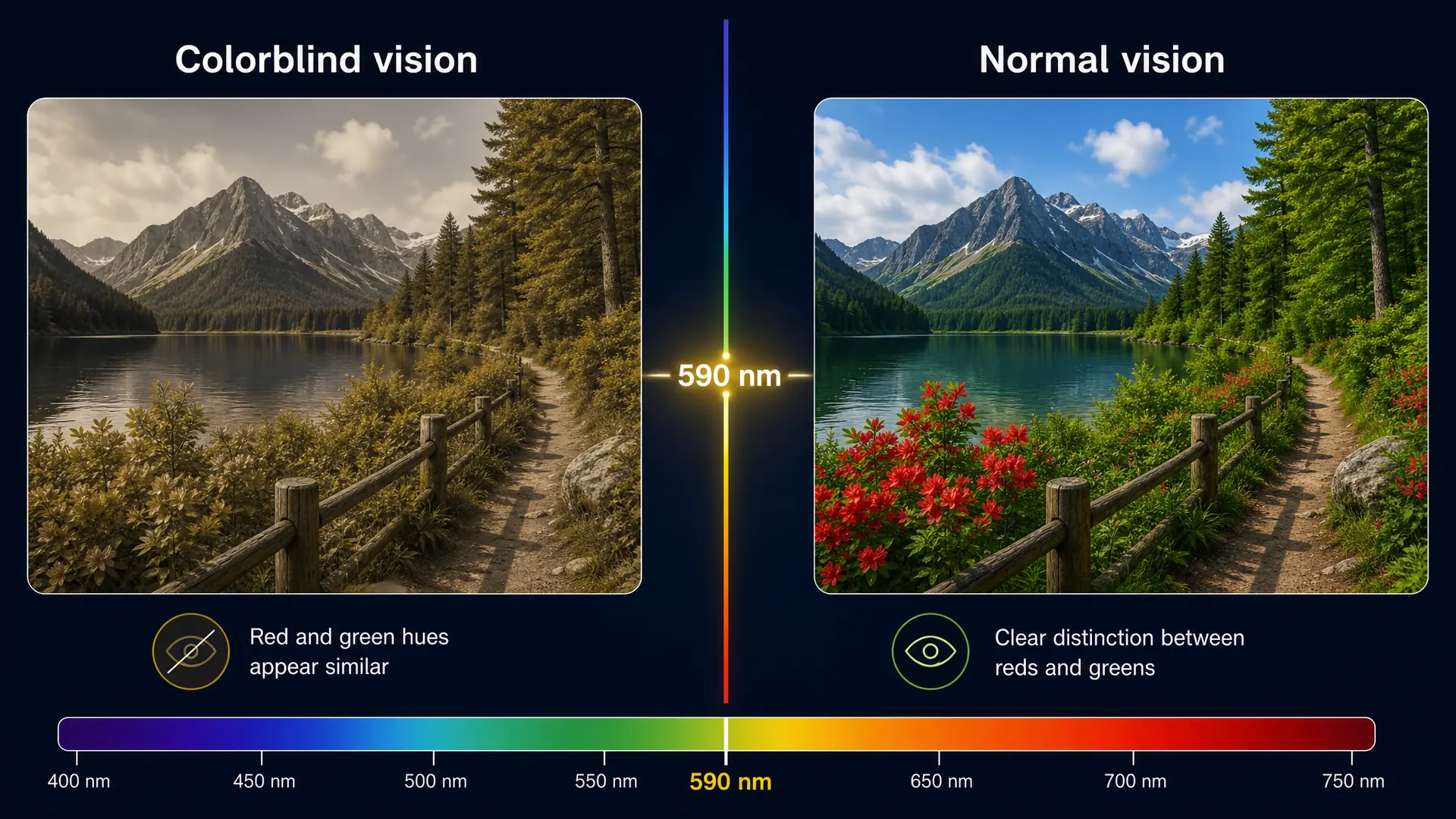
The Visible Light Spectrum
White light is made up of all the colors of the rainbow, each with a specific wavelength measured in nanometers (nm). The human eye can see wavelengths from approximately 380 nm to 780 nm.
| Wavelength Range | Color | Where You See It |
|---|---|---|
| 380-450 nm | Violet to blue | Blue sky, LED indicators |
| 450-495 nm | Blue | Ocean, clear skies |
| 495-570 nm | Green | Grass, leaves, traffic light green |
| 570-590 nm | Yellow-green to yellow | Amber traffic lights, hazard signs |
| 590-620 nm | Orange to red-orange | Caution lights, brake lights |
| 620-750 nm | Red | Traffic light red, brake lights, sunsets |
What Does 590 nm Look Like?
To someone with normal color vision, 590 nm light appears as a yellow-orange hue. It’s the transition zone where green ends and red begins on the spectrum.
This is why 590 nm is so important for color blindness: it sits at the exact boundary between the red and green color channels that your eyes use to perceive color. In colorblind vision, the signals from both channels are too similar in this zone, creating ambiguity.
Why 590-700 nm Causes Red-Green Confusion
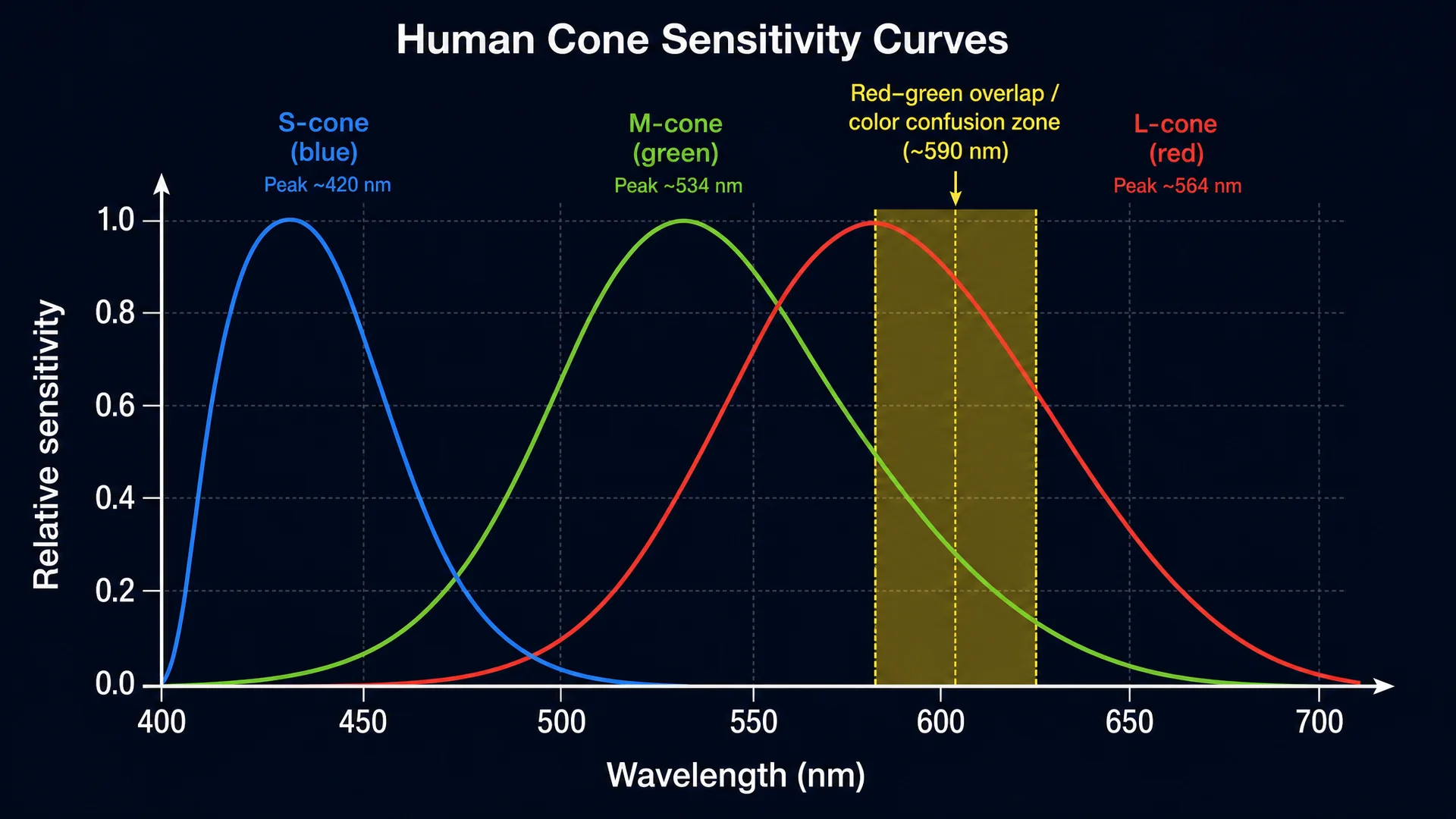
The Cone Sensitivity Overlap
Your retina contains three types of cone cells, each tuned to different wavelengths:
| Cone Type | Peak Sensitivity | Range |
|---|---|---|
| L-cones (long/red) | ~564 nm | 500-700 nm |
| M-cones (medium/green) | ~534 nm | 450-630 nm |
| S-cones (short/blue) | ~420 nm | 400-500 nm |
In normal color vision, each cone type responds most strongly to its own range. But in red-green color blindness, the L-cone and M-cone sensitivity curves overlap excessively — particularly in the 590-700 nm range.
| Wavelength | Normal L-Cone Response | Normal M-Cone Response | In CVD |
|---|---|---|---|
| 450 nm (blue) | Minimal | Minimal | Clear — S-cones dominate |
| 570 nm (yellow-green) | Strong | Strong | Confusion zone begins |
| 590 nm (yellow-orange) | Strong | Moderate | Peak confusion |
| 620 nm (red-orange) | Very strong | Weak | Moderate confusion |
| 700 nm (deep red) | Strongest | Minimal | Less confusion |
Related reading: For a complete explanation of how this technology works, see our spectral notch filter technology guide.
Related Wavelengths and Their Significance
Understanding the full spectrum helps explain why color blindness affects some situations more than others — and why certain colors remain visible even for people with severe CVD.
570 nm: The Yellow-Green Transition — Where Amber Lights Live
At 570 nm, both the L-cones and M-cones respond at nearly equal strength. In normal color vision, this creates a clear yellow-green signal that the brain interprets as amber. But for someone with red-green CVD, the equal response from both cone types creates maximum ambiguity — the brain receives a confusing signal that could be interpreted as red, green, or yellow.
Real-world impact: This is why amber traffic lights are often the most confusing signal for colorblind drivers. The amber sits at 570-590 nm — the exact zone where both cone types produce near-identical responses. The light isn’t clearly red or green to the brain; it’s an ambiguous signal that requires position cues to interpret reliably.
How Colorkinds helps: The spectral notch filter at 590-700 nm removes the overlapping red-green signals. For amber lights that fall at the edge of this range (570-590 nm), the filter partially reduces the confusion by suppressing the red end of the overlap, leaving the yellow-green signal clearer.
450 nm: The Blue End — Why Colorblind People Can Still See Blue
Blue light at 450 nm is primarily detected by S-cones (short wavelength), which are almost never affected by red-green color blindness. This is why people with protan or deutan deficiency can still see blue clearly — the neural pathway for blue is completely separate from the red-green pathway.
Real-world impact: This separation is why:
- Blue sky is visible in full color even for people with severe red-green CVD
- Blue LED indicators are easily identifiable
- The blue quadrant of the NFPA 704 hazard diamond is readable by color alone
- Japan’s “go” traffic lights, which lean toward blue-green, are sometimes more distinguishable for colorblind drivers
Why this matters for your career: If you have red-green CVD and are concerned about color vision testing, remember that blue-yellow (tritan) deficiency is extremely rare and unrelated to the common protan/deutan types. When someone says “color blind,” they almost certainly mean red-green — and that’s the type that can be addressed.
700 nm and Beyond: Deep Red — Where Confusion Decreases
At 700 nm and beyond, the M-cone response drops off significantly while L-cone response remains strong. This means the confusion that exists at 590-620 nm decreases as wavelengths get longer.
Real-world impact:
- Deep red brake lights are more distinguishable than orange-red turn signals, which fall closer to the confusion zone
- Red LEDs at 660 nm+ are often easier for colorblind people to see than standard red at 620 nm
- Sunsets retain their red hues because the long-wavelength red light is less ambiguous
How Spectral Notch Filters Use This Knowledge
Colorkinds CCG-088 contacts embed a nano-scale spectral notch filter that precisely targets the 590-700 nm range — the exact zone where the L-cone and M-cone overlap causes confusion for red-green CVD.
The Engineering Behind the Filter
A spectral notch filter is fundamentally different from a simple colored tint. A tinted lens absorbs broad wavelengths indiscriminately — it shifts all color perception, making everything appear reddish or bluish. A spectral notch filter, by contrast, uses nano-scale interference patterns to cancel specific wavelengths while leaving the rest of the spectrum untouched.
Think of it like a noise-canceling headphone. Instead of blocking all sound, it selectively cancels only the problematic frequency range. The result: the sound you want to hear comes through clearly, and only the noise is removed.
How the Filter Works Step by Step
| Stage | What Happens at the Wavelength Level |
|---|---|
| Light enters the eye | All visible wavelengths (380-750 nm) pass through the contact lens toward the retina |
| Filter blocks 590-700 nm | The nano-scale interference pattern cancels approximately 80-90% of light in this specific range — the exact overlap zone |
| Shorter wavelengths pass freely | Blue (450 nm), green (530 nm), and yellow-green (570 nm) signals reach the cones unaffected |
| Longer red wavelengths pass | Deep red light at 700 nm+ also passes — only the confusion zone is blocked |
| Cone signals separate | Without the overlapping 590-700 nm light confusing both cone types, the L-cone and M-cone now send distinct signals |
| Brain interprets clearly | With two distinct signals instead of one ambiguous one, the brain can distinguish red from green |
Why Not Block All Red Light?
A common question is: if red light at 590-620 nm causes confusion, why not block everything above 590 nm? The answer comes down to the difference between “blocking red light” and “blocking confusing light.”
| Approach | What Gets Blocked | What You Can Still See |
|---|---|---|
| Block only 590-700 nm (spectral notch) | Only the overlap zone where confusion occurs | Blue, green, yellow, AND deep red — natural color perception preserved |
| Block everything above 590 nm | All red and orange light from 590-750 nm | Only blue and green — no brake lights, no red traffic lights, no sunset colors, no fire |
| Block nothing (no filter) | Nothing | Full spectrum but with red-green confusion — the original problem |
The precision of the spectral notch filter is what makes it effective for everyday use. You don’t lose the ability to see red — you lose the confusion between red and green. Brake lights remain visible. Red traffic lights remain visible. The color red doesn’t disappear — it just stops being confused with green.
Practical Applications of Wavelength Knowledge
Understanding which wavelengths cause confusion helps you predict which situations will be challenging — and which solutions will work. Here’s how wavelength knowledge applies to real-world scenarios.
For Occupational Testing
Each color vision test targets specific wavelengths. Knowing which ones helps you understand why you might pass one test but fail another:
| Test | Key Wavelengths | Why It Matters |
|---|---|---|
| Ishihara plates | 570-700 nm (red-green dots) | The filter removes the overlap in the red-green dot patterns, making the hidden numbers visible |
| Farnsworth D-15 | 450-650 nm (full hue circle) | Enhanced contrast across the red-green range improves arrangement accuracy |
| FAA signal light test | Aviation red (620-700 nm) and green (530 nm) | Better separation between red and green aviation signals |
| FAA OCVT | Real-world signals spanning 530-700 nm | Practical light identification with enhanced color contrast |
The reason the Farnsworth D-15 is often passed by people who fail the Ishihara is wavelength-related. The D-15 caps span the full color circle from 450-650 nm. Even if you confuse red-green in the 590-620 nm zone, you can still arrange the caps correctly using the blue and green end as reference points. The Ishihara test, by contrast, concentrates all its confusion in the 570-700 nm zone — the exact overlap region.
For Daily Life
Wavelength knowledge doesn’t just help with tests — it helps you navigate everyday situations more confidently:
| Situation | Why It’s Confusing | Practical Strategy |
|---|---|---|
| Traffic lights | Red (620 nm) and green (530 nm) both stimulate overlapping cone responses | Use position (red on top) as primary cue; Colorkinds filter enhances the color difference |
| Brake lights vs taillights | Both use red LEDs at 620-630 nm — brightness is the only difference | Brake lights are significantly brighter; the filter preserves red perception so both remain visible |
| Dashboard warning lights | Red warning and green OK indicators fall in the confusion zone | Learn symbol positions; the filter helps distinguish critical red warnings from routine green indicators |
| Ripening fruit | Green-to-red color change spans the 530-620 nm confusion range | Use touch (firmness) and smell as additional ripeness cues alongside enhanced color perception |
| LED device indicators | Red and green LEDs are common on electronics and chargers | Check device icons and symbols; the filter makes the LED colors more distinct |
Connecting Wavelengths to Your Solution
The 590-700 nm range isn’t an arbitrary number — it’s the direct result of how human cone cells work. Understanding this range tells you:
- Why colorblind contacts work: They target the exact wavelengths where confusion happens
- Why blue remains visible: S-cones operate at 400-500 nm, completely outside the filter range
- Why deep red is preserved: At 700 nm+, M-cone response drops off, so less filtering is needed
- Why position matters: Since color can be ambiguous in the 590-700 nm zone, redundant cues like position, brightness, and context are essential safety backups
FAQ: 590 nm Color and Wavelengths
590 nm light appears yellow-orange to someone with normal color vision. It sits at the boundary between the yellow and orange ranges of the visible spectrum — the transition zone where red-sensitive and green-sensitive cone cells respond almost equally.
590 nm is the beginning of the wavelength range where the L-cone (red) and M-cone (green) sensitivity curves overlap for colorblind eyes. This overlap — spanning approximately 590-700 nm — is the direct cause of red-green color confusion. Spectral notch filters target this specific range.
570 nm light appears yellow-green — approximately the color of an amber traffic light. It’s the transition point where green shifts to yellow on the visible spectrum. Both L-cones and M-cones respond strongly at this wavelength, making it another area of potential confusion for colorblind observers.
450 nm light appears blue — similar to a clear sky or a blue LED indicator. It primarily stimulates S-cones (blue-sensitive), which are rarely affected by red-green color blindness. This is why blue is usually visible clearly even for people with red-green CVD.
The Colorkinds CCG-088 contact lens embeds a nano-scale spectral notch filter that blocks approximately 80-90% of light in the 590-700 nm range. This removes the overlapping wavelengths that cause red-green confusion while allowing the rest of the visible spectrum to pass through normally.
A notch filter uses nano-scale interference patterns to precisely target specific wavelengths (590-700 nm). A tint uses dye to absorb broad ranges of light. The notch filter is much more precise — it only removes the problematic overlap range rather than shifting all color perception.
Blocking all red light would eliminate the ability to see brake lights, red traffic lights, and many other important red signals. The spectral notch filter only blocks the 590-700 nm range where confusion occurs, preserving the ability to see both red and green while making them easier to distinguish.
Red traffic lights typically emit at 620-630 nm, green traffic lights at 525-530 nm, and amber traffic lights at 590-595 nm. The red and amber ranges fall partially within the spectral notch filter zone, which is why Colorkinds contacts can enhance traffic light discrimination.
No. Someone with normal color vision sees 590 nm as yellow-orange. Someone with protan (red-deficient) CVD sees it differently because their L-cones are less sensitive. Someone with deutan (green-deficient) CVD sees it differently because their M-cones are less sensitive. The exact perception varies by individual.
No. Blue light wavelengths (450-495 nm) are far below the filter’s 590-700 nm range. The spectral notch filter does not affect blue perception at all — blue remains fully visible and unchanged. This is intentional: targeting only the overlap zone preserves normal color perception outside that range.
Similar Posts: