Colorblind Treatment Options: Glasses, Contacts & Therapy (2026)
If you’re colorblind, someone has probably told you there’s nothing you can do about it. That’s not the full story.
Here’s the direct answer: No cure exists for inherited color blindness, but several treatment options can help you distinguish colors more effectively — from specialized glasses and contact lenses to digital aids and emerging gene therapies. The right choice depends on your needs, your type of color vision deficiency, and whether you need to pass an occupational test.
This guide covers every available colorblind treatment option in 2026 — what works, what doesn’t, what’s coming soon, and how to choose the right solution for your specific situation.
Key Takeaways
- Inherited color blindness has no permanent cure, but multiple treatment options can improve color discrimination
- Colorblind contact lenses (spectral notch filters) are the most discreet and effective option for occupational test-passing
- Colorblind glasses (EnChroma, Pilestone) work best for outdoor lifestyle use but have limitations
- Gene therapy is the most promising future treatment but remains years away for common red-green deficiency
- Digital accessibility tools are free and immediately available for screen-based color issues
Is There a Cure for Color Blindness?
The short answer is no. Inherited color blindness is a genetic condition caused by differences in the cone cells of your retina (National Eye Institute). No pill, surgery, or lens can permanently restore the full color discrimination that typical vision provides.
However, “treatment” and “cure” are not the same thing. Treatment options exist that help people with color vision deficiency (CVD) distinguish colors more effectively, pass occupational tests, and navigate daily life with greater ease. These treatments range from simple accessibility settings on your phone to advanced spectral filtering technology in contact lenses.
Important distinction: If your color blindness is acquired (caused by diabetes, cataracts, medication side effects, or eye injury), treating the underlying condition may improve or reverse the color vision loss. Inherited forms — which account for the vast majority of cases — cannot be reversed.
Globally, approximately 300 million people have some form of color vision deficiency. About 1 in 12 men and 1 in 200 women are affected, with red-green deficiency (protan and deutan) accounting for roughly 99% of all cases.
Treatment Option 1: Colorblind Glasses
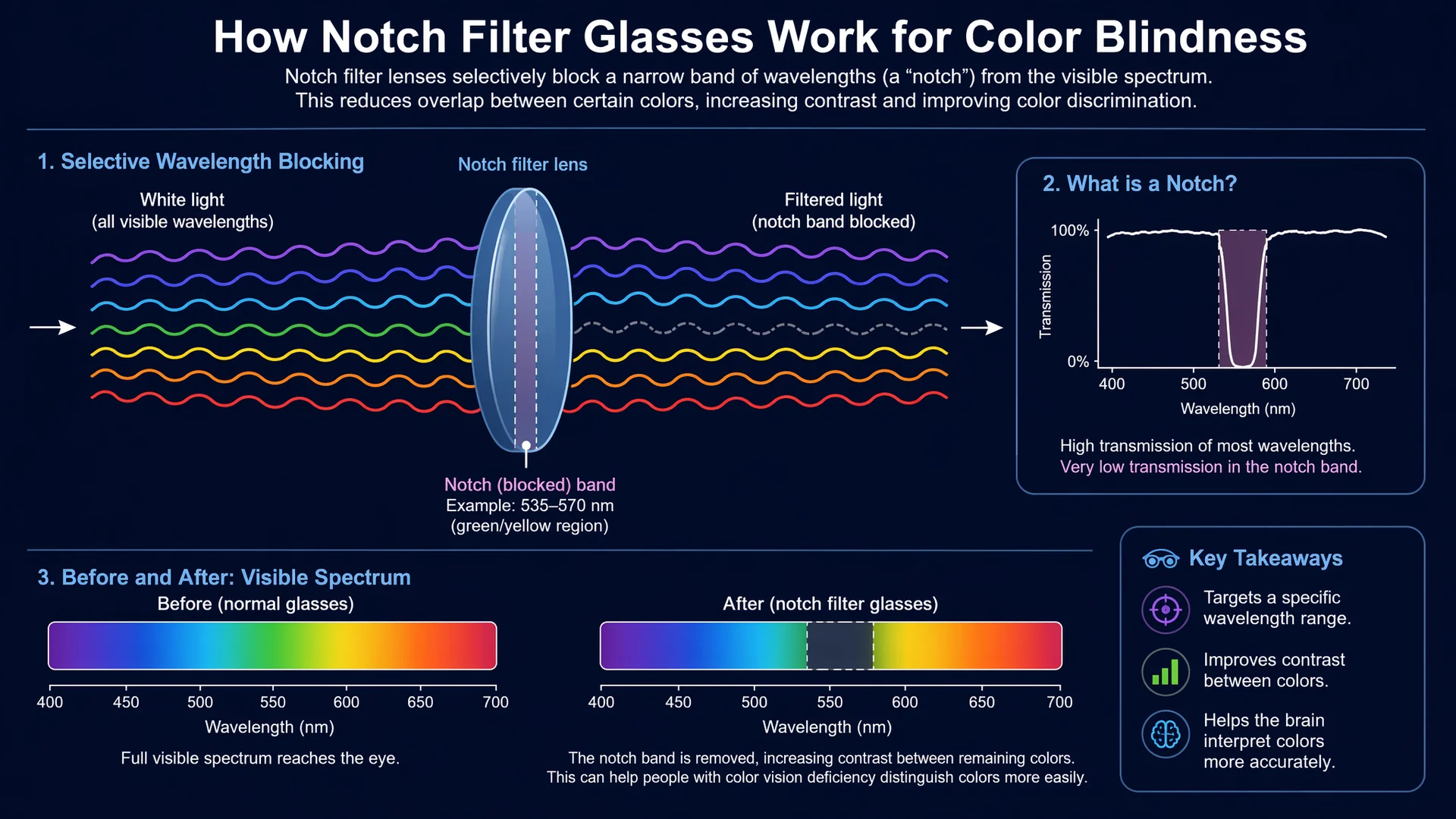
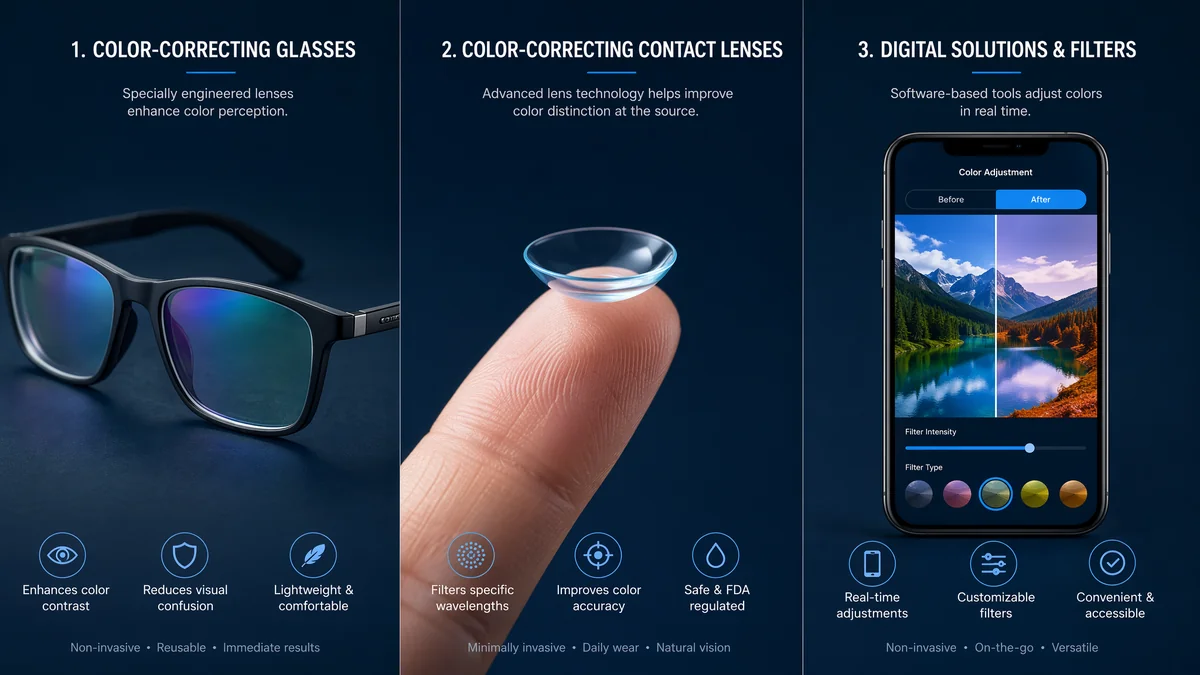
Colorblind glasses are the most well-known treatment option, popularized by brands like EnChroma and Pilestone. These glasses use specialized filters to block specific wavelengths of light, increasing contrast between colors that are typically confused.
How They Work
Colorblind glasses use notch filter technology — thin-film coatings applied to the lens surface that block a narrow band of wavelengths where red and green cone sensitivity overlap. By removing the confusing wavelengths, the brain receives cleaner signals and can distinguish colors more easily.
EnChroma
EnChroma is the dominant brand, offering both indoor and outdoor lens options. Their Cx3 Sun lens is designed for bright outdoor use, while the Cx1 Indoor lens works in lower-light environments. Prices range from $189 to $429 depending on frame and prescription needs.
What the research says: A peer-reviewed study found that only 2 out of 16 colorblind subjects showed statistically significant improvement with EnChroma glasses. Results vary widely by individual, and the dramatic viral videos showing people seeing color “for the first time” are not representative of the typical experience.
Best for: Mild to moderate red-green deficiency, outdoor use in natural light.
Pilestone
Pilestone offers a simpler lens system with five options (Lens A through E) matched to different types and severities of color blindness. Prices are lower at $139 to $170. A 2025 study in International Ophthalmology found that Pilestone glasses reduced Ishihara test error scores from an average of 20 to 8. However, 62.5% of participants were satisfied — meaning roughly one in three did not experience meaningful improvement.
Best for: Budget-conscious users who want a glasses-based solution.
Limitations of Glasses as Treatment
- Reduced night vision: Not safe for driving at night
- Visible: Everyone can see you’re wearing color correction
- Incompatible with safety gear: Cannot be worn under SCBA masks, flight helmets, or many safety glasses
- Not allowed during most official exams: Wearing tinted lenses to a color vision test is prohibited by almost all agencies
- Varies by lighting: Performance depends on available light
Treatment Option 2: Colorblind Contact Lenses
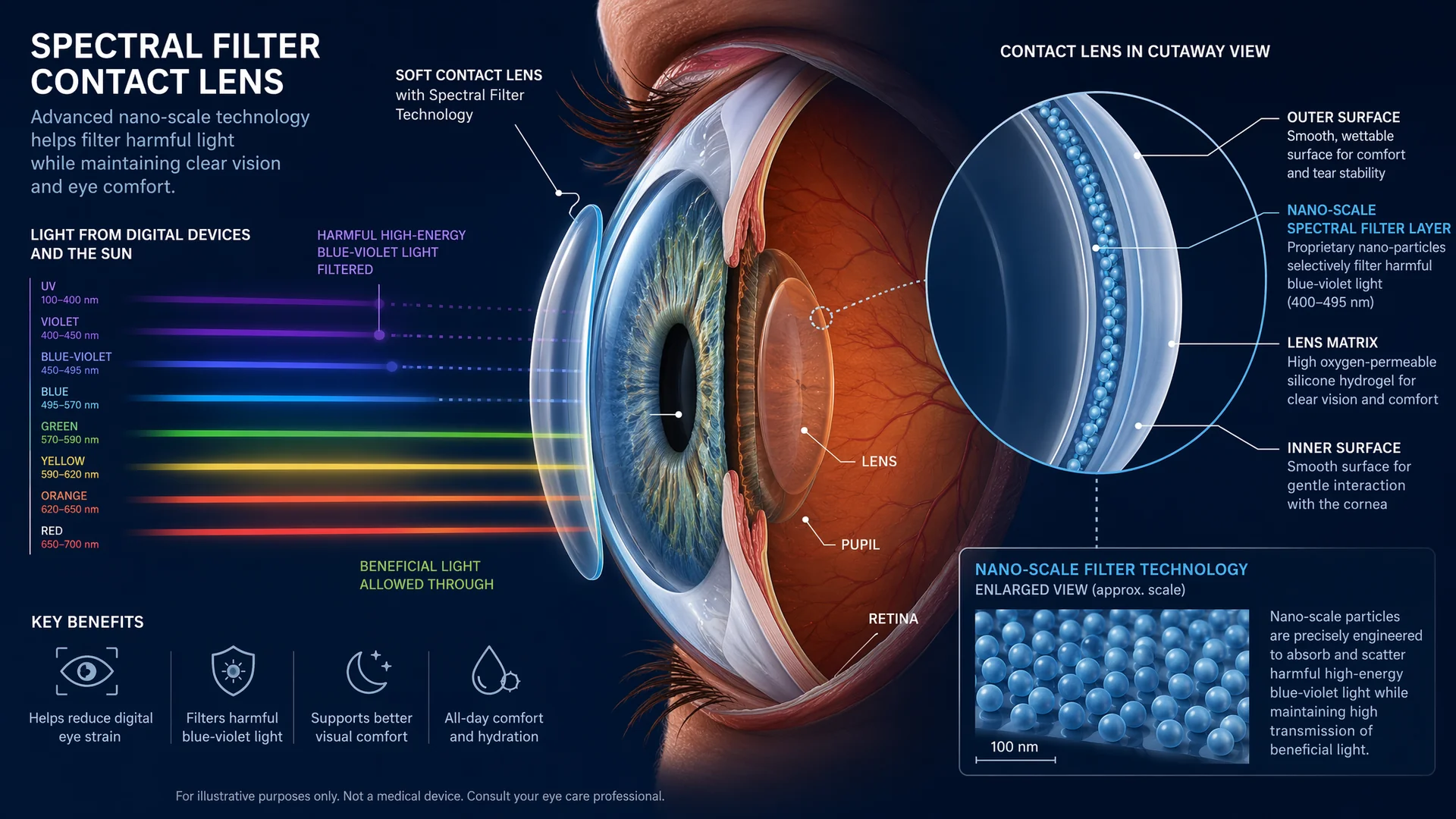
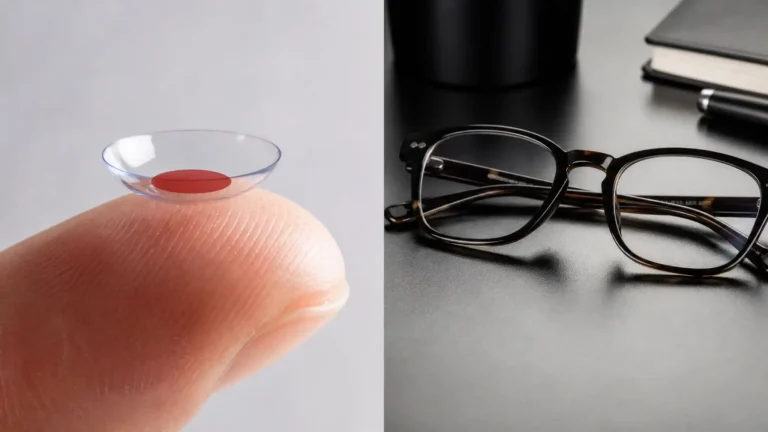
Contact lenses offer a fundamentally different treatment approach — delivering spectral filtering directly on the eye, making them discreet and compatible with any uniform or safety equipment.
This is where Colorkinds specializes, and it’s an important distinction: colorblind contact lenses are the only treatment option that is both discreet and effective for occupational test preparation.
How Contact Lens Treatment Works
Colorblind contact lenses embed a spectral notch filter directly into the soft hydrogel lens material. The filter targets the 590-700 nanometer wavelength range — the specific zone where red and green cone sensitivity overlaps for colorblind eyes. By selectively filtering this range, the lenses help the brain distinguish between red and green signals.
A 2026 study published in Eye (a Nature journal) validated this approach. Researchers found that color correcting lenses (CCLs) significantly improved cone-specific minimum detectable acuity (MDA) in people with hereditary CVD.
Notably, the study observed that extended wear produced improvements that persisted even without the lenses. This suggests possible neuro-adaptive changes from perceptual learning — the brain may learn to see color better over time.
Colorkinds Contacts
Colorkinds colorblind contacts are engineered for one purpose: helping you distinguish red from green and pass your color vision test. Order Colorkinds contacts directly online without an in-person appointment. Key specs:
| Feature | Detail |
|---|---|
| Technology | Spectral notch filter (590-700 nm) |
| Coverage | Protan and deutan (~99% of CVD cases) |
| Type | Yearly disposable, soft hydrogel (Polymacon) |
| Water content | 40% |
| Duration | 12+ hours daily wear |
| Price | ~$99 (includes case, guide, applicator) |
| Guarantee | 60-day money-back guarantee |
| Shipping | Free worldwide |
Best for: Professionals who need to pass occupational color vision tests, anyone who wants discreet correction.
Colormax
Colormax offers a ColorCorrection System with custom-engineered contact lenses based on in-person diagnostic testing. They claim a 100% Ishihara pass rate since 1999, but their process requires a single-day appointment in Baltimore, Maryland, and pricing is not disclosed without consultation.
Best for: Those who prefer an in-person fitting process and are located near Baltimore.
X-Chrom Lens
The X-Chrom is an older monocular lens technology — a red-tinted lens worn in one eye only. It creates a brightness differential between eyes that the brain interprets as color information. While it can help some people pass screening tests, it distorts depth perception and is less effective than modern spectral notch filter designs.
Best for: Historical reference; modern dual-lens designs are superior.
Comparison: Contacts vs. Glasses
| Factor | Colorblind Contacts | Colorblind Glasses |
|---|---|---|
| Discreet | Yes — no one can tell | No — visible frames |
| Night vision safe | Yes | No |
| Under safety gear | Yes — fits under any PPE | No |
| Test-day use | Prohibited at most exams | Prohibited at most exams |
| Daily wear | 12+ hours, comfortable | Limited by lighting |
| Cost per year | ~$99 | $189-$429+ |
| Off-duty training | Excellent | Excellent |
Treatment Option 3: Digital Aids & Software
For color issues that primarily affect screen-based work, digital solutions are the most accessible treatment option — many are completely free.
Built-in Accessibility Settings
Both major operating systems now include color correction features:
- iOS: Settings > Accessibility > Display & Text Size > Color Filters
- Android: Settings > Accessibility > Color Correction
- Windows: Settings > Ease of Access > Color Filters
These tools remap on-screen colors to ranges you can distinguish, making charts, graphs, and interfaces far more usable.
Smartphone Apps
Dedicated apps use your phone’s camera to identify and label colors in real time:
- Color Blind Pal (iOS/Android): Labels colors in photos and real-time camera view
- ColorAssist Lite: Text descriptions of detected colors
- Visolve: Adjusts screen color saturation for different types of CVD
Best for: Screen-based work, everyday color identification, students.
Treatment Option 4: Emerging Therapies & Research (2026)
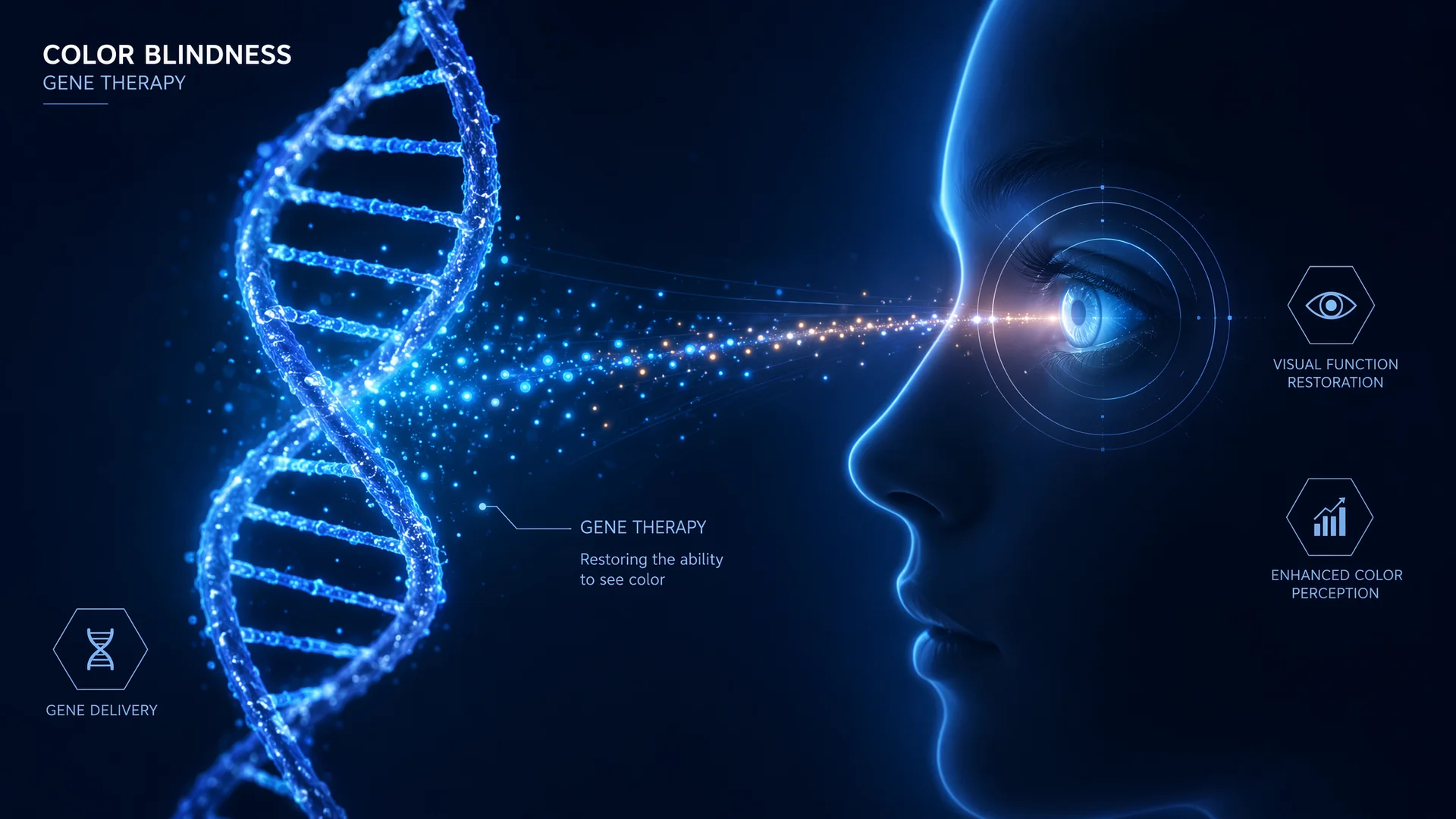
Several promising treatment approaches are under active research. While none are available for common red-green deficiency today, they represent the future of colorblind treatment.
Gene Therapy
Gene therapy works by delivering working copies of color vision genes into the retina. The approach has succeeded in animal models — squirrel monkeys with red-green deficiency gained color discrimination after a landmark 2009 study.
Human clinical trials are ongoing for achromatopsia (complete color blindness). But red-green gene therapy has not yet reached human trials.
Timeline: 5-10+ years for common forms of color blindness.
Nanoparticle Composite Lenses
A May 2026 study in Materials Letters demonstrated rhodamine-titanium dioxide nanoparticle composite lenses achieving 99.72% selective absorption at 550 nanometers — the green wavelength that causes the most confusion for red-green colorblind individuals. This research-grade technology could lead to more precise filtering in future contact lens designs.
Structural Biology Advances
A June 2026 cover article in Science resolved the high-resolution structures of human red, green, and blue cone opsins using cryo-electron microscopy. This provides a structural blueprint for designing targeted gene therapies and understanding how specific mutations affect color vision.
Pigmented Contact Lenses
Researchers are exploring natural pigments from turmeric, spinach, paprika, and woad for incorporation into contact lenses. Turmeric-loaded lenses blocked over 95% of UV light while retaining over 90% visible light transparency, with potential applications for color vision deficiency management.
How to Choose the Right Colorblind Treatment
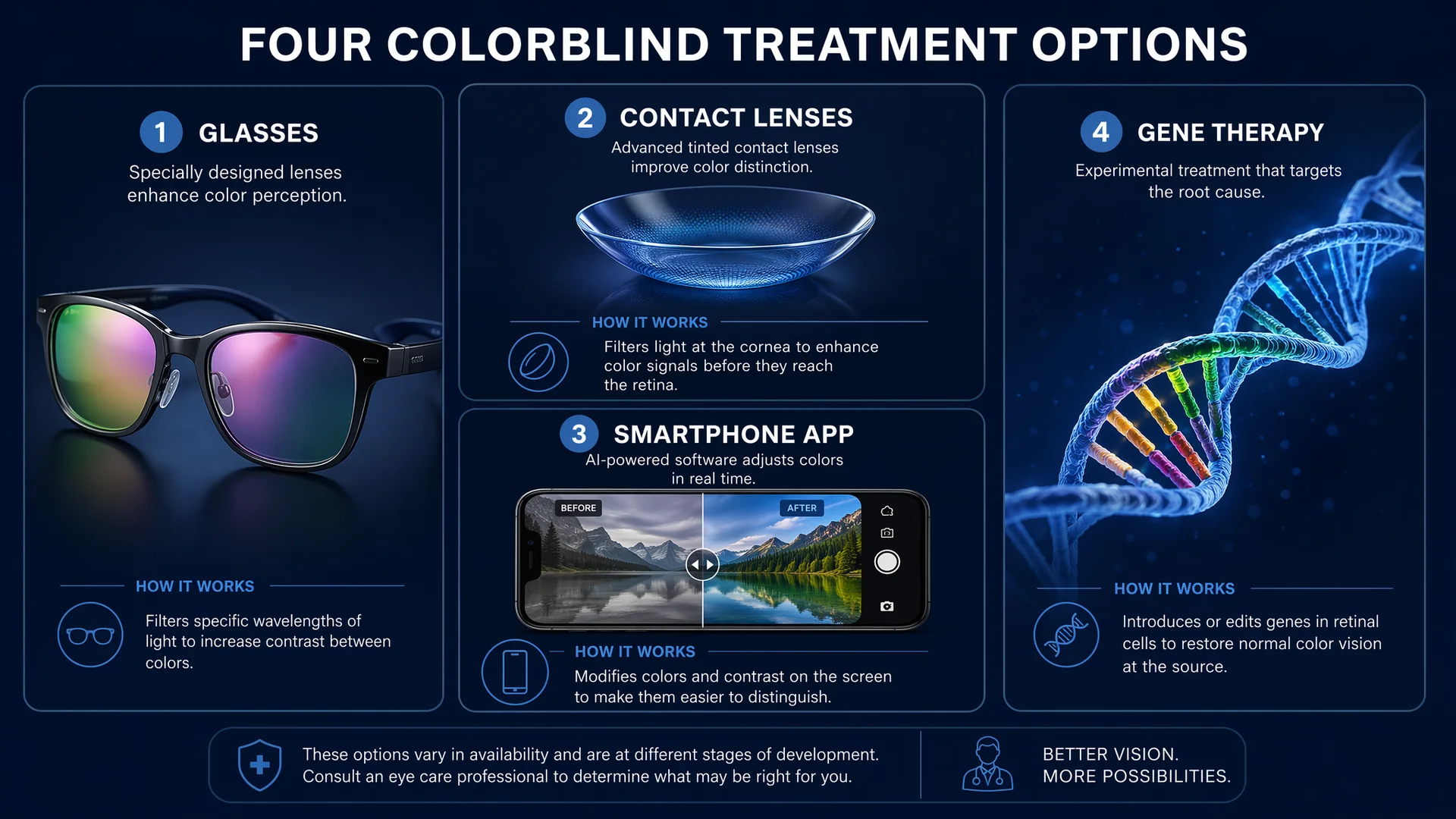
The best treatment depends on your specific needs. Here’s a decision framework:
You Need to Pass an Occupational Color Vision Test
If you’re facing a career-defining Ishihara test for a pilot medical, police academy, electrical license, or similar screening, colorblind contact lenses are your most effective option. They provide the spectral filtering needed to improve red-green discrimination in a discreet format you can wear during off-duty training to build familiarity with the test patterns.
Recommended: Spectral notch filter contact lenses (Colorkinds). Use them for practice and test preparation. Note that almost all agencies prohibit wearing corrective lenses during the actual exam — this is the standard across aviation, law enforcement, and most regulated industries.
You Want Better Everyday Color Perception
For lifestyle use — enjoying nature, watching sports, or simply experiencing colors more vividly — colorblind glasses can enhance your daily experience. EnChroma works best for outdoor use in bright light, while Pilestone offers more affordable options.
Recommended: EnChroma Cx3 Sun (outdoor) or Cx1 Indoor lenses for lifestyle use.
You Only Have Screen-Based Issues
If your main challenges involve reading charts, interpreting data visualizations, or using design software, digital accessibility tools are the simplest and most cost-effective solution.
Recommended: Built-in OS color filters (free) + a color ID app like Color Blind Pal.
You Have Severe Color Blindness or Achromatopsia
For complete color blindness, specialized low-vision aids and light-filtering lenses (often grey-tinted rather than red) can help manage light sensitivity and improve contrast. Gene therapy clinical trials are the most promising long-term option for achromatopsia.
Recommended: Consult a low-vision specialist. Monitor gene therapy trial progress.
Quick Comparison: Treatment Options at a Glance
| Treatment | Effectiveness | Cost | Availability | Best For |
|---|---|---|---|---|
| Contact lenses (spectral notch) | High for red-green | ~$99/year | Now | Test prep, daily discreet use |
| Glasses (EnChroma/Pilestone) | Moderate, varies by person | $139-$429 | Now | Outdoor lifestyle use |
| OS color filters | Good for screens | Free | Now | Screen-based work |
| Color ID apps | Practical aid | Free-$5 | Now | Everyday color identification |
| Gene therapy | Promising (future) | N/A | 5-10+ years | Potential cure |
| Nanoparticle lenses | Research phase | N/A | 3-5+ years | Future filter tech |
Related Guides
Explore more resources for understanding and managing color vision deficiency:
- Color Blind Contacts: Complete Guide (2026) – everything about how colorblind contacts work
- 590 nm Color Guide – the science behind spectral notch filter technology
- What Jobs Can’t You Do With Colour Blindness? – career restrictions overview
- Occupational Color Vision Test Database – searchable career standards
FAQ: Colorblind Treatment
No. Inherited color blindness has no permanent cure. However, treatment options including specialized glasses, contact lenses, and digital aids can help you distinguish colors more effectively. Gene therapy is the most promising future approach but remains in clinical trials.
Yes, spectral notch filter contact lenses have been shown to improve color discrimination in people with red-green color blindness. A 2026 study in the journal Eye found that color correcting lenses significantly improved cone-specific vision, with some benefits persisting even without the lenses after extended wear.
The best treatment depends on your needs. For passing occupational color vision tests, spectral notch filter contact lenses are the most effective option. For everyday lifestyle color enhancement, glasses like EnChroma work well outdoors. For screen-based issues, built-in OS accessibility settings are free and immediately available.
No. EnChroma glasses enhance color discrimination while worn, but they do not cure color blindness. They work best outdoors in bright natural light for mild to moderate red-green deficiency. Results vary significantly by individual, and they are not recommended for nighttime use.
Colorblind contacts can help you practice and prepare for the Ishihara test by improving your red-green discrimination during off-duty training. However, most agencies prohibit wearing corrective lenses during the official exam. Always check your specific agency’s policy before test day.
Gene therapy for common red-green color blindness has not yet reached human clinical trials. Clinical trials are ongoing for achromatopsia (complete color blindness) targeting CNGA3 and CNGB3 gene mutations. Realistic timeline for red-green gene therapy is 5-10+ years.
Costs vary widely. Colorblind glasses range from $139 (Pilestone) to $429+ (EnChroma). Spectral notch filter contact lenses cost approximately $99 per year from Colorkinds. Digital accessibility tools are free. Gene therapy pricing has not been determined.
Yes. Colorblind contacts made from Polymacon soft hydrogel material are FDA-registered and designed for daily wear up to 12 hours. They carry the same safety profile as standard soft contact lenses when proper hygiene practices are followed.
Spectral notch filter contact lenses work for both protan and deutan types — one solution covers approximately 99% of red-green color blindness cases. Some glasses brands offer different lens variants for different types (Pilestone has separate Lens A-E options), while others like EnChroma use a single lens design.
Surgery is not a treatment for inherited color blindness. In cases of acquired color blindness caused by cataracts, cataract surgery may improve color vision. Laser eye surgery (LASIK/PRK) does not affect color vision deficiency.