
Shipyard Color Vision Requirements for Marine Electricians & Engineers (2026)
You’re a marine electrician or engineer working in a shipyard. Every day you work with color-coded wiring, warning lights, and safety signage. And you have color blindness.
Here’s what you need to know: OSHA does not have a universal color vision testing requirement for shipyard employment. While some shipyard roles — particularly marine electricians — may face employer-specific color vision tests for wire identification, many positions have no formal color vision requirement at all, and the Americans with Disabilities Act (ADA) provides legal protections against discriminatory testing.
This guide covers shipyard color vision requirements for marine electricians and engineers, the OSHA regulatory framework, wire color identification standards, employer testing policies, and practical strategies for navigating color vision in shipyard careers.
Key Takeaways:
- OSHA does not require universal color vision testing for shipyard workers — requirements are employer-specific
- Marine electricians are the most likely to face color vision testing due to wire color identification requirements
- Marine engineers and non-electrical trades (welders, pipefitters, riggers) are rarely tested
- The ADA protects shipyard workers from discriminatory testing — employers must show testing is job-related
- NFPA 70E and shipboard wiring standards use consistent color codes (black = hot, white = neutral, green/green-yellow = ground)
- Colorkinds CCG-088 contacts enhance red-green discrimination for wire identification and equipment reading
Who Needs Color Vision Testing in a Shipyard?
Unlike the maritime STCW code (which governs seafarers at sea), shipyard workers fall under OSHA regulations — and OSHA does not have a blanket color vision requirement. This creates a patchwork of employer-specific policies.
Role-by-Role Breakdown
| Role | Color Vision Tested? | Why | Legal Protections |
|---|---|---|---|
| Marine electrician | Often — employer dependent | Wire color ID (red/black, green/gray) | ADA — must be job-related |
| Marine engineer | Rarely | Minimal color-critical tasks | ADA covers any testing |
| Shipyard welder | Almost never | No color-dependent safety tasks | No standard requirement |
| Pipefitter | Almost never | Work from markings, not color alone | Employer discretion |
| Rigger | Almost never | Lift calculations, not color-based | Employer discretion |
| Shipfitter | Rarely | Blueprint reading, not color-dependent | Employer discretion |
| Quality control inspector | Sometimes | May involve color-coded inspection markers | Varies by employer |

Why Marine Electricians Are Most Affected
Marine electricians face the greatest scrutiny because their work involves identifying wire colors by sight. In shipbuilding and repair, electricians must:
- Identify phase wires: Black, red, blue for 208V/480V systems
- Identify neutrals and grounds: White, gray, green, or green/yellow
- Read color-coded cable markings: Manufacturer markings on marine-grade cable
- Verify termination points: Color-coded terminal blocks and bus bars
- Inspect existing wiring: Identify circuits by color coding during troubleshooting
The concern is safety-related: misidentifying a hot wire as neutral, or mixing phases, can cause equipment damage, arc flash, or electrocution.
However, most experienced electricians develop strategies to work around color vision deficiency — using position, labeling, and testing tools — that make color vision tests a poor predictor of on-the-job performance.
OSHA Shipyard Standards vs. STCW Maritime Standards
One of the most confusing aspects of color vision in the shipyard industry is the difference between OSHA regulations and STCW maritime standards. If you work in a shipyard, you may encounter both.
Comparison: OSHA vs. STCW for Shipyard Workers
| Factor | OSHA (Shipyard) | STCW (Seafarer) |
|---|---|---|
| Universal requirement | No — employer-specific | Yes — for deck officers |
| Who is tested | Varies by employer, typically electricians | Deck officers, masters, watchkeepers |
| Testing frequency | Usually one-time (hiring) | Annual or biennial medicals |
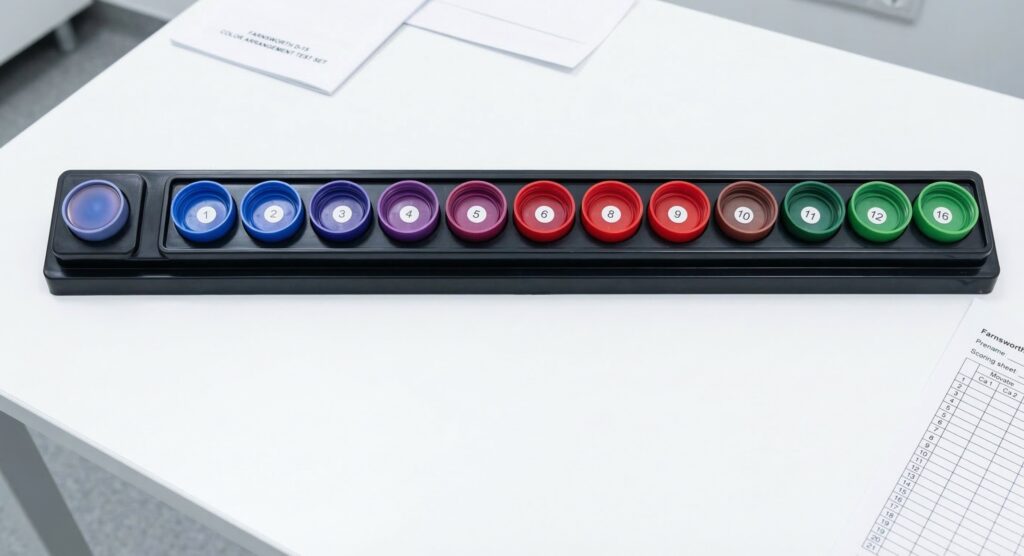
| Alternative tests | Rarely offered by employers | Widely available (D-15, CCVT, lantern) |
| Legal protections | ADA, state disability laws | Flag state policy |
| Marine engineers | Not typically tested | Exempt under STCW |
Key distinction: If you work aboard a vessel at sea, the STCW code applies. If you work in a shipyard (building or repairing ships), OSHA applies. Some workers who do both — riding vessels out for sea trials — may fall under both frameworks. In that case, the stricter standard typically applies for the testing period.
OSHA Shipyard Standards (29 CFR 1915)
OSHA’s shipyard employment standards (29 CFR 1915) cover safety requirements for shipyard workers but do not include a universal color vision testing requirement. The relevant standards focus on:
- 1915.13 — Eye and face protection (general PPE requirements)
- 1915.131 — Safety color code for marking physical hazards
- 1915 Subpart I — Personal protective equipment
None of these standards require employers to test color vision. However, some employers implement their own color vision screening as part of a pre-employment physical or job qualification test.
Wire Color Identification Standards
The wire color identification standards that marine electricians work with come from:
| Standard | What It Covers | Relevant Colors |
|---|---|---|
| NFPA 70E | Electrical safety in the workplace | Phase marking, voltage identification |
| ABYC | Marine electrical systems (small craft) | DC wiring, AC wiring, grounding |
| IEEE 45 | Recommended practice for marine electrical installations | Shipboard cable color coding |
| US Coast Guard | Commercial vessel electrical regulations | Vessel-specific requirements |
| Shipyard spec | Employer-specific wire color standards | Varies by shipyard and contract |
Related reading: Color Blindness in the Electrical Trade: Complete Guide — general electrician color vision standards and NFPA 70E requirements.
What Marine Electricians Actually Need to Identify
Here’s the practical reality: marine electricians in shipyards need to distinguish a specific set of wire colors. Understanding exactly which colors matter can help you assess whether color blindness is a genuine barrier.
Critical Wire Colors in Marine Electrical Work
| Wire Function | Standard Color | Alternative ID Methods |
|---|---|---|
| Hot / Phase A (AC) | Black | Test with multimeter, label with tape |
| Hot / Phase B (AC) | Red | Test with multimeter, trace to source |
| Hot / Phase C (AC) | Blue | Test with multimeter, continuity check |
| Neutral (AC) | White or gray | Brightness difference, multimeter |
| Ground (AC/DC) | Green or green/yellow | Always grounded, verify with tester |
| Positive (DC) | Red | Multimeter positive lead test |
| Negative (DC) | Black or yellow | Multimeter negative lead test |
| Shipboard cable marking | Varies by manufacturer | Read printed markings on cable jacket |
Strategies Colorblind Marine Electricians Use
Experienced colorblind marine electricians develop reliable workarounds:
- Test before trusting color — use a multimeter to confirm voltage, polarity, and continuity rather than relying on wire color
- Label everything — apply colored tape labels or write on wire markers with permanent marker
- Use a partner for verification — for critical connections, have a colleague verify your identification
- Memorize position conventions — in many shipboard systems, wire positions in cable trays follow consistent patterns
- Photograph with flash — smartphone cameras often reveal color differences that are hard to see with the naked eye
- Use a wire tracer — tone generators and probe kits identify wires without relying on color vision
Legal Protections for Colorblind Shipyard Workers
If you’re a colorblind marine electrician or engineer facing a color vision test from an employer, you have legal protections.
The Americans with Disabilities Act (ADA)
Color vision deficiency may qualify as a disability under the ADA if it substantially limits a major life activity (including seeing or working). This means:
- Employers cannot test for color vision unless the test is job-related and consistent with business necessity
- If a test screens out you (or a class of you), the employer must show the test is directly related to essential job functions
- Employers must provide reasonable accommodations unless doing so causes undue hardship
What This Means in Practice
| Scenario | ADA Protection | What to Do |
|---|---|---|
| Employer requires Ishihara test at hiring | You can request the test be job-related | Ask how the test relates to specific job duties |
| Employer refuses hire based on color vision test | You may have a discrimination claim | Document the test, the result, and the decision |
| Employer offers no alternative test | You can request a functional test instead | Propose a wire identification practical test |
| Employer says all electricians must pass | This may not be a valid defense | The employer must prove the requirement is essential |
| You need accommodation to perform the job | Reasonable accommodation required | Suggest labeling systems, partner verification, or test equipment |
How to Request an Accommodation
- Inform your employer about your color vision deficiency (if you choose to disclose)
- Request a specific accommodation — be specific about what would help (labeling, test equipment, partner verification)
- Provide documentation from your doctor or optometrist if requested
- Engage in the interactive process — the ADA requires both you and your employer to work together to find a reasonable solution
Related reading: Occupational Vision Solutions Hub — career-specific guidance across all industries, including electrical trades.
Colorkinds Contacts for Shipyard Professionals
Colorkinds CCG-088 contacts enhance red-green discrimination, making it easier to distinguish the wire colors and equipment indicators that matter most in shipyard work.

Benefits for Marine Electricians and Engineers
| Application | How Colorkinds Helps | Why It Matters |
|---|---|---|
| Wire identification | Enhances red-green-brown-black distinction | Safer terminations, fewer errors |
| Equipment indicators | Clearer reading of colored LEDs and status lights | Faster troubleshooting and monitoring |
| Safety signage | Better identification of warning labels and tags | Improved workplace safety |
| Schematic reading | Improved contrast on color-coded diagrams | Easier circuit tracing and verification |
Designed for Shipyard Environments
- Fits under PPE — works under safety glasses, hard hats, welding hoods, and face shields without interference
- No fogging — unlike glasses, contacts never fog in humid shipyard conditions or when transitioning between climate-controlled shops and exterior work areas
- All-day comfort — daily wear design suitable for 12-hour shifts
- UV400 protection — blocks harmful UV radiation during outdoor work on dry docks and piers
- Discreet — no one needs to know you’re wearing color correction
Important: Colorkinds contacts are designed for off-duty training and daily awareness, not for use as an accommodation during employer-administered color vision tests.
Step-by-Step: Navigating Shipyard Color Vision Requirements
Whether you’re applying for a shipyard job or already working in one, here’s your action plan:
Step 1: Know Your Role
Determine whether your specific role is likely to face color vision testing. Marine electricians face the highest scrutiny. Marine engineers, welders, pipefitters, and riggers are rarely tested.
Step 2: Know Your Rights
If your employer requires a color vision test, you have the right to:
- Ask how the test relates to your specific job duties
- Request a functional (practical) test instead of a screening test
- Request reasonable accommodation if needed
- Be free from discriminatory hiring practices under the ADA
Step 3: Prepare for Testing
If you choose to take a pre-employment test:
- Visit an optometrist beforehand to understand your type and severity of color vision deficiency
- Practice identifying wire colors in good lighting conditions
- Learn which color pairs are most challenging for your specific type (protan vs. deutan)
Step 4: Train with Colorkinds Contacts
Wearing Colorkinds CCG-088 contacts before your test helps you:
- Build confidence in distinguishing red-green wire colors
- Practice identifying equipment indicators and safety signage
- Develop visual recognition habits that serve you on the job
Step 5: Document Everything
If you encounter discrimination or need to request accommodations:
- Keep records of any test results
- Document conversations with employers about color vision requirements
- Save job descriptions and qualification requirements
- Note any accommodations requested and the employer’s response
FAQ: Shipyard Color Vision Requirements
Yes, many marine electricians with color blindness work successfully in shipyards. OSHA does not require color vision testing for electricians. Employer-specific tests may be challenged under the ADA if they are not directly job-related.
No. OSHA’s shipyard employment standards (29 CFR 1915) do not include a universal color vision testing requirement. Any color vision testing is at the employer’s discretion and must be job-related.
The critical colors are black (hot/phase), red (hot/phase B or DC positive), white or gray (neutral), and green or green/yellow (ground). Marine electricians with color blindness use multimeters, labeling, and partner verification as reliable workarounds.
Yes. Shipyard workers fall under OSHA, which has no universal color vision requirement. Seafarers at sea fall under the STCW code, which requires testing for deck officers. Marine engineers are typically exempt under both frameworks.
Yes. Colorkinds CCG-088 contacts enhance red-green discrimination, which helps with wire color identification and reading equipment indicators. They are designed for off-duty training and daily awareness on the job.
Inform your employer of your color vision deficiency, request a specific accommodation (labeling, test equipment, or partner verification), and provide documentation if requested. Employers must engage in the interactive process to find a reasonable solution.
If color vision is not essential to the job duties, refusing to hire based on a color vision test may violate the ADA. The employer must show the test is directly related to essential job functions and that no reasonable accommodation would allow you to perform them.
They use multimeters to confirm voltage and continuity, label wires with tape or markers, use tone generators and probe kits, photograph connections with smartphone flash (which reveals color differences), and work with a partner for verification on critical connections.
Similar posts:
- Color Blindness in the Electrical Trade: Complete Guide for Electricians — general electrician OSHA and NFPA 70E standards
- STCW Color Vision Requirements: Complete Guide for Seafarers — maritime STCW regulatory framework
- Colorblind Solutions for Electricians — product page for electrical trade professionals
- Occupational Vision Solutions Hub — career-specific guidance across all industries
- Can Firefighters Be Color Blind? NFPA Standards Guide — related safety career guide