
STCW Color Vision Requirements (2026): Complete Guide for Seafarers & Shipyard Workers
You want to work at sea, as a deck officer, engineer, or crew member. But you have color blindness, and you’ve heard the maritime industry has strict rules about color vision.
Here’s the direct answer: Color blindness does not automatically disqualify you from working at sea or in a shipyard. The STCW (Standards of Training, Certification, and Watchkeeping) code requires color vision testing for specific roles, mainly deck officers and navigation watchkeepers, but not all maritime jobs require it, and alternative testing pathways exist for those who do.
This guide covers STCW color vision requirements for both seafarers and shipyard workers, which roles are affected, what tests you’ll face, alternative testing options by flag state, and practical strategies to navigate the certification process.
Key Takeaways:
- STCW requires color vision testing for deck officers (OOW), masters, and deck ratings standing watch, but not for engineer officers, engine ratings, or catering staff
- Shipyard workers face different standards under OSHA rather than STCW, color vision requirements vary by role and employer
- Alternative tests (Farnsworth D-15, Waggoner CCVT, lantern tests) are accepted by most flag states if you fail the initial Ishihara screening
- Navigation lights follow a universal position system (port = left, starboard = right), making them identifiable without relying on color alone
- Prior sea service can serve as evidence of safe color navigation in some jurisdictions when upgrading certificates
- Colorkinds CCG-088 contacts enhance red-green discrimination for navigation lights and color-coded charts, with no fogging in humidity, ideal for life at sea
STCW Color Vision Requirements: What the Code Actually Says
The International Maritime Organization’s Standards of Training, Certification, and Watchkeeping (STCW) code establishes the global benchmark for seafarer certification. Regulation I/9 and Section A-I/9 of the STCW code mandate that seafarers must meet specific medical standards, including color vision, to hold certain certificates. (See the official IMO STCW text for the complete regulatory framework.)
But here’s what most resources get wrong: the STCW code does not require color vision testing for all seafarers. It only requires it for those whose duties involve color discrimination, primarily navigation watchkeeping.
Which Maritime Roles Require Color Vision Testing
The STCW code draws a clear line between roles that involve navigation watchkeeping and those that don’t. Here’s how it breaks down:
| Role | Color Vision Required | Testing Standard | Notes |
|---|---|---|---|
| Deck officer (OOW) | Yes, must identify navigation lights | Ishihara, D-15, or lantern test | Required for certificate of competency |
| Master / Captain | Yes, same standard as deck officer | Comprehensive testing required | All flag states require this |
| Chief mate | Yes, serves as deck officer | Same as OOW | Required for STCW endorsement |
| Engineer officer | Not typically required | No standard test | Varies by flag state, rarely tested |
| Deck rating (watchkeeper) | Yes if standing navigation watch | Varies by flag state | Required for AB watchkeeping endorsement |
| Engine rating | No | No requirement | Color vision not tested |
| Electrician | Varies by employer | Employer-specific | Shipyard electricians face OSHA standards |
| Catering staff | No | No requirement | Not tested under STCW |
The critical distinction: if you’re not standing navigation watch, STCW color vision requirements likely don’t apply to you. Engineering officers and engine ratings make up a significant portion of the maritime workforce, and color vision testing is simply not part of their certification process.
Why the STCW Code Tests Color Vision
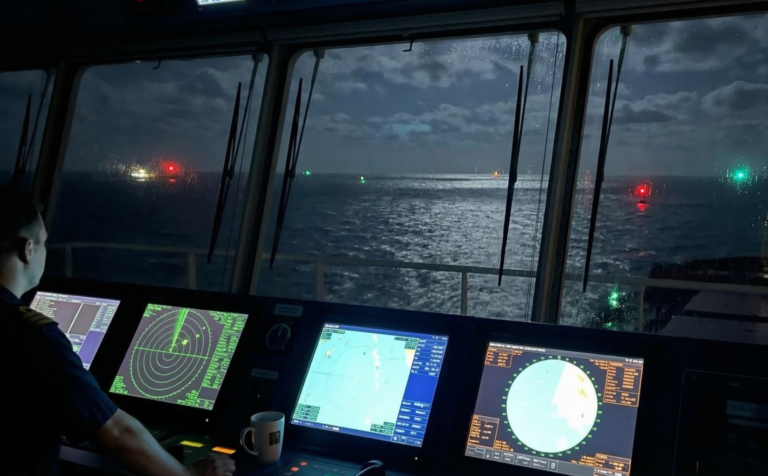
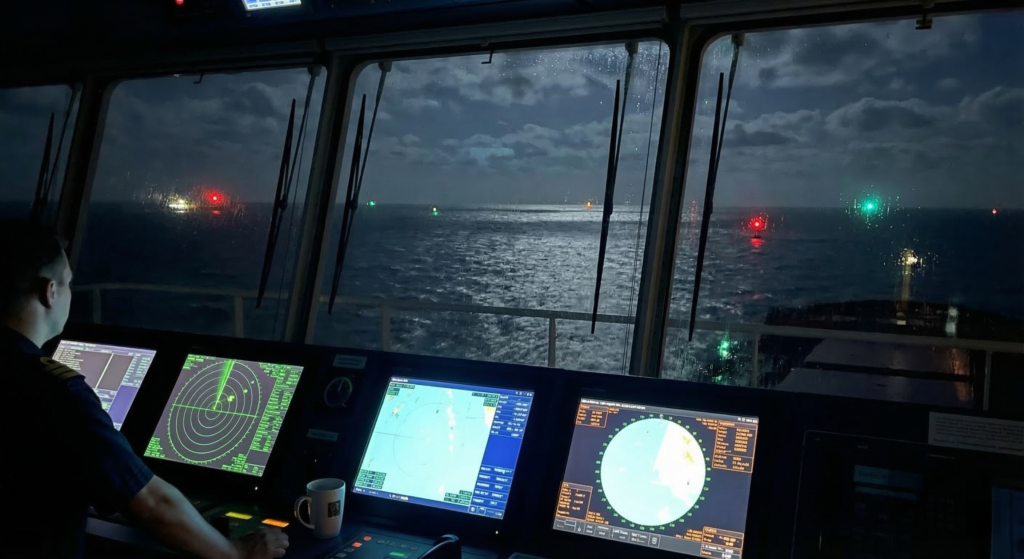
Navigation at sea depends on rapid, accurate identification of colored lights. When you’re on the bridge at 0200 in heavy weather, you need to know instantly what that light on the horizon means:
- Red light, port side of a vessel (always on the left)
- Green light, starboard side of a vessel (always on the right)
- White masthead light, power-driven vessel (highest point, brightest)
- White stern light, vessel viewed from behind
- Yellow towing light, vessel towing another vessel
The STCW code tests color vision because a watchkeeping officer who misidentifies a navigation light can cause a collision. But the code also recognizes something important: color is just one way to identify these lights. Position, brightness, and pattern are equally reliable cues.
Seafarers vs. Shipyard Workers: Two Different Standards
One of the most confusing aspects of maritime color vision requirements is that seafarers and shipyard workers operate under completely different regulatory frameworks. Understanding this distinction can save you a lot of confusion.
Seafarers: Governed by STCW Code
Seafarers, anyone who works aboard a vessel at sea, fall under the STCW code and flag state regulations. Their color vision testing is tied to the certificate of competency they hold. A deck officer who holds an STCW endorsement must meet the color vision standard every time they renew their medical certificate (typically every 1-2 years depending on age and flag state). For a complete overview of all career paths, visit our career navigation hub.
Key points for seafarers:
- Color vision is tested as part of the STCW medical examination
- Testing frequency depends on flag state policy (annual or biennial)
- Alternative testing is available in most jurisdictions
- Engineer officers and engine ratings are typically exempt
- Prior sea service can support waiver applications
Shipyard Workers: Governed by OSHA and Employer Policy
Shipyard workers, marine electricians, welders, pipefitters, riggers, and other tradespeople working in ship repair and construction, fall under OSHA (Occupational Safety and Health Administration) standards for shipyard employment in the United States, or equivalent workplace safety regulations in other countries.
Key points for shipyard workers:
- OSHA does not have a universal color vision requirement for shipyard employment
- Color vision requirements are employer-specific and role-dependent
- Marine electricians may face color vision tests for wire identification
- Welding and fabrication roles rarely require color vision testing
- The Americans with Disabilities Act (ADA) provides protections against discriminatory testing
Comparison: Seafarer vs. Shipyard Worker Color Vision Standards
| Factor | Seafarer (STCW) | Shipyard Worker (OSHA) |
|---|---|---|
| Regulatory body | IMO (STCW) + Flag state | OSHA (or national equivalent) |
| Universal requirement | Yes, for deck roles | No, employer-specific |
| Testing frequency | Annual or biennial | Usually one-time (hiring) |
| Alternative tests | Widely available | Depends on employer |
| Legal protections | Flag state policy | ADA (US) or local disability law |
| Engineering roles | Typically exempt | Rarely tested |
| Waiver options | Possible with sea service | Varies by employer |
The bottom line: If you’re a shipyard worker with color blindness, you have more flexibility than a seafarer, but less regulatory clarity. Your path forward depends on discussing accommodations directly with your employer, rather than navigating a standardized international code.
Navigation Lights: How Colorblind Mariners Identify Them Safely
Here’s a fact that surprises many aspiring mariners: navigation lights follow a universal position system that makes them identifiable without relying on color alone. This is the single most important skill for a colorblind watchkeeper to master.
The Position System
Every navigation light has a fixed, unchangeable position on a vessel:
| Light | Color | Position | Identification Strategy |
|---|---|---|---|
| Port | Red | Left side | Position, always on the left |
| Starboard | Green | Right side | Position, always on the right |
| Masthead | White | Highest point | Brightness, brightest light on vessel |
| Stern | White | Rear of vessel | Position, always aft |
| Towing | Yellow | Above stern | Context, only on towing vessels |
| All-round | Red or green | Mast (anchor lights) | Context, vessel at anchor or underway |
Three-Step Identification Method
Experienced colorblind mariners use this approach:
- Position first, before trying to identify color, note where the light is located. Port = left side. Starboard = right side. This alone identifies the light in the majority of situations.
- Brightness and pattern, white masthead lights are the brightest lights on a vessel. The combination of lights (not just individual colors) tells you the vessel’s type, size, and activity.
- Confirm with technology, modern ships carry radar, AIS (Automatic Identification System), and electronic chart displays that provide vessel identification information independent of light color. Use these systems to confirm what your eyes are seeing.
“I’ve been a deck officer for 12 years with protanopia. I identify navigation lights by position and confirm with AIS. In a decade at sea, I’ve never had a lighting-related incident.”, Anonymous mariner, r/ColorBlind
Training Your Brain
The brain is remarkably adaptable. With practice, colorblind mariners develop the ability to distinguish navigation lights through context clues even when the colors appear similar:
- Practice in good conditions first, train during clear weather when you have multiple identification cues
- Use shore-based training, study navigation light configurations on the water from a safe position
- Build the habit early, every time you see a vessel, practice identifying its lights by position before checking color
Alternative Color Vision Testing for Mariners
If you’re pursuing a deck officer role and fail the initial Ishihara screening, you are not automatically disqualified. The STCW code and most flag states recognize several alternative tests.
Tests Accepted for Maritime Certification
| Test | How It Works | Why It Helps | Flag State Acceptance |
|---|---|---|---|
| Farnsworth D-15 | Arrange 15 colored caps by hue order | Many who fail Ishihara pass D-15 easily | Widely accepted (UK, Canada, Australia, US) |
| Waggoner CCVT | Computer-adaptive digital color vision test | Digital format reduces false positives | Growing acceptance globally |
| Lantern test | Identify colored signal lights directly | Most realistic test for maritime duties | Accepted in UK, Australia, Singapore |
| Farnsworth Lantern (FALANT) | Match colored light pairs | Original military maritime standard | USCG, US Navy |
| Practical assessment | Demonstrate safe navigation light ID | Accepted for experienced mariners | Limited flag states |
What to Do If You Fail the Initial Test
- Request the Farnsworth D-15 immediately, many medical examiners can administer this during the same appointment. The D-15 uses 15 colored caps arranged by hue, and most people with mild-to-moderate color blindness pass it without difficulty.
- Ask about the Waggoner CCVT, this computer-adaptive test adjusts difficulty based on your responses and often produces more accurate results for mild deficiencies.
- Inquire about flag state policies, some flag states accept lantern tests or practical assessments that your initial examiner may not offer by default. Don’t accept “you failed” as the final word.
- Document everything, keep records of all test attempts, results, and correspondence with the administering authority. If you need to appeal or request a waiver, documentation is your strongest asset.
- Consider a second opinion, if your initial examiner only offers the Ishihara, you may need to find a medical professional who can administer the full range of approved tests.
The Farnsworth D-15: Your Best Alternative
The Farnsworth D-15 color vision test is the most widely accepted alternative test in the maritime industry. Unlike the Ishihara plates, which test color recognition against complex backgrounds, the D-15 evaluates your ability to perceive subtle differences in hue, a skill more relevant to real-world navigation.
What passing looks like: Arrange the 15 caps in the correct hue sequence with zero or only one “major crossing” (a reversal in the sequence that shows confusion between specific color pairs).
Why it helps colorblind mariners: The D-15 classifies color vision deficiency type (protan, deutan, tritan) rather than simply giving a pass/fail result. Many who fail the Ishihara pass the D-15 comfortably because it measures hue discrimination rather than color naming.
Related reading: Farnsworth D-15 test: Complete clinical guide, detailed scoring, interpretation, and preparation tips.
Flag State Policies: How Your Country Affects Your Options
Your color vision testing options depend significantly on which flag state issues your maritime credentials. Different countries have different policies, and understanding this can open doors.
Major Flag State Approaches to Color Vision Testing
| Flag State | Primary Test | Alternative Tests | Sea Service Consideration |
|---|---|---|---|
| United Kingdom (MCA) | Ishihara | Farnsworth D-15, lantern test, CCVT | Yes, experience considered |
| United States (USCG) | Ishihara | D-15, FALANT, OPTEC 900 | Limited, case-by-case |
| Canada | Ishihara | D-15, CCVT, lantern test | Yes, prior service accepted |
| Australia (AMSA) | Ishihara | D-15, CCVT, practical assessment | Yes, strong consideration |
| Panama | Ishihara | Limited alternatives | No |
| Liberia | Ishihara | D-15 (varies by medical officer) | Limited |
| Singapore | Ishihara | Lantern test, CCVT | Yes |
| Netherlands | Ishihara | D-15, anomaloscope | Yes |
| Norway | Ishihara | D-15, CCVT | Yes |
Strategic Advice by Flag State
If you’re starting your maritime career:
- Choose a flag state with flexible policies, the UK, Canada, Australia, and Singapore offer the most testing options
- Get tested early, knowing your testing options before you commit to a career path saves time and money
- Consider the flag state’s treatment of alternative tests when choosing which maritime authority to certify under
If you’re an experienced mariner upgrading your certificate:
- Document your sea service, several flag states accept prior service as evidence of safe color navigation
- Apply for certificates early, some states grandfather existing certificate holders under older, less restrictive standards
- Request a practical assessment, if you’ve served safely for years, ask whether a practical demonstration can substitute for a color plate test
Prior Sea Service as Evidence
This deserves emphasis: several flag states recognize that an experienced mariner who has served safely at sea for years has already demonstrated their ability to identify navigation lights, regardless of what a color plate test says.
The UK Maritime and Coastguard Agency (MCA), Transport Canada, and the Australian Maritime Safety Authority (AMSA) all have provisions for considering prior sea service when evaluating color vision for certificate upgrades. If you already hold sea service and are pursuing a higher certificate, ask your administering authority whether prior service can substitute for a color vision test or support a waiver application.
Colorkinds Contacts for Maritime Professionals
Colorkinds CCG-088 colorblind contacts are designed to enhance red-green discrimination, exactly what’s needed for identifying navigation lights and reading color-coded maritime charts.
How They Help at Sea
| Application | How Colorkinds Helps | Why It Matters |
|---|---|---|
| Navigation lights | Enhances red-green distinction | Port (red) vs. starboard (green) become more distinguishable |
| Color-coded charts | Improves contrast on depth markings, buoy symbols | Safer route planning and position fixing |
| Bridge equipment | Clearer reading of colored displays and indicators | Faster reaction to changing conditions |
| Safety signage | Better identification of color-coded safety equipment | Improved emergency response |
Designed for the Marine Environment
The maritime environment presents unique challenges for any visual aid. Colorkinds CCG-088 contacts address these specifically:
- No fogging in humidity, unlike glasses, contacts never fog in tropical conditions, bridge environments, or when transitioning between air-conditioned spaces and exterior decks
- Fits under all gear, works under binoculars, safety glasses, foul weather hoods, and PPE without interference
- Discreet, no one needs to know you’re wearing color correction; no questions from crew or examiners
- Comfortable for long watches, daily wear design suitable for 12-hour shifts, comfortable in both air-conditioned and humid conditions
- UV400 protection, blocks harmful UV radiation, important for extended time on deck
Important: Exam Room Policy
Colorkinds contacts are designed for off-duty training and daily awareness, not for wear during official STCW medical examinations. Most maritime medical exams require you to take the test without any color-correcting aids. However, wearing them in the weeks before your exam helps you train your brain to recognize color differences, building the visual recognition skills that serve you on the bridge.
Related reading: Colorblind solutions for maritime professionals, product information and career-specific guidance for mariners.
Step-by-Step: Preparing for Your STCW Color Vision Test
Whether you’re a new cadet or an experienced mariner upgrading your certificate, here’s your action plan:
Step 1: Know Your Role
Determine whether your target role requires color vision testing. If you’re pursuing engineering or catering, you likely have no requirement to worry about. If you’re going for deck officer, master, or watchkeeping deck rating, you need to prepare.
Step 2: Identify Your Flag State’s Policy
Research which alternative tests your flag state accepts. The UK MCA, Transport Canada, and AMSA are among the most flexible. If you have a choice of flag state, factor this into your decision.
Step 3: Take a Baseline Test
Visit an optometrist who can administer the full range of color vision tests, not just the Ishihara. Knowing your baseline performance on the D-15, Waggoner CCVT, and lantern tests helps you prepare and understand your options.
Step 4: Train With Colorkinds Contacts
Wearing Colorkinds CCG-088 contacts in the weeks before your exam helps you:
- Build visual recognition habits for navigation light identification
- Practice distinguishing red-green signals in real-world conditions
- Develop confidence in your ability to identify colors correctly
Step 5: Present Your Case
If you need to request an alternative test or waiver:
- Bring documentation of your baseline test results
- Reference your flag state’s alternative testing policies
- If applicable, present your sea service records as evidence of safe navigation
FAQ: STCW Color Vision Requirements
Yes, depending on the role. Engineering and catering roles typically have no color vision requirements. Deck officers and navigation watchkeepers face restrictions but may qualify through alternative testing routes.
The STCW code requires color vision testing for deck officers using approved tests such as the Ishihara, Farnsworth D-15, or specialized lantern tests. The specific test depends on the flag state and the administering medical authority.
Failing the initial Ishihara screening does not disqualify you. You can request alternative tests (Farnsworth D-15, Waggoner CCVT, lantern test). If you pass an alternative test, most flag states accept the result as meeting STCW requirements.
OSHA does not require universal color vision testing for shipyard workers. Requirements depend on the employer and specific role. Marine electricians may face testing for wire identification, but most shipyard trades are not tested.
Yes, they operate under completely different regulatory frameworks. Seafarers fall under the STCW code and flag state regulations, which require testing for navigation roles. Shipyard workers fall under OSHA (or equivalent), which does not have a universal color vision requirement.
Colorkinds CCG-088 contacts are designed for off-duty training and daily awareness, not for wear during official medical exams. Wearing them before your test helps build color recognition skills that make you more confident on the bridge and during your exam.
It depends on the flag state. Some countries allow alternative testing pathways for master mariners. Others require standard color vision. If you have prior sea service and are upgrading your certificate, some authorities consider experience as evidence of safe color navigation.
Most flag states require color vision testing as part of the STCW medical certificate renewal, which is typically every 1-2 years depending on your age and the flag state’s requirements. Mariners under 40 may have biennial renewals; those over 40 often require annual medicals.
Yes, the USCG accepts the Farnsworth D-15 and FALANT as alternative tests for most maritime credentials. However, specific policies vary by certificate type. Check the USCG National Maritime Center for current guidance.
Similar posts:
- Colorblind Contacts for Maritime Professionals: STCW Guide, product-focused guide for mariners
- Colorblind Solutions for Maritime, career landing page with product information
- Occupational Vision Solutions Hub, career-specific guidance across all industries
- Farnsworth D-15 Color Vision Test: Complete Guide, detailed D-15 test preparation
- Can Firefighters Be Color Blind? NFPA Standards Guide, related career guide for emergency services
- Colorblind Electrician Guide: OSHA & Workplace Standards, related trades-focused career guide