
Can Color Blind People Drive Safely on the Roads?
Yes, colorblind people can drive, and in most countries there is no legal restriction on a standard car licence. Color vision deficiency affects roughly 1 in 12 men and 1 in 200 women, and almost all of them hold ordinary driving licences. What changes is not whether you may drive, but which jobs you can drive for, and how you read a signal at a glance.
The rules really answer two different questions. Can you hold a private car licence? Almost always yes. Can you hold a commercial licence, fly, or work in a safety-critical role? That is where color vision standards start to matter.
The short version:
- Color blindness is not a bar to a standard driving licence in the US, UK, Australia, Canada or the EU
- In the UK, color blindness is explicitly excluded from the conditions you must report to the DVLA
- US commercial drivers must be able to recognize red, green and amber signals under 49 CFR 391.41
- Protan color blindness makes red lights look dimmer, which matters most in bright sun and at dusk
- The crash-risk evidence is weaker and more mixed than most articles claim
What color blindness actually does behind the wheel
Color vision deficiency is not one condition. It is a family of them, and only some affect how you read a road. The difference that matters is whether your red cones are weak (protan) or your green cones are (deutan).
| Type | How red and green appear | What it means on the road |
|---|---|---|
| Deuteranomaly | Muddier, closer together; the most common form | Red lights can look less saturated but stay clearly the brighter of the pair |
| Deuteranopia | Red and green both read as similar yellow-brown | Position and brightness do the work; color gives little away |
| Protanomaly | Red looks darker, closer to brown | Red signals and brake lights appear dimmer than for other drivers |
| Protanopia | Red reads as near-black | The most safety-relevant type: dim red lights in sun or dusk |
| Tritanopia | Blue and green are confused | Rare; affects some displays and signs, rarely signal logic |
| Monochromacy | No color, only brightness | Entirely positional and brightness-based; very rare |
About 99% of color vision deficiency is red-green, which is why almost all driving rules are written around red, amber and green signals. Blue-yellow deficiency is rare and does not map onto the signal problem at all.

Are colorblind people allowed to drive? Country by country
No country bans colorblind drivers outright. What varies is whether the licensing authority tests color discrimination, and how strict that test is.
| Country | Standard car licence | Color vision tested? | Notes |
|---|---|---|---|
| United States | Yes | Rarely, and set by each state | No federal requirement for a private licence |
| United Kingdom | Yes | No | Not a reportable condition for DVLA |
| European Union | Yes | Set by member state | The directive harmonises acuity and field of view, not color |
| Australia | Yes | No blanket test | Rules set by state and territory |
| Canada | Yes | No blanket test | Rules set by province |
| South Korea | Yes, if you can name red, green and yellow | Yes | A functional test, not an outright ban |

The UK: nothing to declare
The DVLA position is the clearest of any major licensing body. GOV.UK’s driving eyesight rules tell drivers they must report any eyesight problem affecting both eyes, then exclude color blindness from that duty by name: the reporting requirement "does not include being short or long sighted or colour blind."
There is no color vision test for a Group 1 car or motorcycle licence. Group 2 licences for lorries and buses carry stricter eyesight rules, but color blindness alone is still not the disqualifying factor unless it prevents you from recognizing the signal colors.
The US: states first, then the commercial standard
For a private licence there is no federal color vision rule. Each state sets its own visual standards, and most do not test color vision for a standard Class D licence. Where a state does test, it is usually checking that you can identify signal colors, not that you have normal color vision.
Commercial driving is different. 49 CFR 391.41 requires a commercial driver to have "the ability to recognize the colors of traffic signals and devices showing standard red, green, and amber." A mild deficiency usually clears that bar. A driver who cannot separate red from green does not, and there is no color-vision waiver equivalent to the acuity exemption.
Why "some countries ban colorblind drivers" is mostly wrong
Most of the confusion comes from countries that test color discrimination rather than ban deficiency. South Korea is the usual example. Its Road Traffic Act enforcement decree requires applicants to be able to distinguish red, green and yellow. That is a functional standard: a colorblind applicant who can still tell those three apart passes. The blanket exclusion of colorblind applicants was removed from Korean law decades ago.
The same pattern repeats elsewhere. A rule that says "must recognize signal colors" reads like a ban in a headline, but it is usually a test most colorblind drivers pass.

How licensing actually tests color vision
Where a test exists, it is rarely a full clinical assessment. Licensing bodies use short screening instruments, and they care about one question: can you separate the three signal colors in realistic conditions?
| Test | What it measures | Where you meet it |
|---|---|---|
| Ishihara plates | Red-green discrimination under controlled light | Pre-employment, military, aviation, some US states |
| Holmes-Wright lantern | Recognition of actual signal light colors at distance | Rail, maritime, some licensing appeals |
| Farnsworth D-15 | Severity and axis of the deficiency | Occupational screening, second-line assessment |
| CAD and Rabin CCT | Threshold contrast sensitivity per cone type | Military, research, appeals against a failed plate test |
The Ishihara test is the one people worry about, and it is the least relevant to ordinary driving. It was designed to detect deficiency, not to predict driving ability, and it fails people who drive safely every day. If you have failed one and need to understand the result, our Ishihara test guide covers how the scoring works and what the alternatives are.

Does color blindness increase crash risk?
This is where most articles overstate the case in both directions. The honest answer is that the evidence is mixed, and the largest studies disagree.
A 2021 systematic review and meta-analysis in Lancet Global Health pooled data from low- and middle-income countries and found a 36% higher crash risk among drivers with color vision defects, comparable to the risk from visual field defects. A 2025 meta-analysis in Safety looked at the same question across cross-sectional studies and found an association that did not reach statistical significance, with the authors rating the underlying evidence as low quality.
Both can be true. The studies are observational, they cover different road conditions and vehicle mixes, and almost none of them isolate color vision from the other things that vary with it.
What the research does agree on is that protan deficiency carries more risk than deutan. A protan driver’s red cones respond weakly, so a red signal looks dimmer and can be lost against a bright background. That is a real effect on a low sun or a hazy afternoon, and it is why some standards still treat protan and deutan differently.
What does not follow is that colorblind drivers are dangerous. The behavioral causes of crashes, distraction and speed, dominate the data by a wide margin.

How colorblind drivers read the road
Traffic lights without color
Signal position is standardized almost everywhere, and it is reliable. On a vertical signal red is at the top and green at the bottom. On a horizontal signal red is on the left. The amber light sits between them, and the sequence red, amber, green always runs in the same order.
That consistency is doing more work than most drivers realize. The case for colorblind-friendly traffic signals explains why a standard layout matters more than a brighter bulb.
Brightness is the second cue. Red is the top light and, for a driver with normal color vision, the most saturated. For a protan driver the useful cue is that red is the darkest of the three in the same housing.
Signs by shape and position
Road signs were designed to survive this problem. Stop signs are octagonal, yield signs are triangular, and regulatory signs share shapes that do not depend on color. Most colorblind drivers learn the outline of each sign long before they learn its color.
Night and low sun
Night driving is the realistic weak point. Dim signals, bright oncoming headlights and reduced contrast all work against you, and a protan driver is affected most. Increasing following distance, reducing speed and avoiding unfamiliar routes after dark is more effective than any consumer filter.
The defensive driving techniques that reduce risk for every driver matter more here, not less. Scanning further ahead and reading the cross-traffic signal instead of your own gives you a second or two of warning that color alone would not.
Aids, apps, and color blind contacts
Phone apps that name colors are useful for parking signs, address markers and dashboard warnings, though they add distraction and should not be used while moving. Vehicle settings, map displays and heads-up systems increasingly encode information in shape and text rather than color alone.
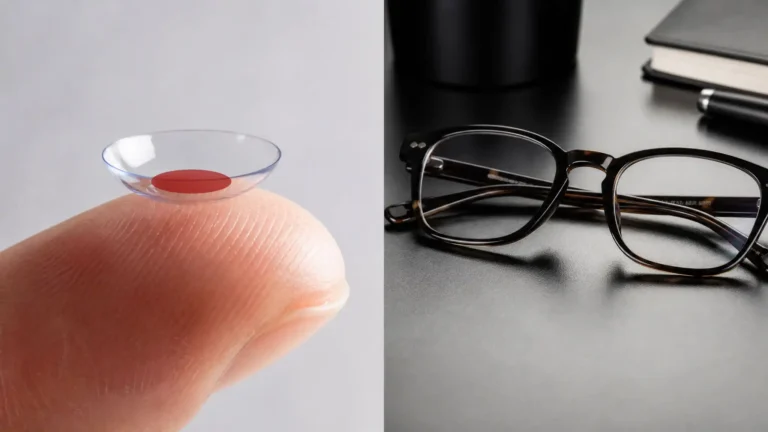
Colorkinds lenses use a spectral notch filter between 590 and 700 nanometres, the band where red and green overlap for a colorblind eye. Users report clearer separation between reds and greens in everyday daylight, which helps with dashboard lights, brake lights and signage.
Two limits are worth stating plainly. These lenses are a visual aid, not a correction, and they do not change the underlying cone response. And they are not a way to pass a licensing or medical color vision test. Turning up in an undeclared visual aid can be treated as concealing a condition, and the safer route is to test through the alternative instruments listed above.
| Situation | Do color blind contacts help? | Why |
|---|---|---|
| Everyday driving in daylight | Often yes | Improves red-green separation on signs and dashboard |
| Reading a signal at distance | Limited | Position and brightness still do most of the work |
| Driving at night | Marginal | Filtering removes light, and low light is already the constraint |
| Passing a license test | No | Undeclared aids can be treated as concealment |
Commercial and professional drivers
The private-licence answer rarely applies to people who drive for a living. Each regulated sector sets its own standard, and they differ sharply.
| Role | Color vision standard | Practical effect |
|---|---|---|
| US commercial driver (CDL) | Must recognize red, green and amber signals | Mild deficiency usually passes; no color waiver exists |
| UK lorry and bus (Group 2) | Stricter eyesight rules than Group 1 | Color blindness alone is not disqualifying |
| Airline pilot | Normal color vision, or an approved alternative | Rated roles are closed; see the aviation guide |
| Rail, maritime, emergency services | Lantern or plate tests | Often the strictest of all, because signals are color-only |
If your goal is a professional licence rather than a private one, the preparation route matters more than the driving itself. Our guide to color vision requirements in aviation covers the ratings and alternative tests, and the same logic applies to other safety-critical roles.
FAQ: driving with color blindness
Are color blind people allowed to drive?
Yes. In the United States, United Kingdom, Australia, Canada and most of the European Union there is no legal bar to holding a standard car licence because of color blindness. Some countries test color discrimination, and commercial or aviation licences carry stricter standards.
Can you drive with red-green color blindness?
Yes. Red-green deficiency is the most common form and almost never disqualifies a private driver. Traffic lights are read by position as well as color, so most red-green colorblind drivers pass a practical test without difficulty.
Do you have to tell the DVLA you are color blind?
No. GOV.UK states that you must report an eyesight problem affecting both eyes, and that this does not include being short or long sighted or colour blind. Color blindness is not a reportable condition for a Group 1 car or motorcycle licence.
Can color blind people get a CDL?
It depends on the severity. US federal rule 49 CFR 391.41 requires the ability to recognize the colors of traffic signals and devices showing standard red, green and amber. Mild deficiency usually passes; a driver who cannot identify those three colors does not.
How do colorblind drivers know when a light is red?
By position and brightness. On a vertical signal red is always at the top and green at the bottom, and on a horizontal signal red is on the left. Red also sits above amber and green in the sequence most countries use.
Is night driving harder if you are color blind?
It can be. Low light reduces the brightness difference that protan drivers rely on, which is why dim red signals and brake lights can be harder to pick out after dusk. Increasing following distance and reducing speed help more than any filter.
Do color blind contact lenses help with driving?
They can improve red-green separation in everyday daylight conditions, which helps with dashboard lights, signs and brake lights. They are not a substitute for meeting a licence standard, and you should not wear them to a licensing or medical test without declaring them.
Can you wear color blind glasses for a driving test?
Only if you declare them and the testing authority allows it. Turning up in an undeclared visual aid can be treated as concealing a condition. Check with the licensing body first, in writing, before the appointment.
See the difference before your test
If you are heading for a commercial licence, an aviation medical or a pre-employment color vision screen, the test is the thing to prepare for, not the driving.
Colorkinds CCG-088 contact lenses use a spectral notch filter that separates red from green in the 590 to 700 nanometre range. One design covers both protan and deutan deficiency, which together account for about 99% of cases. Independent testing reports a 97% success rate for red-green color blindness, and every pair comes with a 60-day guarantee.
They are for preparation and daily wear. They are not a way to sit a licensing test undeclared, and this guide is not legal or medical advice on your specific case.
Sources
- GOV.UK: Driving eyesight rules, DVLA reporting requirements for Group 1 and Group 2 licences
- 49 CFR 391.41, physical qualifications for commercial drivers in the United States
- Directive 2006/126/EC, Annex III: minimum standards of physical and mental fitness for driving, European Union
- Piyasena et al., Lancet Global Health (2021): vision impairment and traffic safety outcomes, systematic review and meta-analysis
- García-Lozada et al., Safety (2025): color vision deficiency and crash risk, meta-analysis of observational studies
- National Eye Institute and American Academy of Ophthalmology: color vision deficiency reference material
- Color Blind Awareness: prevalence data and workplace guidance