
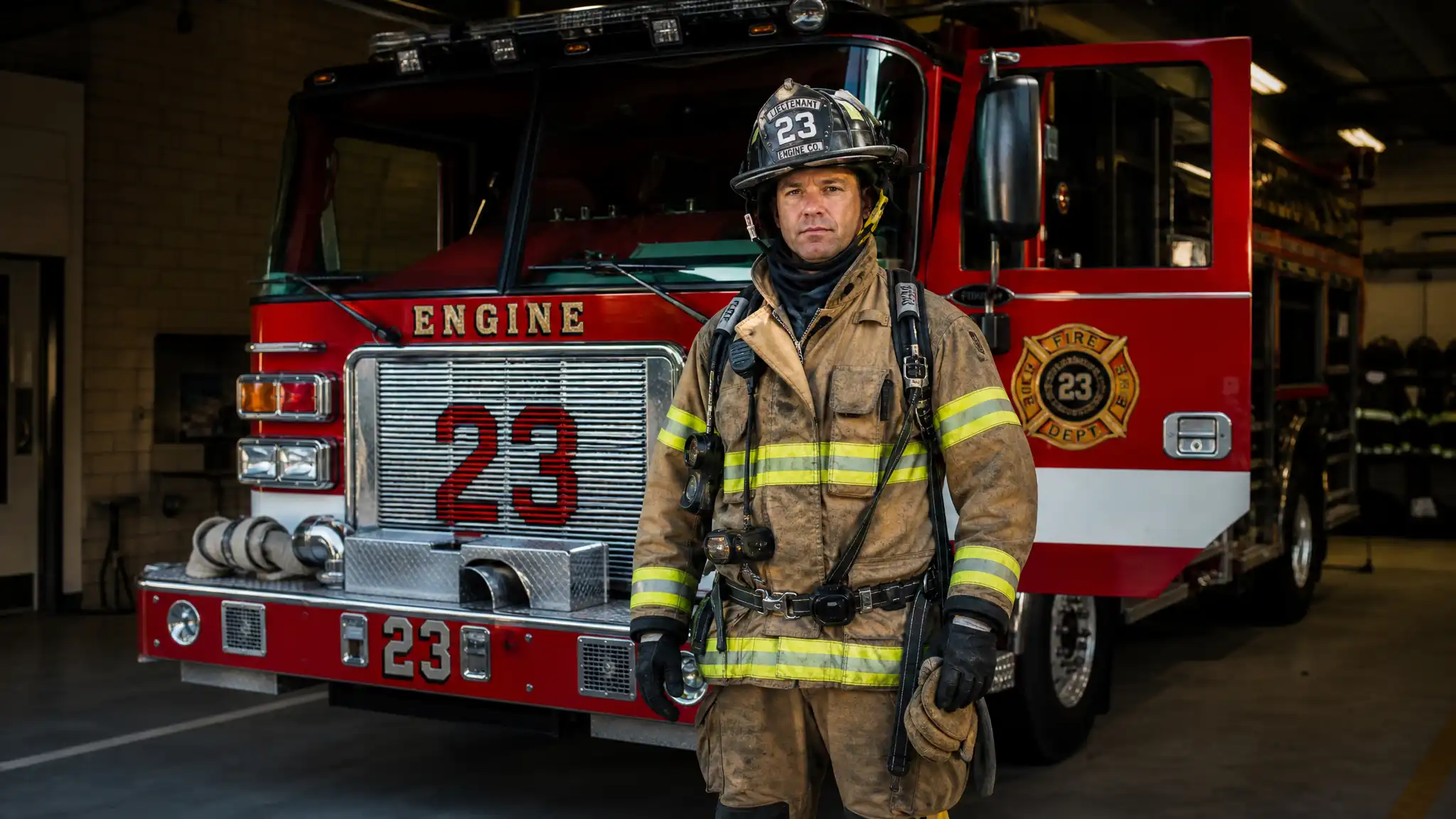
Can Firefighters Be Color Blind? NFPA 1582 Standards & Career Guide (2026)
You want to be a firefighter. You’ve got the physical fitness, the courage, and the commitment to serve. But you have color blindness, and you’ve heard the NFPA has strict vision standards.
Here’s the direct answer: Yes, firefighters can be color blind — but the specific requirements vary by department. The NFPA 1582 standard (medical requirements for firefighters) includes color vision assessment, but many departments offer alternative testing or accommodations. Colorblind firefighters serve successfully using position, context, and partner communication.
This guide covers NFPA 1582 color vision standards, how different fire departments handle color vision, practical strategies for colorblind firefighters, and how to navigate the hiring process.
Key Takeaways:
- NFPA 1582 includes color vision screening but does not automatically disqualify colorblind candidates
- Many fire departments accept alternative testing (Farnsworth D-15, Waggoner CCVT) after Ishihara failure
- Colorblind firefighters use position, brightness, and context cues to identify hazards
- Colorkinds contacts can enhance red-green discrimination for training and daily duties
- Hazard identification (NFPA 704 diamond) is readable by position and symbol, not just color
- Some of the most dangerous situations (smoke, darkness) reduce color cues for everyone
NFPA 1582 Color Vision Requirements
Standard Medical Requirements
The NFPA 1582 standard (Comprehensive Occupational Medical Program for Fire Departments) includes vision requirements:
| Vision Component | NFPA 1582 Standard |
|---|---|
| Visual acuity | 20/20 binocular corrected (20/40 uncorrected) |
| Field of vision | 140+ degrees horizontal |
| Color vision | Ability to distinguish colors necessary for safe job performance |
What NFPA 1582 Actually Says
The standard requires the ability to distinguish colors needed for:
- Identifying hazard classes (NFPA 704 diamond)
- Reading color-coded equipment controls
- Distinguishing emergency vehicle traffic signals
- Recognizing color-coded hoses and fittings
- Identifying colored warning lights and indicators
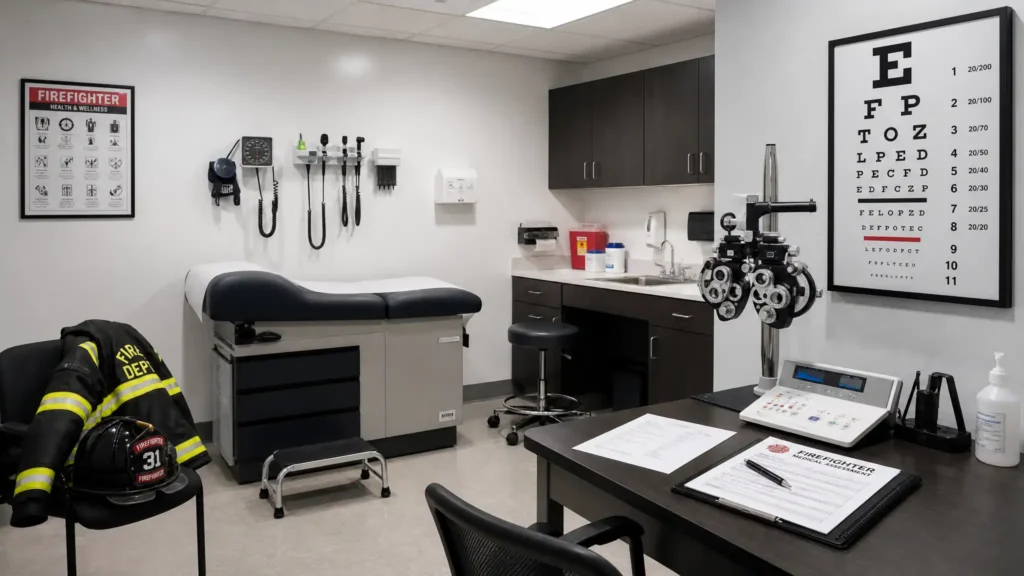
Fire Department Color Vision Testing
| Department Type | Testing Approach | Alternative Options |
|---|---|---|
| Career (paid) | Often follow NFPA 1582 strictly | May offer D-15 or Waggoner CCVT |
| Volunteer | More flexible | Often accept practical assessment |
| Federal (USFS, BLM) | Follow NFPA standards | Alternative testing available |
| Municipal | Varies widely | Some accept Ishihara only, others flexible |
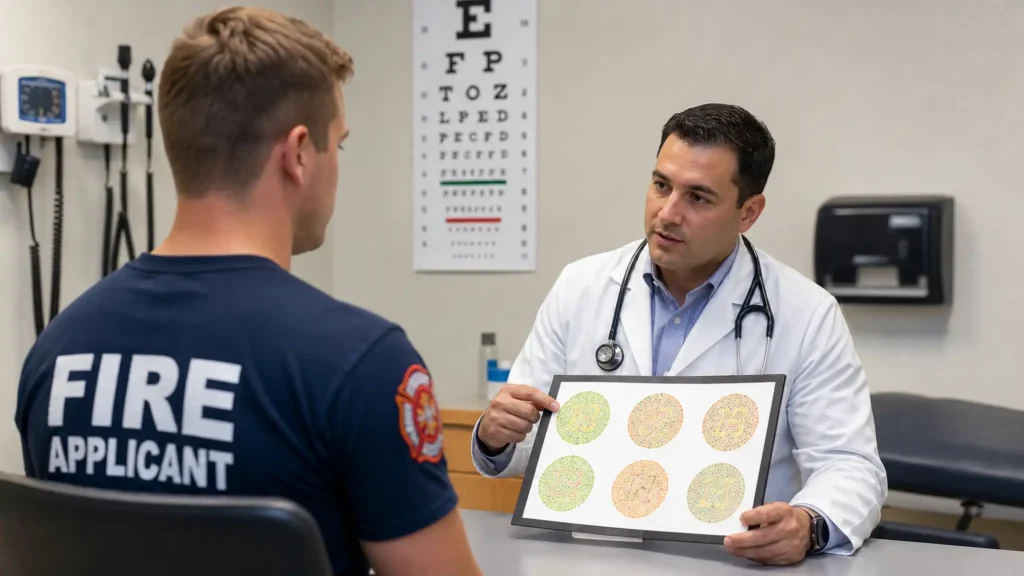
If You Fail the Initial Ishihara
If you fail the Ishihara screening, the most common next step is the Farnsworth D-15 hue arrangement test. Many people who fail Ishihara pass the D-15 without difficulty because it measures hue discrimination differently.
Some departments also accept:
- Waggoner CCVT — adaptive digital test
- Practical skills assessment — demonstrate safe hazard identification
- Chief’s letter — confirming you can perform the job
Volunteer departments are significantly more flexible than career departments and often skip formal testing altogether.
How Colorblind Firefighters Identify Hazards
The most common question is how colorblind firefighters handle the NFPA 704 hazard diamond — the colored diamond that tells responders what hazards are present.
The NFPA 704 Diamond: Three Ways to Read It
The system was designed with built-in redundancy. Every quadrant has multiple identification methods:
| Quadrant | Color | Position | Number (0-4) | Meaning |
|---|---|---|---|---|
| Health | Blue | Left | 0-4 severity | Higher number = more hazardous |
| Fire | Red | Top | 0-4 severity | Higher number = more flammable |
| Reactivity | Yellow | Right | 0-4 severity | Higher number = more unstable |
| Special | White | Bottom | Letter codes | W = water reactive, OX = oxidizer |
A colorblind firefighter reads the diamond instantly by:
- Position: Blue is left, red is top, yellow is right, white is bottom
- Number: The severity number (0-4) in each quadrant tells the hazard level
- Symbols: The special quadrant uses letter codes, not colors
Working in Smoke and Darkness
Smoke and darkness reduce color cues for everyone. In a zero-visibility fire environment, every firefighter — regardless of color vision — relies on touch, sound, heat, and partner communication rather than color. Colorblind firefighters are not at a disadvantage here because no one can see well enough to use color cues in those conditions.
Partner Communication Is Standard Practice
Firefighting is a team profession. Confirming observations with crewmates during size-up and operations is standard practice for everyone. No one operates alone at a fire scene. This built-in teamwork makes color vision much less critical than it might seem from the outside.
Practical Strategies from Colorblind Firefighters
| Strategy | How It Helps |
|---|---|
| Memorize position systems | NFPA 704 diamond, apparatus controls, panel layouts all use standardized positions |
| Label equipment personally | Add tape labels or tags to color-coded gear you use regularly |
| Adjust scene lighting | Apparatus scene lights — full-spectrum lighting improves color discrimination |
| Know your equipment | Familiarize yourself before calls, not under pressure |
| Use your other senses | Heat, sound, texture, and airflow give critical cues that override color |
Colorkinds Contacts for Firefighters
Colorkinds CCG-088 contacts are ideal for firefighting because they work where glasses cannot:
| Advantage | Why It Matters |
|---|---|
| Fits under SCBA mask | Contacts sit on your eye — no interference with mask seal |
| Never fogs up | No lens to fog in heat, humidity, or temperature changes |
| Won’t slip off | Stays in place during hose advancement, ladder climbs, physical activity |
| Discreet | No one knows you wear them — no uniform conflicts |
| PPE compatible | Works under helmets, hoods, facepieces, safety glasses |
| Enhanced red-green discrimination | Better identification of hazard colors and warning lights |
| Comfortable for 24-hour shifts | Daily wear design suits long shifts and station duty |
Colorkinds contacts are Plano (non-corrective) and can be worn alongside prescription glasses. The 60-day guarantee makes them risk-free to try for your department’s requirements.
FAQ: Firefighters and Color Blindness
Yes, firefighters can be color blind. NFPA 1582 requires the ability to distinguish colors needed for safe job performance, but many departments offer alternative testing or accommodations. Colorblind firefighters serve successfully using position and context cues.
NFPA 1582 requires firefighters to distinguish colors needed for hazard identification, equipment operation, and emergency response. It does not specify a particular test — departments can use Ishihara, Farnsworth D-15, or other accepted tests.
The NFPA 704 hazard diamond uses position (blue left, red top, yellow right, white bottom) and numbers (0-4 severity) in addition to color. Colorblind firefighters rely on these redundant cues. Partner communication and memorization of common hazards also help.
Yes. Colorkinds CCG-088 contacts enhance red-green discrimination, which helps with identifying hazard colors, reading equipment controls, and distinguishing emergency signals. Contacts are ideal for firefighters — they fit under SCBA masks and safety gear without fogging.
Yes. Volunteer fire departments are generally more flexible than career departments regarding color vision requirements. Many volunteer departments accept a practical skills assessment in place of formal color vision testing.