
Achromatopsia: Symptoms, Causes & Why It’s Not What Most People Have (2026)
You searched for “achromatopsia” because someone — a doctor, an article, a forum — used that word. Maybe you’ve been told you have it. Maybe you’re trying to understand what it means.
Here’s the short answer: Achromatopsia is complete color blindness — the inability to see any color at all, only shades of gray, black, and white. But it is incredibly rare, affecting roughly 1 in 33,000 people. And if you struggle to tell red from green but can still see colors, you almost certainly have something else entirely.
This guide covers what achromatopsia actually is, how to tell if you have it, and — for the vast majority of readers — why your color vision problem is probably the much more common red-green color vision deficiency that has a real solution.
Key Takeaways:
- Achromatopsia is total color blindness — seeing only in shades of gray — and is extremely rare (1 in 33,000)
- Most people who think they have “color blindness” actually have red-green CVD, which affects 1 in 12 men
- Complete achromatopsia includes other symptoms: light sensitivity (photophobia), involuntary eye movements (nystagmus), and reduced visual acuity
- Incomplete achromatopsia is a milder form where some color perception remains
- Red-green CVD is treatable with spectral notch filter contacts like Colorkinds; achromatopsia requires different solutions
- If you can see any colors at all — even if reds and greens look the same — you do not have achromatopsia
What Is Achromatopsia?
Achromatopsia (also called rod monochromatism or total color blindness) is a rare genetic condition where the cone cells in your retina do not function properly. Cone cells are responsible for color vision. When they don’t work, you see the world in shades of gray — like a black-and-white film.
This is fundamentally different from the “color blindness” that 1 in 12 men experience. That’s red-green color vision deficiency (CVD), where you see colors but struggle to tell red from green. Achromatopsia is not a deficiency in one part of the spectrum — it is the complete absence of color perception.
| Type of Color Blindness | Sub-types | Vision Deficit | Prevalence / Quantity |
|---|---|---|---|
| Red-Green (Deutan) | Deuteranomaly (Weak Green) Deuteranopia (Green Absence) |
M-cones affected. Green and yellow blend together; red and green look similar. | ~75% of red-green cases (Accounts for the vast majority of the 8% of affected males) |
| Red-Green (Protan) | Protanomaly (Weak Red) Protanopia (Red Absence) |
L-cones affected. Red appears darker/muted; difficulty separating red from green. | ~25% of red-green cases |
| Blue-Yellow (Tritan) | Tritanomaly Tritanopia |
S-cones affected. Difficulty distinguishing blue from green, or yellow from violet. | Rare (Affects males and females equally; often acquired rather than genetic) |
| Complete (Achromatopsia) | Complete, Incomplete, Rod Monochromacy | Total or near-total absence of cone function. Vision is mostly in black, white, and gray. | Extremely Rare (Approx. 1 in 33,000 in the U.S.) |
People with achromatopsia have vision that relies entirely on rod cells, which detect light and dark but not color. This creates a visual experience similar to how a black-and-white photograph captures the world: shapes, contrast, depth — but no color.
Complete vs. Incomplete Achromatopsia
Achromatopsia exists on a spectrum. The severity depends on how much cone function remains:
| Type | Color Perception | Visual Acuity | Light Sensitivity | Prevalence |
|---|---|---|---|---|
| Complete achromatopsia | No color perception — only grayscale | 20/200 or worse (legally blind) | Severe photophobia | ~1 in 33,000 |
| Incomplete achromatopsia | Some residual color discrimination | 20/80 to 20/200 | Moderate photophobia | Even rarer |
How to cite: Bourne R, et al. Trends in prevalence of blindness and distance and near vision impairment over 30 years: an analysis for the Global Burden of Disease Study. Lancet Glob Health. 2020. Accessed via the IAPB Vision Atlas: visionatlas.iapb.org.
Incomplete achromatopsia is the milder variant. People with this form retain some cone function, meaning they can perceive some colors — often blues and yellows — but reds and greens remain indistinguishable. Even so, the condition is still extremely rare and comes with significant visual challenges beyond color.
How Rare Is Achromatopsia?
This is the most important number to understand:
- Achromatopsia: affects 1 in 33,000 people worldwide
- Red-green color blindness: affects 1 in 12 men worldwide
That’s a difference of roughly 2,750x. For every single person with achromatopsia, there are nearly 3,000 people with the common red-green type.
To put it in perspective: in a stadium of 50,000 people, roughly 4,000 men will have red-green color blindness. About 1 to 2 people in that entire stadium will have achromatopsia.
If you are reading this because you have trouble telling red from green, the statistical probability that you have achromatopsia is near zero. You almost certainly have red-green color vision deficiency — the treatable kind.
| Condition | Prevalence | Color Perception | Treatable With Contacts? |
|---|---|---|---|
| Achromatopsia | 1 in 33,000 | No color (grayscale) | No — dark-tinted lenses for light sensitivity only |
| Red-green CVD (protan/deutan) | 1 in 12 men | Sees colors but confuses red/green | Yes — Colorkinds CCG-088 spectral notch filters |
| Blue-yellow CVD (tritan) | 1 in 100 | Sees colors but confuses blue/yellow | Limited — ChromaGen offers some options |
Symptoms Beyond Color
Achromatopsia is not just about color — or rather, the lack of it. The condition affects vision in several other ways that distinguish it sharply from common red-green CVD:
Photophobia (Severe Light Sensitivity)
This is often the most disabling symptom. People with achromatopsia have eyes that are extremely sensitive to bright light because their cone cells — which normally help regulate light adaptation — don’t function. In normal lighting conditions, they may squint, blink excessively, or need to wear very dark tinted lenses just to function comfortably. Bright sunlight can be genuinely painful.
Red-green color blindness has no light sensitivity component.
Nystagmus (Involuntary Eye Movement)
Many people with achromatopsia have nystagmus — a rhythmic, involuntary back-and-forth movement of the eyes. This typically appears in early infancy and may improve with age, though it rarely disappears completely. Nystagmus reduces visual clarity and can make reading or focusing on details more difficult.
Red-green color blindness has no eye movement component.
Reduced Visual Acuity
Achromatopsia significantly affects sharpness of vision. Most people with the condition have visual acuity in the range of 20/80 to 20/200, which meets the legal definition of low vision or legal blindness in many countries. This is because vision in achromatopsia relies entirely on rod cells, which detect light and dark but lack the density and precision of cone cells for detailed vision.
Red-green color blindness does not affect visual acuity at all. If you have 20/20 vision but can’t tell red from green, you have red-green CVD — not achromatopsia.
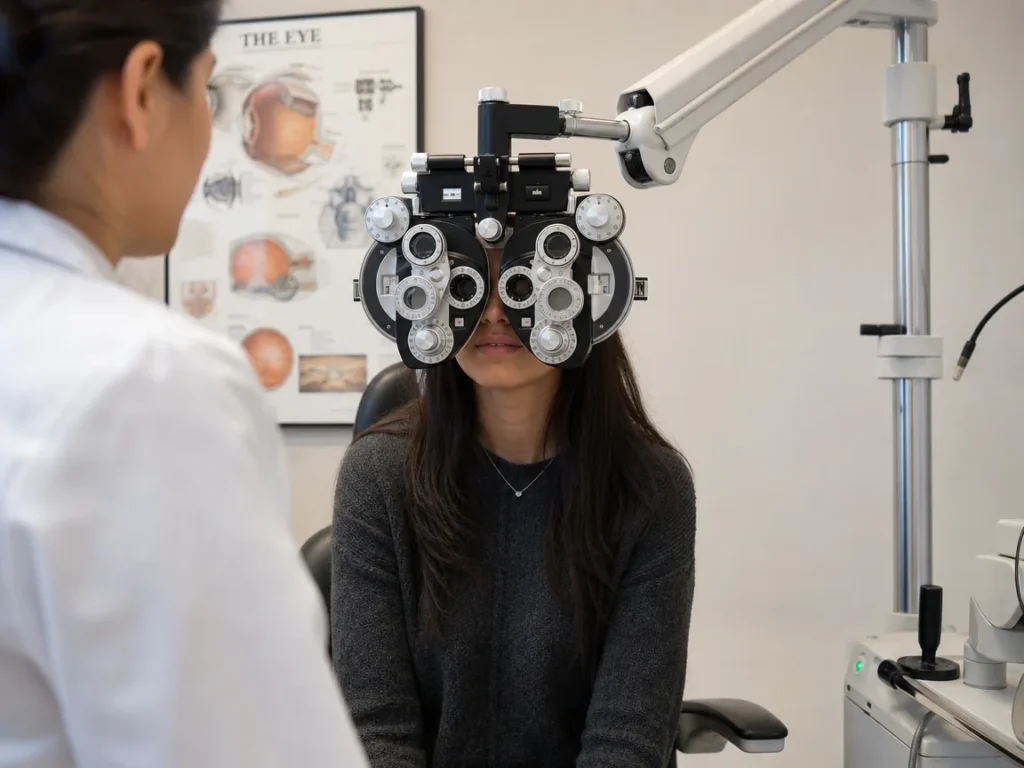
Symptom Comparison
| Symptom | Achromatopsia | Red-Green CVD |
|---|---|---|
| Color perception | None — grayscale only | Sees colors, confuses red/green |
| Light sensitivity | Severe — disabling in bright light | None — normal light tolerance |
| Eye movements | Nystagmus common | Normal — no involuntary movement |
| Visual acuity | 20/80 to 20/200 (low vision) | Normal — 20/20 possible |
| Onset | Present from birth | Present from birth |
| Impact on daily life | Significant — multiple vision systems affected | Mild to moderate — mostly color-specific tasks |
If you do not have light sensitivity, nystagmus, or reduced visual acuity — and your only symptom is trouble telling red from green — you do not have achromatopsia. You have red-green color vision deficiency, which is common, manageable, and treatable.
What Causes Achromatopsia?
Achromatopsia is a genetic condition caused by mutations in one of several genes that are essential for cone cell function:
- CNGA3 — the most common cause, accounting for ~25% of cases
- CNGB3 — the second most common, also ~25% of cases
- GNAT2 — a smaller percentage of cases
- PDE6C and PDE6H — rarer still
These mutations disrupt the phototransduction cascade — the chemical process that converts light into electrical signals in your cone cells. Without this process working correctly, your cones cannot send color information to your brain.
The condition is inherited in an autosomal recessive pattern, meaning both parents must carry a copy of the mutated gene for their child to have achromatopsia.
Solutions for Achromatopsia
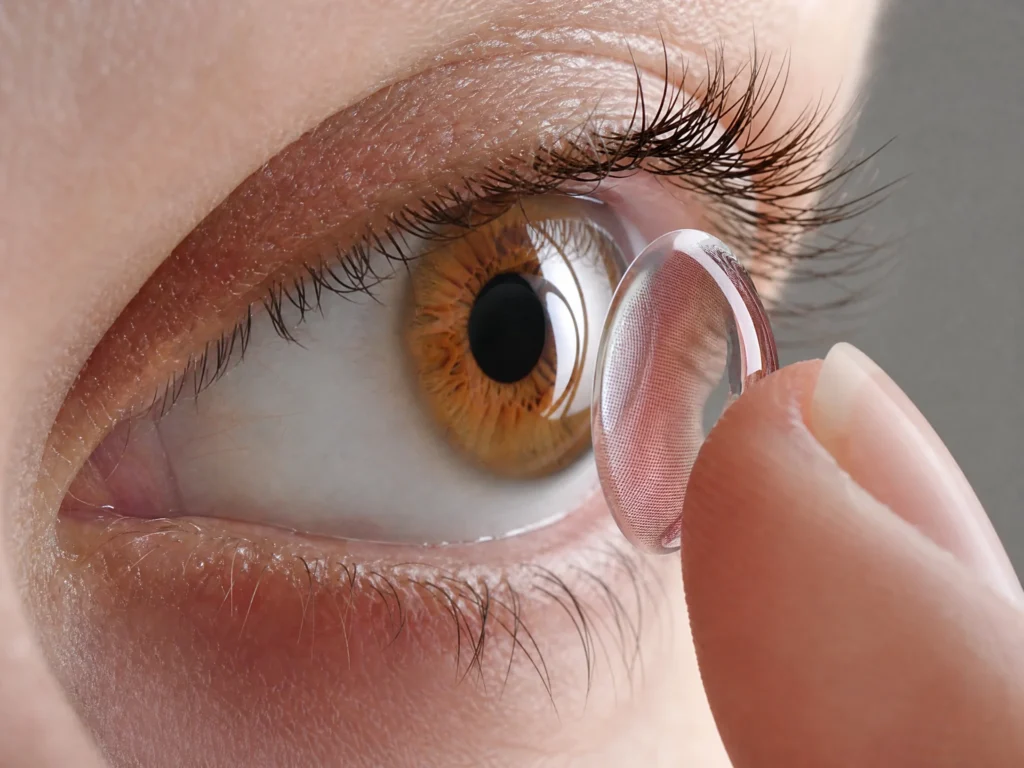
Because achromatopsia involves non-functioning cone cells, colorblind corrective contacts like Colorkinds CCG-088 — which work by filtering specific wavelengths of light — do not restore color vision in achromatopsia. The cone cells must be functional for spectral filtering to have any effect.
However, several solutions help manage the condition:
Dark-tinted contact lenses or glasses: These reduce photophobia by limiting the amount of light reaching the retina. Some specialized contacts are available with dark tints specifically for achromatopsia-related light sensitivity. They do not restore color but make daily life more comfortable.
Low-vision aids: Magnifiers, screen readers, and other assistive technologies help with the reduced visual acuity that often accompanies achromatopsia.
Gene therapy (experimental): Clinical trials are underway for gene therapies targeting CNGA3 and CNGB3 mutations. Early results show promise, but these treatments are not yet widely available.
Why Your “Color Blindness” Is Probably Red-Green CVD
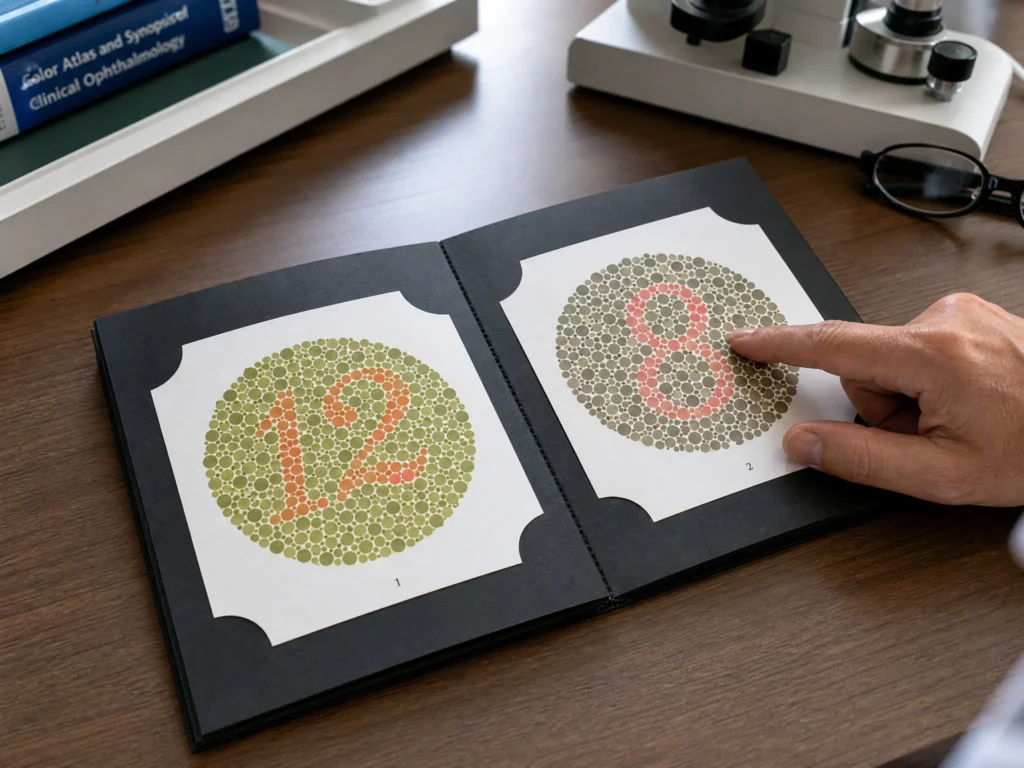
Here is the reality: the vast majority of people who search for “achromatopsia” do not have it. They have red-green color vision deficiency — the common kind — and they encountered the term “achromatopsia” while researching their symptoms.
If you can see colors — any colors at all — you do not have complete achromatopsia. And if your only symptom is difficulty distinguishing red from green, you have red-green CVD, which affects approximately 200 million men worldwide and has a proven solution.
Red-green color vision deficiency is caused by overlapping sensitivity in your L-cones and M-cones. The red and green signals your brain receives are too similar to tell apart. But the cones themselves work — they just need help separating the signals.
That is exactly what colorblind contacts do.
Colorkinds CCG-088 contacts use a spectral notch filter embedded in the lens material that selectively blocks the 590-700 nanometer range — the zone where red and green overlap for colorblind eyes. By removing that overlapping light, the filter creates separation between the signals your cones send to your brain. Reds look redder. Greens look greener. Those Ishihara numbers that were invisible suddenly stand out.
This technology works for:
- Protanomaly and protanopia (red-deficient) — covering ~25% of red-green cases
- Deuteranomaly and deuteranopia (green-deficient) — covering ~75% of red-green cases
- ~99% of all color vision deficiency cases
The same technology does not work for achromatopsia because the cones themselves are non-functional — filtering light cannot fix a signal that never transmits. But for the 99% of colorblind individuals who have red-green CVD, spectral notch filtering is the most effective tool available for passing occupational color vision tests.
Which One Are You?
If you are still unsure whether you have achromatopsia or red-green CVD, ask yourself these questions:
- Can you see any colors at all? If yes, you do not have complete achromatopsia.
- Do bright lights hurt your eyes or make you squint excessively? If no, that is another sign against achromatopsia.
- Is your vision sharp (20/20 or correctable to 20/20)? If yes, achromatopsia is extremely unlikely.
- Do you struggle specifically with red vs. green? If yes, you almost certainly have red-green CVD.
If you have red-green color vision deficiency and need to pass an occupational test — for aviation, law enforcement, electrical trades, firefighting, medical, or maritime — Colorkinds CCG-088 contacts are the most practical solution available. They cost ~$99 for 12 months, require no prescription, ship worldwide, and come with a 60-day money-back guarantee.
Frequently Asked Questions
Achromatopsia is a rare genetic condition where the cone cells in your retina do not function, causing complete color blindness — seeing only in shades of gray. It affects roughly 1 in 33,000 people and also causes light sensitivity, nystagmus, and reduced visual acuity.
Achromatopsia affects approximately 1 in 33,000 people worldwide. In comparison, red-green color blindness affects 1 in 12 men — making it roughly 2,750 times more common. If you have trouble telling red from green, you almost certainly have the common red-green type, not achromatopsia.
Achromatopsia is total color blindness — no color perception at all, only grayscale. “Color blindness” in everyday language usually refers to red-green color vision deficiency, where you see colors but struggle to distinguish red from green. They are completely different conditions with different causes, symptoms, and treatments.
Incomplete achromatopsia is a milder form where some cone function remains. People with this type may retain some color perception — often blues and yellows — but still have significant light sensitivity, reduced visual acuity, and difficulty with red-green discrimination. It is even rarer than complete achromatopsia.
No. Colorblind corrective contacts like Colorkinds CCG-088 use spectral notch filtering to separate overlapping red and green wavelengths, which requires functioning cone cells. In achromatopsia, the cone cells do not work, so filtering light cannot restore color perception. Dark-tinted lenses can help with light sensitivity but will not add color.
If you can see any colors at all, you do not have complete achromatopsia. Other signs against it: you have normal visual acuity (20/20), you are not unusually sensitive to bright light, and you do not have involuntary eye movements. If your only symptom is difficulty telling red from green, you almost certainly have red-green CVD — which is treatable with Colorkinds contacts.
There is no FDA-approved cure for achromatopsia yet. Gene therapy clinical trials targeting the CNGA3 and CNGB3 genes are underway and show early promise, but they are not yet widely available. Current management focuses on symptom relief: dark-tinted lenses for light sensitivity, low-vision aids for reduced acuity, and specialized educational support.
Yes. Colorkinds CCG-088 contacts use spectral notch filter technology to help people with red-green color vision deficiency distinguish red from green. They work for both protan and deutan types, covering ~99% of all red-green CVD cases, and have a 100% Ishihara pass rate with proper use.
No, though the terms are often confused. Achromatopsia is complete color blindness — total inability to see any color. What most people call “color blindness” is actually red-green color vision deficiency, where you see colors but confuse reds and greens. Using “color blind” to describe red-green CVD is common but technically imprecise.
Driving with achromatopsia is challenging due to severe light sensitivity and reduced visual acuity, but some people with incomplete achromatopsia can drive with restrictions. Dark-tinted lenses, bioptic telescopes, and limiting driving to low-light conditions may help. Licensing depends on local regulations and individual visual function.
If you have red-green color blindness (not achromatopsia) and need to pass a color vision test for your career, Colorkinds CCG-088 contacts can help. Try them risk-free with a 60-day guarantee.
Related guides: