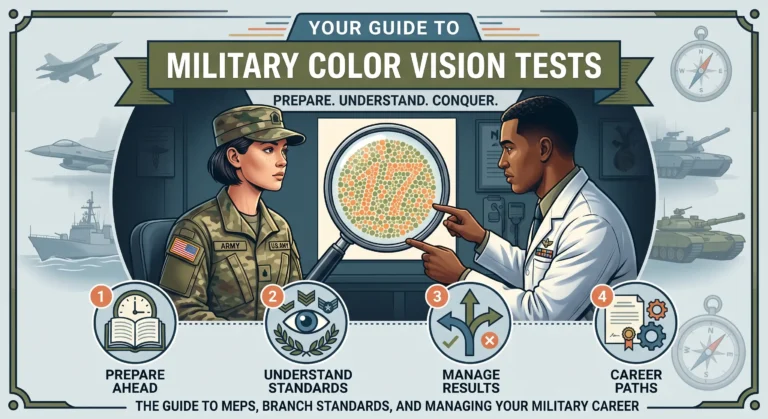

Can You Join the Military with Color Blindness? Complete Guide (2026)
You want to serve your country. You’ve researched military careers, found your ideal role, and started the enlistment process. Then someone mentions the color vision test — and you’ve heard that color blindness means automatic disqualification from military service.
Here’s the direct answer: It depends on the branch and the job. The military does not automatically disqualify all colorblind individuals. Each branch — Army, Navy, Air Force, Marines, Coast Guard, Space Force — has specific color vision standards for different roles. Some Military Occupational Specialties (MOS) are restricted, while others are fully open to colorblind service members.
This guide covers each branch’s color vision requirements, which roles are open or restricted, the testing process, and how to navigate enlistment with color blindness.
Key Takeaways:

- Color blindness does not automatically disqualify you from all military service
- Each branch has different color vision standards — the Navy is generally strictest, the Army most flexible
- Many support and administrative roles are fully open to colorblind personnel
- Combat arms roles and certain technical specialties may be restricted
- Waivers and alternative testing are available in some cases
- The ASVAB and physical exam include color vision screening during MEPS processing
Military Color Vision Standards by Branch
Each branch of the US military sets its own color vision requirements based on the operational needs of its roles.
Army
The Army is generally the most flexible branch regarding color vision waivers.
| Factor | Detail |
|---|---|
| Screening test | Ishihara 14-plate (standard) or PIP (Pseudoisochromatic Plate) test |
| Pass threshold | Most medical exams use 10+ correct plates |
| Restricted roles | Combat arms (infantry, armor, artillery), certain technical MOS (electronics repair, EOD, aviation maintenance) |
| Open roles | Administration, logistics, medical support, many support roles |
| Waiver policy | Waivers available for some restricted roles on a case-by-case basis |
Navy
The Navy has some of the strictest color vision requirements due to the color-critical nature of shipboard operations.
| Factor | Detail |
|---|---|
| Screening test | Ishihara test at MEPS |
| Restricted roles | Most operational shipboard roles, aviation, electronics, SEALs/EOD |
| Open roles | Some administrative and shore-based support roles |
| Waiver policy | Very limited — waivers are rare for color vision |
Air Force
The Air Force evaluates color vision against specific Air Force Specialty Codes (AFSC).
| Factor | Detail |
|---|---|
| Screening test | Ishihara plates at MEPS |
| Restricted roles | Pilot, air traffic control, security forces, electrical systems, fire protection |
| Open roles | Many administrative, medical, and support AFSCs |
| Waiver policy | Case-by-case for non-color-critical roles |
Marine Corps
The Marines follow similar standards to the Navy but with additional infantry considerations.
| Factor | Detail |
|---|---|
| Screening test | Ishihara at MEPS |
| Restricted roles | Infantry, armor, artillery, aviation, combat engineer, communications |
| Open roles | Logistics, administration, some support roles |
| Waiver policy | Limited — most restricted roles require waiver approval from higher command |
Coast Guard
| Factor | Detail |
|---|---|
| Screening test | Ishihara at MEPS |
| Restricted roles | Afloat operations, aviation, electronics, small boat stations |
| Open roles | Some support and administrative roles |
| Waiver policy | Case-by-case with operational assessment possible |
Space Force
As the newest branch, Space Force color vision standards are similar to Air Force requirements, with a focus on technical roles.
Related reading: See our Career Navigation Hub for all career-specific guides.
Military Color Vision Testing: What to Expect
At MEPS (Military Entrance Processing Station)
All military branches process recruits through MEPS, where the color vision screening occurs during the physical exam.
| Test Component | What Happens |
|---|---|
| Ishihara plates | You’ll be shown approximately 14 plates and asked to identify the numbers |
| Passing standard | Typically 10+ correct (varies slightly by branch) |
| If you fail | Your file is flagged with a color vision code; recruiter discusses options |
| Documentation | Result is recorded in your medical file for branch assignment |
Secondary Testing Options
If you fail the initial Ishihara screening, some branches offer secondary testing:
| Test | What It Measures | Availability |
|---|---|---|
| Farnsworth D-15 | Hue arrangement — classifies severity | Some MEPS sites |
| Waggoner CCVT | Computerized color testing | Limited availability |
| Rabin Cone Contrast Test | Cone function assessment | Limited — mostly research settings |
Military Occupational Specialties (MOS) and Color Vision
Understanding which roles are restricted helps you plan your military career.
Commonly Restricted Roles
These MOS/AFSC ratings typically require normal color vision:
| Category | Examples | Reason |
|---|---|---|
| Combat arms | Infantry, armor, artillery, fire support | Target identification, map reading, signal recognition |
| Aviation | Pilot, crew chief, aviation maintenance | Navigation lights, instrument panels, signal lights |
| Electronics | Radar repair, communications, avionics | Color-coded wiring, component identification |
| EOD | Explosive ordnance disposal | Color-coded hazard identification |
| Fire protection | Firefighter, crash rescue | Hazard identification, NFPA 704 diamond |
| Law enforcement | Military police, security forces | Signal recognition, evidence identification |
| Transportation | Vehicle operation, convoy operations | Traffic signals, brake lights |
Commonly Open Roles
Many non-color-critical roles are fully open to colorblind personnel:
| Category | Examples |
|---|---|
| Administration | Human resources, personnel, administrative support |
| Logistics | Supply chain, warehouse management, transportation coordination |
| Medical | Hospital corpsman, medic (some restrictions on surgical roles) |
| Legal | Paralegal, court reporter, legal administration |
| Finance | Financial management, accounting, payroll |
| Intelligence | Intelligence analyst (some restrictions on tactical roles) |
| Public affairs | Journalism, broadcasting, public relations |
| Information technology | IT support, network administration (some restrictions) |
Related reading: For federal law enforcement roles, see our 1811 Medical Guide.
Military Waiver Process for Color Vision
If your desired role requires normal color vision, a waiver may be possible.
How the Waiver Process Works
| Step | Description |
|---|---|
| 1. Fail screening at MEPS | Your medical file is flagged |
| 2. Discuss options with recruiter | They explain which roles are open vs. restricted |
| 3. Identify target role | You choose an MOS that interests you |
| 4. Request waiver (if needed) | For restricted roles, your recruiter submits a waiver request |
| 5. Medical review | Waiver is reviewed by branch medical command |
| 6. Decision | Approved, denied, or additional testing required |
Factors That Affect Waiver Approval
| Positive Factors | Negative Factors |
|---|---|
| High ASVAB scores | Multiple medical disqualifiers |
| Prior color-critical experience | Severe color vision deficiency |
| Strong recruiter advocacy | Role with no civilian alternative |
| Passing secondary color test | History of color vision-related incidents |
| High demand for the role | No supporting evidence of safe performance |
Colorblind Contacts and Military Testing
During Official Testing
Colorblind contacts are not permitted during the official color vision screening at MEPS. The military tests your natural color vision as part of the enlistment physical.
As a Training Tool
Colorkinds CCG-088 contacts can be valuable as an off-duty training tool:
- Color identification practice — build confidence identifying colors relevant to military tasks
- Map reading preparation — color-coded military map symbols become clearer
- Signal light recognition — distinguish red, green, and amber signals
- Equipment familiarization — learn color-coded equipment markings with enhanced discrimination
After Enlistment
Some service members with mild color vision deficiencies use Colorkinds contacts during their duties where local policy permits. Since contacts are discreet, they don’t interfere with uniform requirements or equipment.
How to Prepare for Military Service with Color Blindness
| Step | Action |
|---|---|
| 1. Know your type | Confirm whether you have protan or deutan deficiency |
| 2. Review branch requirements | Each branch has different standards — research before choosing |
| 3. Identify open roles | Focus on MOS/AFSC that don’t require normal color vision |
| 4. Prepare for MEPS | Understand the testing process and what to expect |
| 5. Discuss with recruiter | Be upfront about your color vision — they can help navigate options |
| 6. Practice with contacts | Use Colorkinds as a training tool for color-dependent tasks |
| 7. Have a backup plan | Identify alternative roles in case your first choice is restricted |
Similar Posts:
- Color Blind Contacts: Complete Guide
- Colorblind Pilot Guide (2026)
- Federal Law Enforcement 1811 Medical Guide
- Career Navigation Hub
- Military Color Vision Test Guide
- FAA Color Vision Test Guide
- Occupational Solutions Hub
- Colorblind Solutions for Maritime
FAQ: Military and Color Blindness
Yes, but with restrictions. The Air Force evaluates color vision against specific Air Force Specialty Codes (AFSC). Security forces, fire protection, electrical systems, and air traffic control are typically restricted. Many administrative, medical, and support AFSCs are open to colorblind personnel.
The Army is generally the most flexible branch for colorblind individuals, with the broadest range of open roles and the most favorable waiver policy. The Navy and Marine Corps tend to be the strictest due to shipboard and combat operations that rely heavily on color discrimination.
Many roles are open including: administration, logistics, medical support (some restrictions), legal, finance, intelligence analysis, public affairs, information technology (some restrictions), human resources, and supply chain management. Combat arms, aviation, EOD, and electronics roles are typically restricted.
It is very difficult. All military branches require normal color vision for pilot training due to the critical need to identify navigation lights, instrument panel colors, and signal flares. Waivers are extremely rare for pilot roles. However, some ground-based aviation support roles may be available.
The Navy has strict color vision requirements for most operational roles — including all shipboard positions that involve navigation, lookout duties, or electronics. However, some shore-based support and administrative roles may be available. Waivers are very limited.
Yes, the Army is the most colorblind-friendly branch. While combat arms roles (infantry, armor, artillery) are restricted, many support and technical roles are open. The Army also has the most favorable waiver policy, allowing some colorblind individuals to serve in roles that would be restricted in other branches.
The primary color vision test used by all military branches at MEPS is the Ishihara color plate test (typically 14-plate version). You identify numbers hidden in colored dot patterns. Passing requires approximately 10+ correct plates. Some branches may offer secondary testing like the Farnsworth D-15.
No. The military tests your natural color vision during the enlistment physical at MEPS. Wearing colorblind contacts or any corrective device during the official test would violate testing protocols. Colorkinds contacts are best used as an off-duty training tool to build color identification skills.
Yes, waivers are available in certain cases. The Army offers the most favorable waiver policy. Factors that help include: high ASVAB scores, passing secondary testing, prior experience in a color-critical role, and high demand for the specific MOS. Waivers are reviewed on a case-by-case basis by branch medical command.
Yes, but with restrictions. The Air Force evaluates color vision against specific Air Force Specialty Codes (AFSC). Security forces, fire protection, electrical systems, and air traffic control are typically restricted. Many administrative, medical, and support AFSCs are open to colorblind personnel.