

Color Blind Contacts: Complete Guide to Types, How They Work & Where to Buy (2026)
You’re an aspiring pilot who’s been told a failed Ishihara test means your medical certificate is denied. Or an electrician who can’t tell the difference between red and green wiring. Maybe a police recruit who’s worried eight weeks of academy training could end with a single color vision screening.
You’ve searched for answers and found mostly dead ends. “Color blind contacts” promises a solution — but do they actually work? Which ones are real? And will they help you pass your test?
Here’s the direct answer: Yes, colorblind contacts work for red-green color vision deficiency. They use spectral notch filter technology to help your brain distinguish red from green — exactly what the Ishihara test measures. For protan and deutan (which covers ~99% of color blindness cases), they’re the most effective tool available for passing occupational color vision screenings.
This guide covers everything: how they work, the types available, which careers they help with, how they compare to glasses, what they cost, and where to buy them.
If you need to pass a color vision test for your career, start here.
Key Takeaways:
- Colorblind contacts use a spectral notch filter to separate overlapping red and green wavelengths — they don’t “cure” color blindness but enhance contrast while worn
- They work for both protan (red-deficient) and deutan (green-deficient) color blindness — covering ~99% of cases
- Two commercially available options exist: Colorkinds (99) and ChromaGen (~400-800)
- Colorblind contacts are generally more effective than glasses for passing Ishihara and other occupational tests
- Most careers (police, fire, electrical, medical) allow corrective contacts during testing — but always verify with your examiner
- Safety requires proper fitting, hygiene, and FDA-registered products — never buy from unregulated sellers
What Are Color Blind Contacts?
Colorblind contact lenses are soft contacts with a built-in filter. They help people with red-green color blindness see colors better. These are not cosmetic colored contacts. They are medical devices that improve color vision.
Regular contacts fix nearsightedness. Colorblind contacts fix something else. They target red-green confusion in your retina.
These lenses come in Plano (non-prescription) for people with normal vision. They can also include prescription power. They’re for daily wear and last 12 months with proper care.
The Problem They Solve
Red-green color blindness affects 350 million people — about 1 in 12 men and 1 in 200 women. Reds, greens, browns, and oranges all look the same. This isn’t about blurry vision. It’s about mixing up colors.
For pilots, police, electricians, firefighters, and nurses, this becomes a career problem. They must pass the Ishihara test and other screenings. Failing can block their career path.
Colorblind contacts help these professionals pass those tests and move forward.
Why These Are NOT Cosmetic Colored Contacts
This is a critical distinction. Cosmetic colored contacts are purely aesthetic — they change your eye color with an opaque printed layer. They do nothing for color vision. Colorblind corrective contacts are transparent during wear, with a nano-scale spectral notch filter embedded in the lens material that selectively targets the 590-700nm wavelength range.
| Feature | Cosmetic Colored Contacts | Colorblind Corrective Contacts |
|---|---|---|
| Purpose | Change eye color | Improve red-green discrimination |
| Technology | Printed pigment layer | Nano-scale spectral notch filter |
| Appearance | Opaque, changes iris color | Subtle red tint, blends naturally |
| Vision impact | Can reduce clarity | Enhances red-green contrast |
| Medical claim | None | Pass Ishihara, improve CVD |
| FDA status | Cosmetic (some unregulated) | Medical device (FDA registered) |
| Price | $15-50 per pair | $99-800 per pair |
If you buy “colorblind contacts” from a marketplace that also sells Halloween costume lenses, you are being misled. Legitimate colorblind corrective contacts are medical devices from specialized manufacturers — not fashion accessories.
How Do Colorblind Contact Lenses Work?
Understanding how colorblind contacts work starts with understanding what goes wrong in colorblind eyes.
The Science of Color Blindness
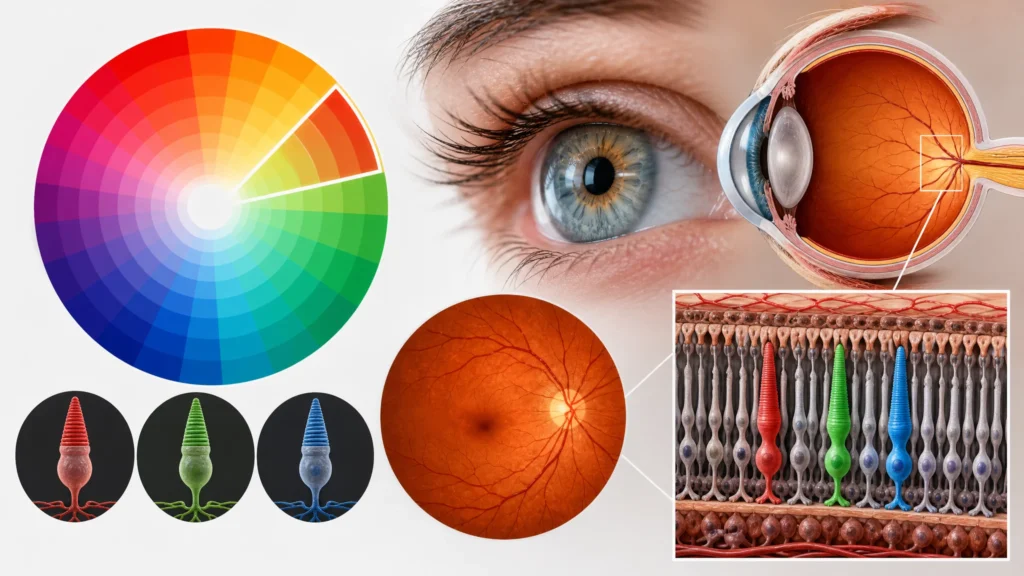
Your retina has three types of cone cells. Each one picks up different light wavelengths:
| Cone Type | Peak Sensitivity | Function |
|---|---|---|
| S-cones (short) | ~420 nm | Blue detection |
| M-cones (medium) | ~530 nm | Green detection |
| L-cones (long) | ~560 nm | Red detection |
With normal vision, these cones send different signals to your brain. Your brain mixes them into the full color spectrum you see.
With red-green color blindness (deuteranomaly or protanomaly), the M-cones and L-cones overlap too much. Their sensitivity curves shift toward each other. Your brain gets two nearly identical signals. That makes reds, greens, browns, and oranges almost impossible to tell apart.
The Notch Filter Solution
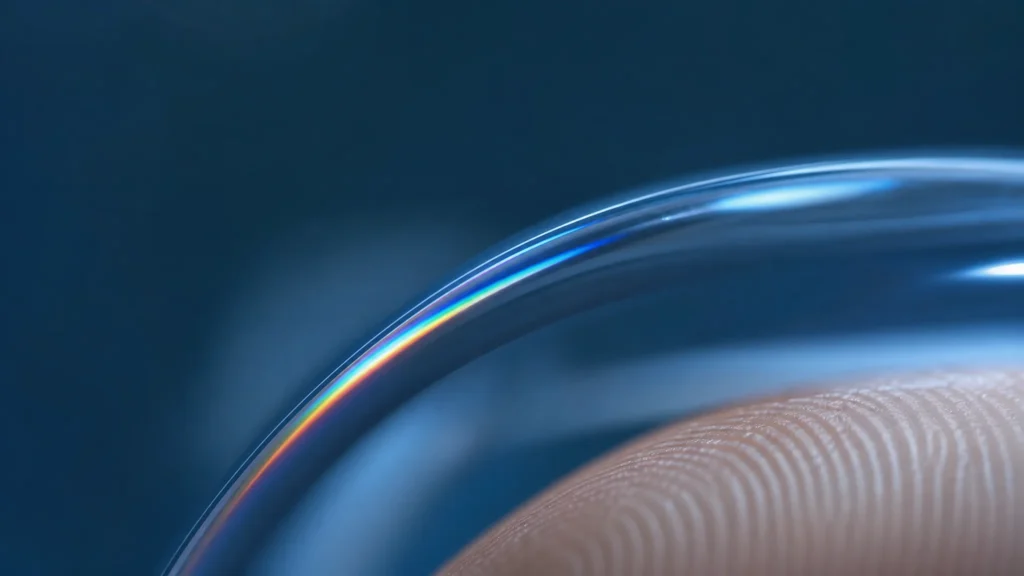
Colorblind contact lenses use a spectral notch filter. This is a nano-scale filter built into the lens. It blocks a narrow band of light in the 590–700 nanometer range. That’s the exact zone where red and green signals overlap for colorblind eyes.
Think of it like an audio equalizer. Two instruments sound muddy and overlapping. You notch out the problem frequency. Now you hear both clearly. The notch filter does the same for your vision. It removes the “confusion band” so your brain gets cleaner red and green signals.
The result is artificial separation between colors your eyes normally can’t tell apart. Your brain receives distinct signals instead of one muddy blend.
What They Can and Cannot Do
| Works For | Does NOT Work For |
|---|---|
| Deuteranomaly (green-weak) — ~75% of cases | Tritanomaly/Tritanopia (blue-yellow deficiency) |
| Protanomaly (red-weak) — ~20% of cases | Complete dichromacy (one cone type entirely absent) |
| Passing the Ishihara color plate test | Curing color blindness (it’s a genetic condition) |
| Passing the Farnsworth D-15 arrangement test | Restoring “normal” color perception |
| Enhancing red-green contrast in daily life | |
| ~99% of all color blindness cases |
Crucially: Colorblind contacts do not cure color blindness. They are like glasses for nearsightedness. The help is immediate but not permanent. Put them in, see better. Take them out, your vision goes back to normal.
Scientific Evidence
Studies back up how colorblind contacts work. A 2021 study in Advanced Materials Technologies found that dye-infused contacts blocked 95% of unwanted wavelengths. They outperformed commercial color-blind glasses on Ishihara testing. Research from Khalifa University also showed gold nanoparticle lenses filter precisely in the 520–580 nm range — with no harm to corneal cells.
Learn more about the science and evidence in our dedicated guide: Do Colorblind Contacts Work? Science, Evidence & Real User Results
Types of Color Blind Contacts
Colorblind contact lenses come in several types based on what you need.
By Color Vision Deficiency Type
| Deficiency Type | Lens Compatibility | Notes |
|---|---|---|
| Protanomaly (red-weak) | Yes — excellent results | Spectral filters target the overlap zone effectively |
| Protanopia (red-blind) | Partial — results vary | More severe deficiency may show limited improvement |
| Deuteranomaly (green-weak) | Yes — excellent results | Best response — most common deficiency type |
| Deuteranopia (green-blind) | Partial — results vary | |
| Tritanomaly/Tritanopia (blue-yellow) | No | Not designed for this type |
| Achromatopsia (complete) | Limited | Separate dark-tinted lenses exist for light sensitivity |
What this means for you: If you have red-green color blindness — and about 99% of people with CVD do — colorblind contacts will work. Not sure which type you have? Our guide to protan vs. deutan will help you figure it out.
By Lens Design
| Lens Type | Description | Best For |
|---|---|---|
| Plano (non-prescription) | Zero optical power — color correction only, like Colorkinds CCG-088 | People with normal vision who need color correction for testing |
| Single Vision Rx | Corrects both color deficiency and refractive errors (nearsightedness, farsightedness) | People who also wear prescription contacts |
| Toric | Corrects astigmatism | People with astigmatism who need color correction |
By Use Case
| Use Case | Recommended Lens Type | Key Feature |
|---|---|---|
| Occupational test passing | Colorkinds CCG-088 | Discreet design, optimized for Ishihara pass rate |
| Daily color enhancement | ChromaGen or Colorkinds | Comfortable for all-day wear |
| Light sensitivity + color correction | Dark-tinted achromatopsia lenses | Reduces photophobia |
| Wearing under safety gear | Any contact lens (glasses won’t fit) | Full PPE compatibility |
For a detailed breakdown of which deficiency type needs what, read: Color Blind Contacts for Protan and Deutan: What’s the Difference?
Colorblind Contacts vs. Glasses: Which Is Right for You?
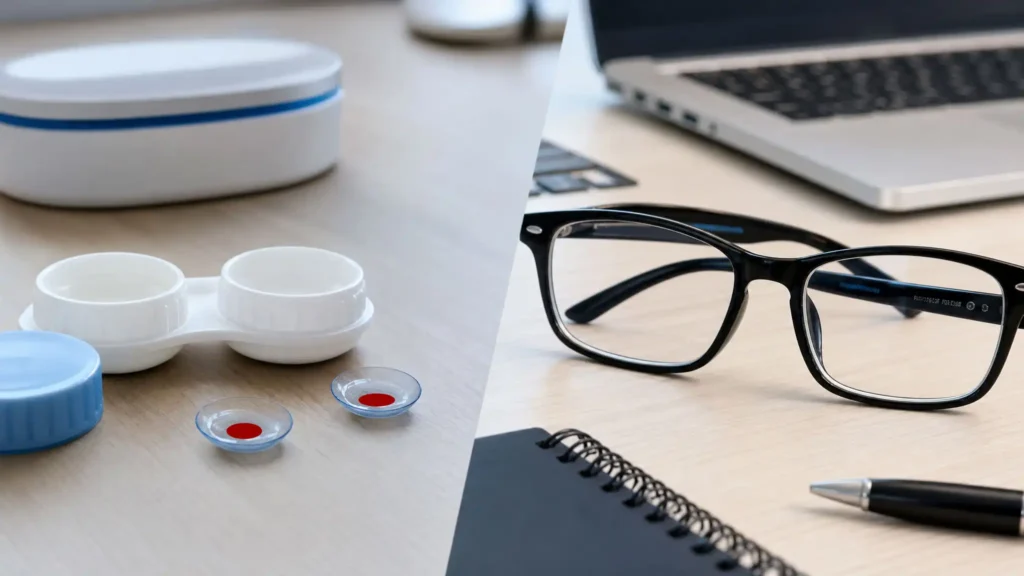
One of the most common questions is whether to choose colorblind contacts or colorblind glasses. Each has strengths, and the answer depends on your specific situation.
Head-to-Head Comparison
| Factor | Colorblind Contacts | Colorblind Glasses (EnChroma, Pilestone) |
|---|---|---|
| Field of view | Full peripheral — nothing in the way | Limited by frame — peripheral color visible through non-filtered areas |
| Discretion | No one can tell you’re wearing them | Visible to everyone — tinted lenses are obvious |
| PPE compatibility | Fits under safety glasses, helmets, SCBA masks | Cannot be worn under most safety gear |
| Fogging | Never fogs up | Fogs in temperature changes, physical activity |
| Cost | ~$99 (Colorkinds) for 12 months | $189–$429+ per pair |
| Test passing | Excellent for Ishihara, D-15, FALANT | Moderate at best per systematic reviews |
| Daily comfort | All-day — put them in and forget them | Can cause pressure points, slipping |
| Prescription option | Available in some models | Available in most brands |
| Safety risk | Requires proper hygiene | Very low (external wear) |
When to Choose Contacts
Choose colorblind contacts if:
- You need to pass a color vision test for your job
- You want a discreet solution — no one will know you’re wearing them
- You wear safety glasses, goggles, or helmets at work
- You need full side-to-side color vision
- You’re in a uniform where glasses don’t fit the dress code
- You want the most affordable option
When to Choose Glasses
Choose colorblind glasses if:
- You don’t want anything in your eyes
- You just want better color for everyday life
- You already wear prescription glasses and prefer not to switch
- Your job or hobby makes wearing contacts hard
For a complete breakdown with decision matrix, read our comparison: Colorblind Contacts vs Glasses: Which Solution Is Right for You?
Can You Wear Both?
Yes. Some people wear colorblind contacts for testing and daily work, then use EnChroma or other glasses for weekends and casual time. The contacts handle the career-critical moments. The glasses cover the lifestyle side. There’s no conflict between the two — they solve different problems.
Best Color Blind Contacts in 2026
Only two commercially available colorblind contact lenses exist on the market today. Here’s how they compare.
Available Options
| Brand | Price | Type | Key Feature | Availability |
|---|---|---|---|---|
| Colorkinds CCG-088 | ~$99 | Soft hydrogel plano contacts | Spectral notch filter, 100% Ishihara pass rate, discreet design | Order online directly — colorkinds.com |
| ChromaGen | ~$400–800 | Soft hydrogel plano or Rx | FDA-cleared, 8 lens tints for different deficiencies | Requires practitioner fitting — chromagen.us |
| Experimental (in development) | TBD | Nanoparticle, 3D-printed | Tunable filtering, personalized | Not yet commercially available |
Colorkinds CCG-088
Our flagship colorblind contacts are designed specifically for occupational test passing. Key specifications:
| Specification | Detail |
|---|---|
| Product name | CCG-088 colored contact lenses |
| Material | Polymacon (soft hydrogel) |
| Water content | 40% |
| Diameter | 13.6 mm |
| Base curve | 8.6 mm |
| Prescription | Plano (0.00 — non-corrective) |
| Disposable period | 12 months (yearly disposable) |
| Technology | Spectral notch filter (590–700 nm) |
| Compatibility | Protan and Deutan |
| Pass rate | 100% on Ishihara test (with proper use) |
| Guarantee | 60-day money-back, 1-year warranty |
| Shipping | Free worldwide |
Colorkinds contacts are available as Plano (non-prescription) lenses. If you need vision correction, you can wear them alongside your regular prescription contacts or glasses.
ChromaGen
ChromaGen is the older option on the market. It has FDA 510(k) clearance from 2000. It offers 8 lens tints for different deficiency types. But it costs more ($400–800) and requires a visit to a trained practitioner for fitting.
Colorkinds vs. ChromaGen: Full Comparison
| Factor | Colorkinds | ChromaGen |
|---|---|---|
| Annual cost | ~$99 | ~$400-800 |
| Ordering | Online, no prescription | In-person practitioner |
| Availability | Worldwide shipping | UK/Europe primarily |
| Material | Polymacon (FDA registered) | Custom hydrogel |
| Filter | Spectral notch (590-700nm) | Tinted filter system |
| Coverage | Protan + Deutan | Protan + Deutan + Limited Tritan |
| Guarantee | 60-day money-back | Varies by practitioner |
| Prescription | Plano (0.00) | Custom parameters available |
The Bottom Line
For most people who need to pass an occupational color vision test, Colorkinds CCG-088 offers the best value: lower cost, simpler ordering, discreet design, and a 60-day guarantee that makes trying them risk-free.
Want a full comparison? Read: Best Color Blind Contacts 2026: Comparison Review
What to Look for When Choosing
Not all colorblind contacts are the same. Here’s what matters most when choosing:
| Factor | Why It Matters |
|---|---|
| Filter range | Make sure it covers 590–700 nm — that’s the red-green overlap zone |
| Comfort | Look for soft hydrogel with good water content (40%+) for all-day wear |
| Discretion | The tint should blend with your iris — no one should know you’re wearing them |
| Guarantee | A 60-day trial lets you test them risk-free for your specific exam |
| Shipping | Free worldwide shipping means no surprise fees |
| Warranty | A 1-year warranty protects against defects |
Colorkinds CCG-088 checks all these boxes. It’s our flagship lens for a reason.
How Much Do Color Blind Contacts Cost?
Pricing varies significantly between the two commercially available options.
| Cost Factor | Colorkinds CCG-088 | ChromaGen |
|---|---|---|
| Upfront cost | ~$99 | ~$400–800 |
| Replacement | 1 pair lasts 12 months | ~$400–800 per pair |
| Annual cost | ~$99 | ~$400–800 |
| Shipping | Free worldwide | Varies — international payment |
| Hidden costs | None — complete kit included | Practitioner fitting fee may apply |
| Trial | 60-day money-back guarantee | Varies by practitioner |
| Warranty | 1 year | Varies |
What’s Included in Colorkinds CCG-088
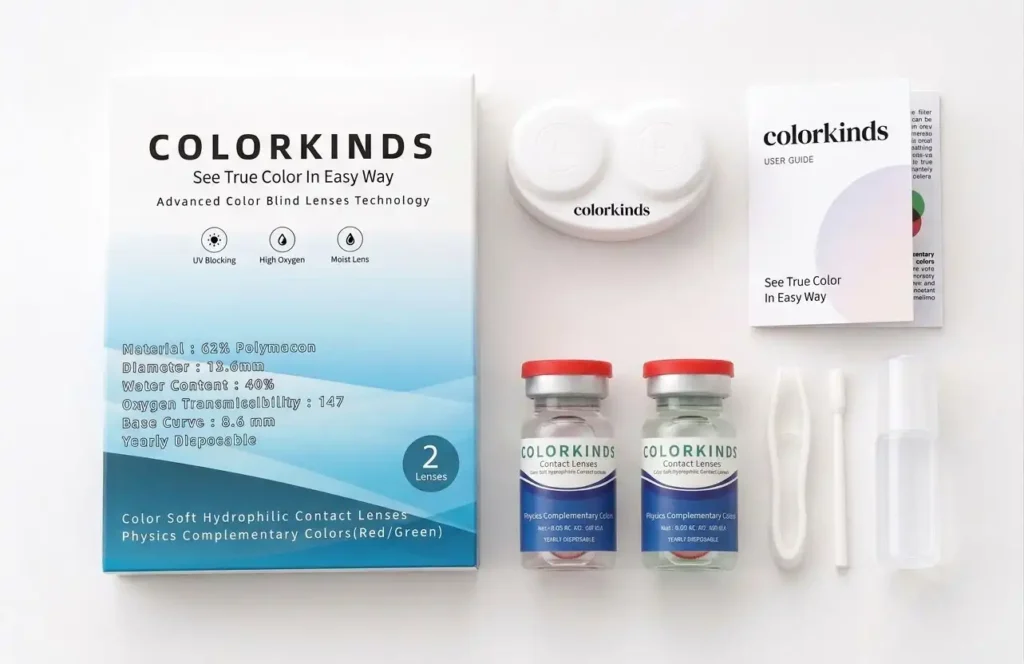
Your order includes everything you need: one pair of colorblind contacts, a lens storage case, a user guide with instructions, and an applicator and removal pack. No additional purchases required to get started.
Price vs. Value
Colorkinds contacts cost about $0.27 per day for 12 months of use. Think about what passing your color vision test means for your career. A promotion. A new job. A career path that would otherwise be blocked. At $99 for the whole year, it’s hard to beat.
For a full breakdown with total cost of ownership and insurance considerations, read: Color Blind Contacts Price: Cost Guide & Value Comparison (2026)
Prescription Requirements and Vision Correction
Do you need a prescription for colorblind contacts? It depends on the product:
- Colorkinds CCG-088: No prescription required. The lenses are Plano (0.00) — non-corrective — and classified as a medical device for color vision correction. If you have 20/20 vision or correct your vision separately, you can order directly from colorkinds.com without an eye exam.
- ChromaGen: Requires an in-person fitting with an authorized practitioner. The lenses can be made with or without prescription power depending on your needs.
What If You Need Vision Correction?
If you already wear prescription contacts or glasses for nearsightedness, farsightedness, or astigmatism, you have several options:
- Wear Colorkinds under clear prescription glasses. Put in your Colorkinds contacts first, then wear your regular glasses on top. This works well because Colorkinds are Plano and don’t interfere with your prescription correction. Your color vision improves while your refractive error stays corrected.
- Alternate between pairs. Wear Colorkinds on test days and color-critical workdays, and your regular contacts on other days. Since Colorkinds are yearly disposable, you can stretch your investment across the entire year while only using them when color discrimination matters most.
- Get ChromaGen with prescription built in. ChromaGen can be manufactured with your prescription power integrated into the lens. The trade-off is higher cost ($400-800) and the requirement for an in-person practitioner visit, which may not be accessible depending on your location.
This flexibility means colorblind contacts work for virtually anyone — regardless of whether you need vision correction or not.
Can Color Blind Contacts Help You Pass Occupational Tests?
This is the question most people are really asking. The answer depends on which test you’re facing and which career you’re pursuing.
Test Compatibility
| Test | Colorblind Contacts Effective? | Notes |
|---|---|---|
| Ishihara color plate test | Yes — highest effectiveness | The most common occupational screening — contacts are engineered specifically for this |
| Farnsworth D-15 | Yes — contrast enhancement helps | Arrangement test becomes significantly easier with enhanced color discrimination |
| Farnsworth Lantern (FALANT) | Yes | Color separation helps identify navigation light colors |
| OPTEC 900 | Yes | Digital test with color discrimination tasks |
| Waggoner CCVT | Yes | Computerized test — enhanced contrast aids performance |
| FAA MCT (Medical Certificate Test) | Yes — for initial screening | FAA does not permit contacts during the exam itself but they can help with off-duty training |
| CAD test | Limited | High-precision test may detect filtering |
Career-Specific Guidance
| Career | Contacts Helpful? | Testing Policy |
|---|---|---|
| Pilot (FAA) | Yes — for training and practice | FAA prohibits contacts during the actual medical exam. Use them to build color recognition habits for OCVT/Signal Light Gun test. Read our [FAA pilot guide](https://www.colorkinds.com/how-to-prepare-faa-pilot-color-vision-test-guide/) |
| Police / Law enforcement | Yes — for pre-employment testing | Most agencies allow corrective contacts during screening. Verify with your specific department. |
| Electrician | Yes — for licensing tests and daily work | Wiring identification becomes safer and more accurate |
| Firefighter | Yes — for NFPA 1582 screening | Compatible with SCBA masks and helmets |
| Nurse / EMT | Yes — for credentialing tests | Helps read patient monitoring equipment and color-coded charts |
| Military | Yes — for entry screening | Each branch has specific policies. Check with your recruiter. |
| Maritime / USCG | Yes — for STCW requirements | Navigation light and signal flag identification improves |
Detailed Career Breakdown
Aviation: Pilots, air traffic controllers, and aviation maintenance technicians face strict color vision requirements for medical certification. The FAA and most civil aviation authorities require passing the Ishihara test or an approved alternative (Farnsworth D-15, CAD test, Waggoner CCVT). Colorblind contacts help pilots prepare for these screenings and improve their color discrimination for daily flight operations. For FAA-specific guidance, see our dedicated FAA pilot guide.
Law Enforcement: Police officers, federal agents, and state troopers undergo Ishihara screening as part of their medical examination. Many departments offer secondary testing (Farnsworth D-15 or Waggoner CCVT) if you fail the initial Ishihara — and contacts improve performance on both. On patrol, contacts help with identifying suspect descriptions, traffic signals, and evidence involving color.
Electrical Trades: Electricians, lineworkers, and technicians must distinguish red, green, brown, and blue wiring on a daily basis. Color vision is tested for licensing in many jurisdictions. Contacts worn on the job provide continuous color enhancement without interfering with safety glasses or hard hats — unlike glasses, which fog up and shift around during physical work.
Firefighting: The NFPA 1582 medical standard includes color vision requirements for structural firefighters. Colorblind contacts help firefighters pass their medical evaluation and improve hazard identification — distinguishing red warning lights, green status indicators, and color-coded equipment on scene. Contacts fit comfortably under SCBA masks and helmets.
Medical: Nurses, doctors, surgeons, and EMTs rely on color-coded charts, patient monitoring equipment, and visual assessment of skin tone (cyanosis, flushing, jaundice). Hospital credentialing often includes color vision screening. Contacts provide discreet correction that works under surgical loupes and face shields.
Maritime: Deck officers, Coast Guard personnel, and maritime crew must pass STCW color vision standards for international certification. Navigation lights, signal flags, and chart symbols all require color discrimination. Contacts work under binoculars, weather gear, and uniform requirements.
When NOT to Wear Contacts During Testing
Some agencies ban color-correcting lenses during exams. The FAA medical certificate test is a key example. Wearing contacts there is an integrity violation. The same goes for some federal law enforcement agencies.
That’s why we recommend Colorkinds contacts as an off-duty training tool. Use them to build color recognition habits. Or use them for careers where corrective aids are allowed during screening.
Read our complete guide: Color Blind Contacts for Test Passing: How to Prepare for Your Occupational Exam
Are Colorblind Contacts Safe?
Is it safe? Yes — with the right product and proper use.
FDA Status
Only ChromaGen has FDA 510(k) clearance (K994320, cleared October 2000) specifically for “enhancing color discrimination in patients with protan or deutan color vision deficiencies.” It is classified as a Class II medical device.
Colorkinds CCG-088 contacts are made from Polymacon, an FDA-approved contact lens material widely used in the industry. They are registered with the FDA and manufactured following medical device quality standards.
Known Side Effects
The FDA warns that darker-tinted colorblind contact lenses may cause:
- Reduced low-contrast acuity
- Reduced illumination at night
- Distortions in distance perception of moving objects
- Distortions of apparent velocity
These effects are more pronounced with darker tints and in low-light conditions. Colorkinds CCG-088 uses a lighter tint designed to minimize these effects.
General Contact Lens Safety
All contact lenses — including colorblind contacts — carry standard risks:
| Risk | Prevention |
|---|---|
| Corneal infection | Proper hygiene — wash hands, use fresh solution daily |
| Corneal scratch | Proper fitting, clean lenses, no overnight wear |
| Dryness | Use rewetting drops, limit wear time if needed |
| Allergic reaction | Check lens material compatibility |
Safety Guidelines
- Buy from reputable sellers — only FDA-registered products from trusted brands
- Wash your hands before handling your lenses
- Use fresh solution every time — never reuse
- Don’t sleep in them — these are daily wear only
- Replace after 12 months — even if they still feel fine
- Take them out if your eyes feel uncomfortable
- See an eye doctor if problems persist
Want more detail? Read: Are Colorblind Contacts Safe? FDA Status, Side Effects & Proper Care
How to Buy Color Blind Contacts
Option 1: Colorkinds CCG-088 — Direct Online Order
Best for: Most people who need contacts for occupational test passing
- Visit colorkinds.com
- Confirm your color blindness type (protan or deutan — both work)
- Place your order — no prescription needed for Plano lenses
- Receive your complete kit with user guide
- Start with short wear periods to adapt, then use 30 minutes before your test
Price: ~$99 with free worldwide shipping Guarantee: 60-day money-back — if they don’t work for your test, send them back
Option 2: ChromaGen — Practitioner Visit Required
Best for: People who also need a prescription fitting or want FDA-cleared lenses
- Find a ChromaGen-trained practitioner near you
- Schedule a fitting and color vision assessment
- The practitioner orders your custom lenses
- Attend a follow-up to verify fit and effectiveness
Price: ~$400–800 depending on prescription and country
What to Avoid
- Don’t buy from random online sellers — skip costume shops and social media ads
- Watch for prices that seem too low — real colorblind contacts cost more to make
- Ignore “miracle cure” claims — no product cures color blindness
- Always check the return policy before you buy
International Buyers
Colorkinds ships free worldwide from our Hong Kong warehouse. Delivery typically takes 7-14 days depending on your location. The package is discreet — no one needs to know what’s inside.
UK buyers should read our dedicated guide: Colour Blind Contact Lenses: Complete UK Guide (2026) for British-specific pricing, shipping, and career information. We cover CAA pilot rules, UK police testing, NHS considerations, and more.
Orders are processed in USD but the checkout accepts all major currencies and payment methods including Visa, Mastercard, and PayPal.
Color Blind Contacts vs. Other Solutions
A quick comparison of all available solutions for red-green color blindness:
| Solution | Price Range | Best For | Limitations |
|---|---|---|---|
| Colorkinds contacts | ~$99/year | Test passing, daily use, PPE compatibility | Plano only (non-prescription) |
| ChromaGen contacts | ~$400–800/pair | Prescription wearers, full tint range | Expensive, requires practitioner |
| EnChroma glasses | $189–$429 | Lifestyle color enhancement | Less effective for test passing, visible, no PPE |
| Pilestone glasses | $100–200 | Budget glasses option | Limited testing data for occupational use |
| Colorlite glasses | Varies | Personalized prescription glasses | Requires in-person fitting |
| No correction | Free | — | May limit career options with color vision requirements |
The bottom line: If your goal is passing an occupational color vision test, colorblind contacts are the most practical solution you’ll find.
The Bottom Line
Color blind contacts are a real, proven technology that helps thousands of professionals pass color vision tests and advance their careers. Two options exist — Colorkinds (affordable, online, ~99/year) and ChromaGen (higher cost, practitioner-required, ~400-800) — and both have legitimate safety credentials.
If you need to pass a color vision test for your career, contacts are the most effective tool available:
- They cost less than glasses on an annual basis
- They perform better on Ishihara and other occupational tests
- They work under any safety gear — helmets, SCBA masks, safety glasses
- Nobody can tell you’re wearing them — complete discretion
- They ship worldwide and require no prescription (Colorkinds)
Ready to try them? Colorkinds colorblind contacts come with a 60-day money-back guarantee. Put them in 30 minutes before your exam and see what you’ve been missing.
Frequently Asked Questions
Yes, for red-green color vision deficiency (protan and deutan). They use spectral notch filtering to help your brain tell red from green. Multiple studies support their effectiveness. Thousands of professionals have used them to pass occupational tests.
Colorkinds CCG-088 costs ~$99 for a pair that lasts 12 months. ChromaGen ranges from ~$400–800 per pair. Colorkinds includes free worldwide shipping and a 60-day money-back guarantee.
You can order Colorkinds CCG-088 directly from colorkinds.com — no prescription needed for Plano lenses. ChromaGen requires a visit to a trained practitioner. Always buy from reputable sellers.
Yes — when bought from trusted brands and used correctly. Colorkinds CCG-088 uses FDA-registered material. ChromaGen has FDA clearance. Follow basic contact lens hygiene: wash hands, use fresh solution, don’t sleep in them, replace each year.
Yes — they are designed for daily wear up to 12+ hours. Put them in the morning and wear them through your workday. The soft hydrogel material with 40% water content provides all-day comfort.
Colorkinds CCG-088 Plano (non-prescription) lenses do not require a prescription. If you need vision correction, you can wear them under your regular prescription glasses or alongside prescription contacts.
Yes. Colorkinds contacts are specifically engineered to enhance red-green discrimination — which is exactly what the Ishihara test measures. With proper use (put them in 30 minutes before your exam), they have a 100% Ishihara pass rate.
Most state and local police departments allow corrective contacts during vision screening. However, some agencies — particularly federal law enforcement and the FAA — prohibit auxiliary aids. Always check with your specific examiner before your test.
Colorkinds CCG-088 is a yearly disposable lens — one pair lasts up to 12 months with proper care. ChromaGen also offers a 12-month replacement schedule.
Yes. Colorkinds CCG-088 works for both protan (red-deficient) and deutan (green-deficient) color blindness, covering ~99% of all color vision deficiency cases.
Related Resources
- Do Colorblind Contacts Work? Science, Evidence & Real User Results
- Color Blind Contacts for Protan and Deutan: What’s the Difference?
- Color deficiency contact lenses vs color blind contacts: Same thing?
- Colorblind Contacts vs Glasses: Head-to-Head Comparison Guide (2026
- Color blind contacts price: Cost guide and value comparison 2026
- Colorblind contact lenses for adults: Complete buying guide 2026
- Career Navigation Hub: Color Vision Test Guide by Career
- Colorkinds Colorblind Contacts — Shop Now