The Police Color Blind Test: How to Pass & What If You Fail (2026)
If you have spent your life dreaming of wearing the badge, only to discover you have a color vision deficiency, you are likely experiencing a massive wave of anxiety. You are not alone. Every year, thousands of highly qualified law enforcement applicants type “police color blind test” into Google, terrified that a simple booklet of colored dots will instantly end their career.
Let’s get straight to the facts: Failing your initial police color vision test is rarely an automatic disqualification.
While complete color blindness (seeing only in grayscale) is a dealbreaker for police work, the vast majority of people with a red-green color deficiency can still become sworn officers. Law enforcement agencies across the country have realized that clinical clinic tests do not always reflect real-world street capabilities.
In this ultimate guide, we will break down exactly how the medical screening process works, what happens if you fail the initial test, the state-by-state standards you need to know, and how to successfully navigate a practical field test to save your career.
What is the Police Color Blind Test? (The Primary Gatekeeper)
When you finally make it through the grueling interviews, background checks, and physical fitness exams, you will be sent for a comprehensive medical evaluation. This is where the primary gatekeeper of color vision awaits.
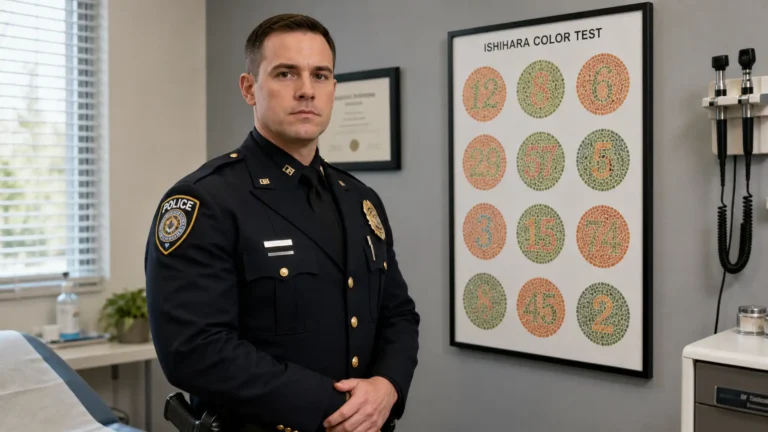
The Ishihara Plate Test
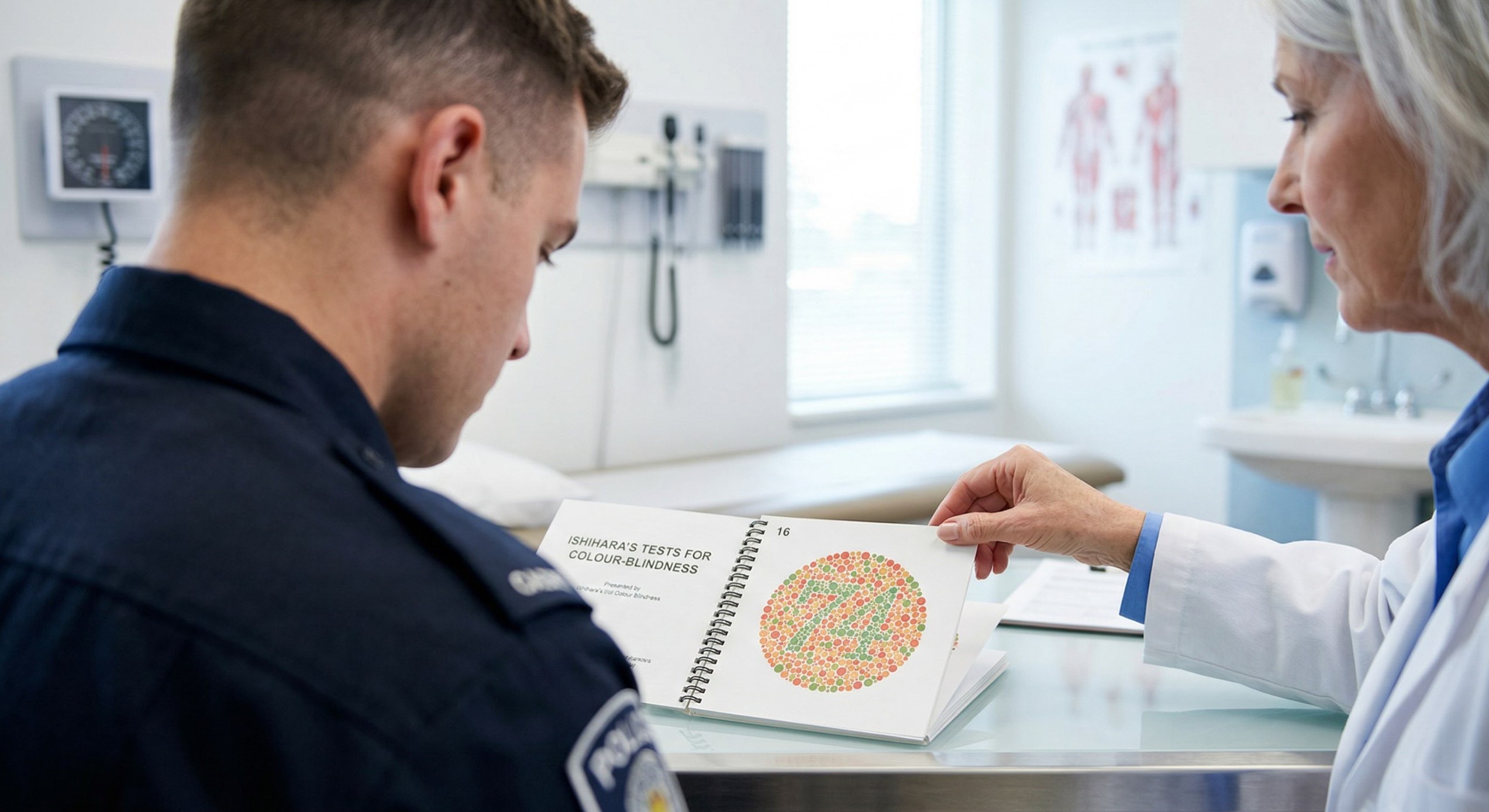
In almost every jurisdiction, your first encounter with a police color blind test will be the Ishihara Pseudoisochromatic Plate Test. This test has been around for over a century.
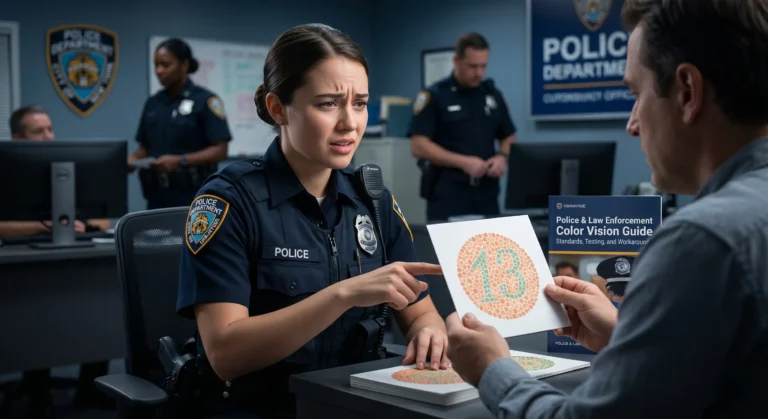
You will be seated in a brightly lit room and handed a booklet. Each page features a circle composed of randomized colored dots. Hidden within those dots is a number in a contrasting color (for example, a green number “8” hidden in a field of red and orange dots). You must correctly identify the number within a few seconds.
Why the Ishihara Test Causes Panic
The Ishihara test is notoriously unforgiving. It is designed to be hyper-sensitive. Because of this, candidates with incredibly mild anomalous trichromacy (a slight weakness in seeing red or green) will often fail this test, even if they have absolutely no problem seeing traffic lights or brake lights in the real world.
Why Color Vision Matters in Law Enforcement
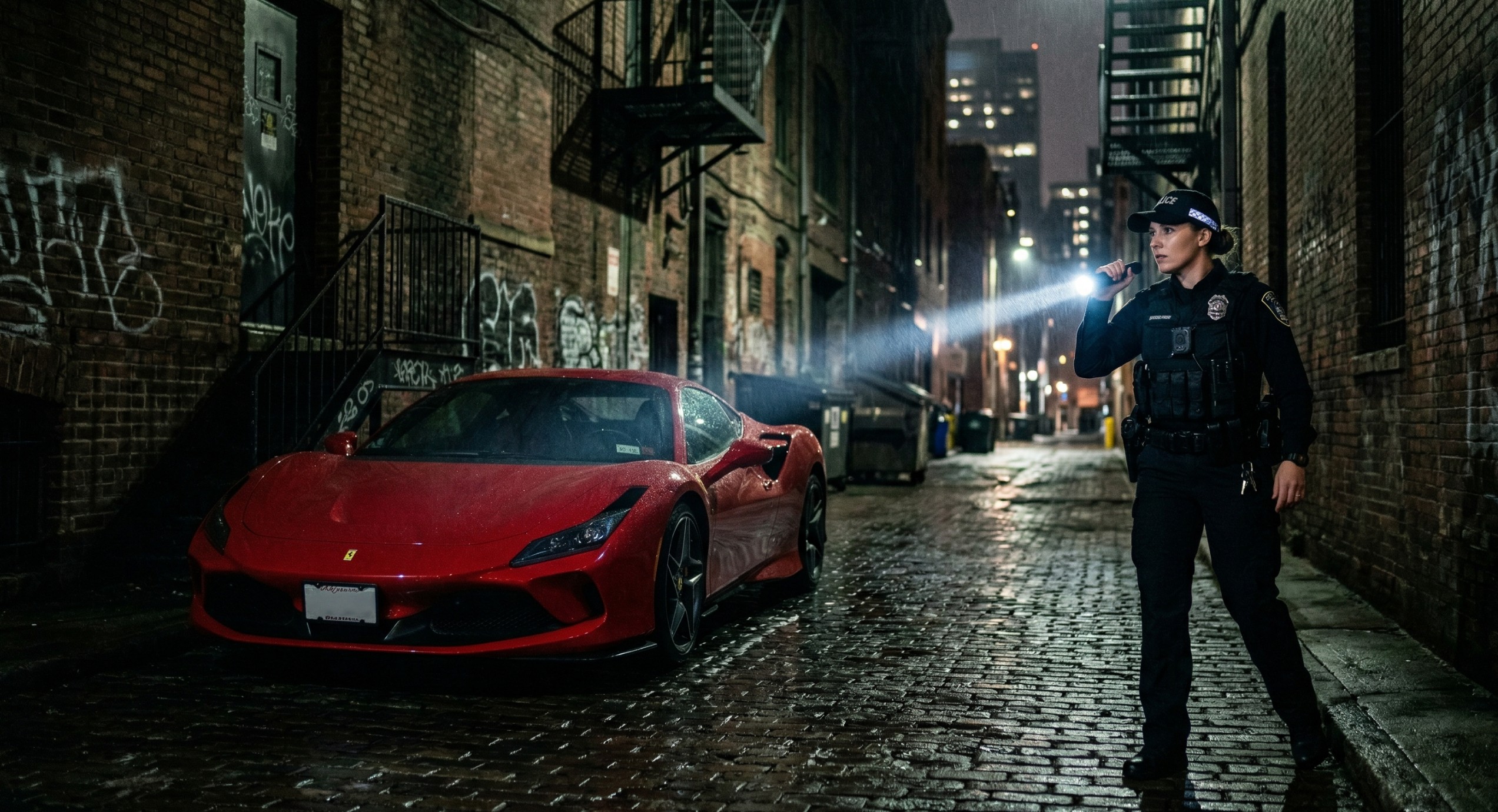
It is easy to get frustrated with these medical standards, but police departments enforce them for critical safety reasons. The Americans with Disabilities Act (ADA) generally supports police departments in upholding these standards because color vision is classified as a “Bona Fide Occupational Qualification.”
On patrol, your life and the lives of others depend on accurate color identification:
- Suspect Identification: You must be able to instantly differentiate between a suspect fleeing in a red hoodie versus a brown jacket in a crowded area.
- Vehicle Pursuits: Accurately relaying the color of a fleeing vehicle to dispatch is vital for coordinating roadblocks.
- Crime Scene Analysis: You must be able to spot the subtle difference between a blood stain and a dark puddle of water on dark pavement.
- Tactical Situations: In high-stress scenarios, you must be able to quickly acquire the red dot of a Taser laser sight against a suspect’s clothing.
What Happens if You Fail? (The Backup Tests)
If you fail the Ishihara test at the clinic, take a deep breath. For many agencies, failing the “dot test” simply triggers the next phase of the medical evaluation. You have the right to prove your functional vision through alternative means.
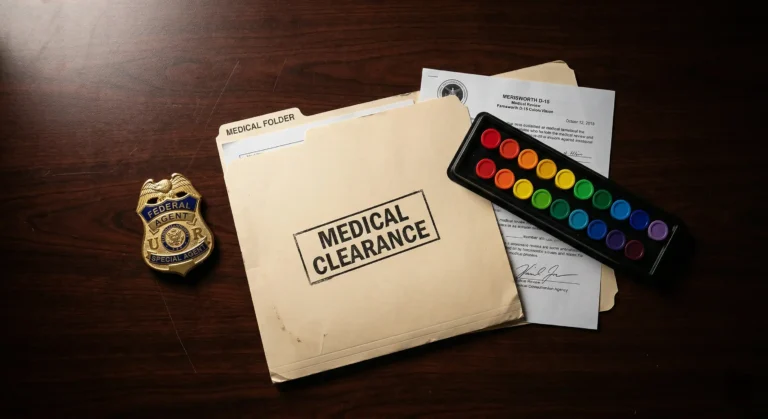
The Farnsworth D-15 Alternative
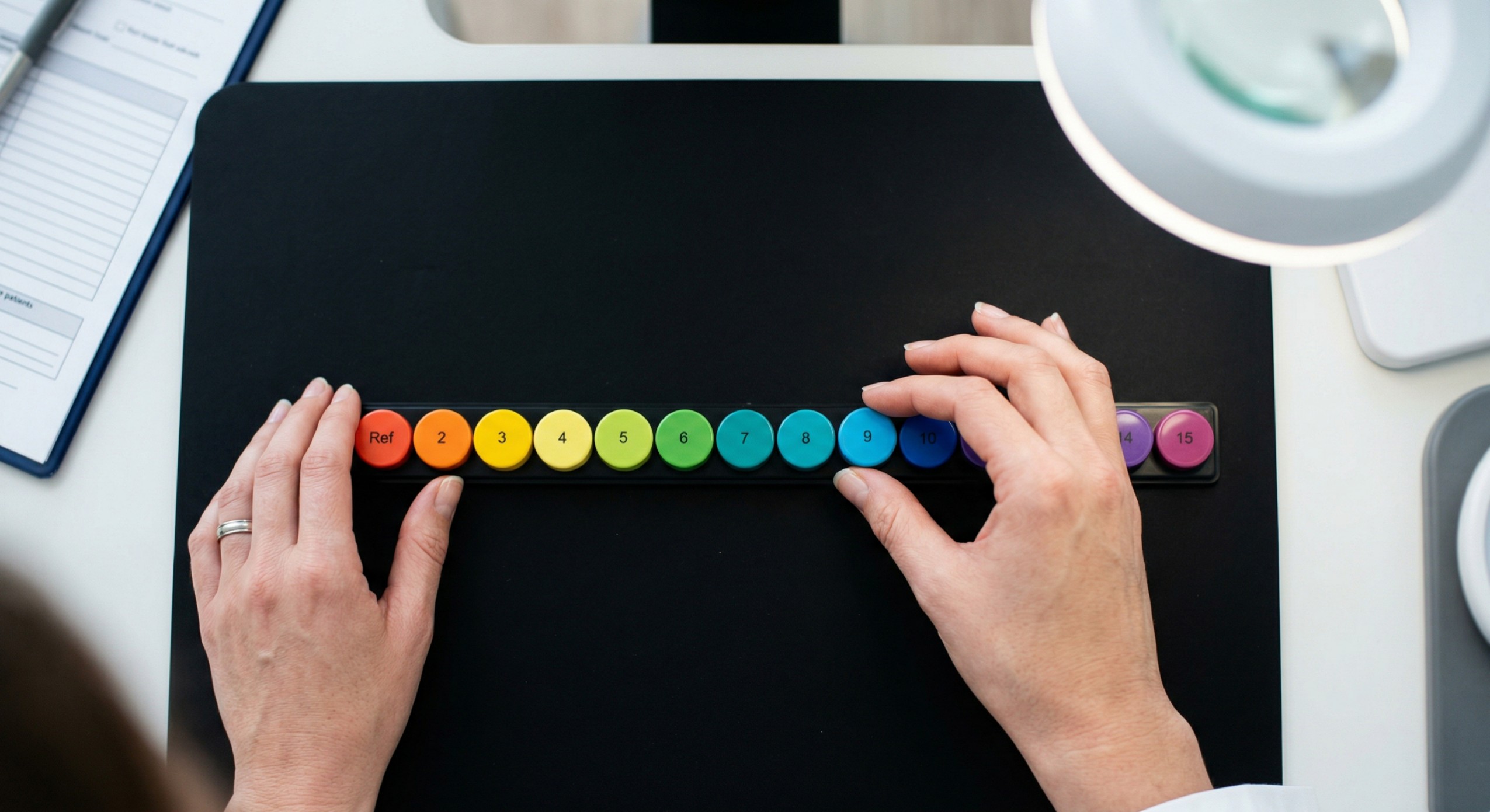
If you are researching failing police color vision test protocols, the term you need to memorize is the Farnsworth D-15. Many state POST (Peace Officer Standards and Training) commissions mandate that if a candidate fails the Ishihara, the medical examiner must administer the D-15 test.
Unlike the dot test, the Farnsworth D-15 test police alternative is a color arrangement test. You are given 15 colored caps and asked to arrange them in a smooth, continuous color gradient (like a rainbow).
Why is this good news? The D-15 is specifically designed to screen out severe color blindness while allowing individuals with mild to moderate deficiencies to pass. If you only make one or two minor sequence errors, you pass the test and are cleared for duty.
The Police “Field Test” (How to Prepare)
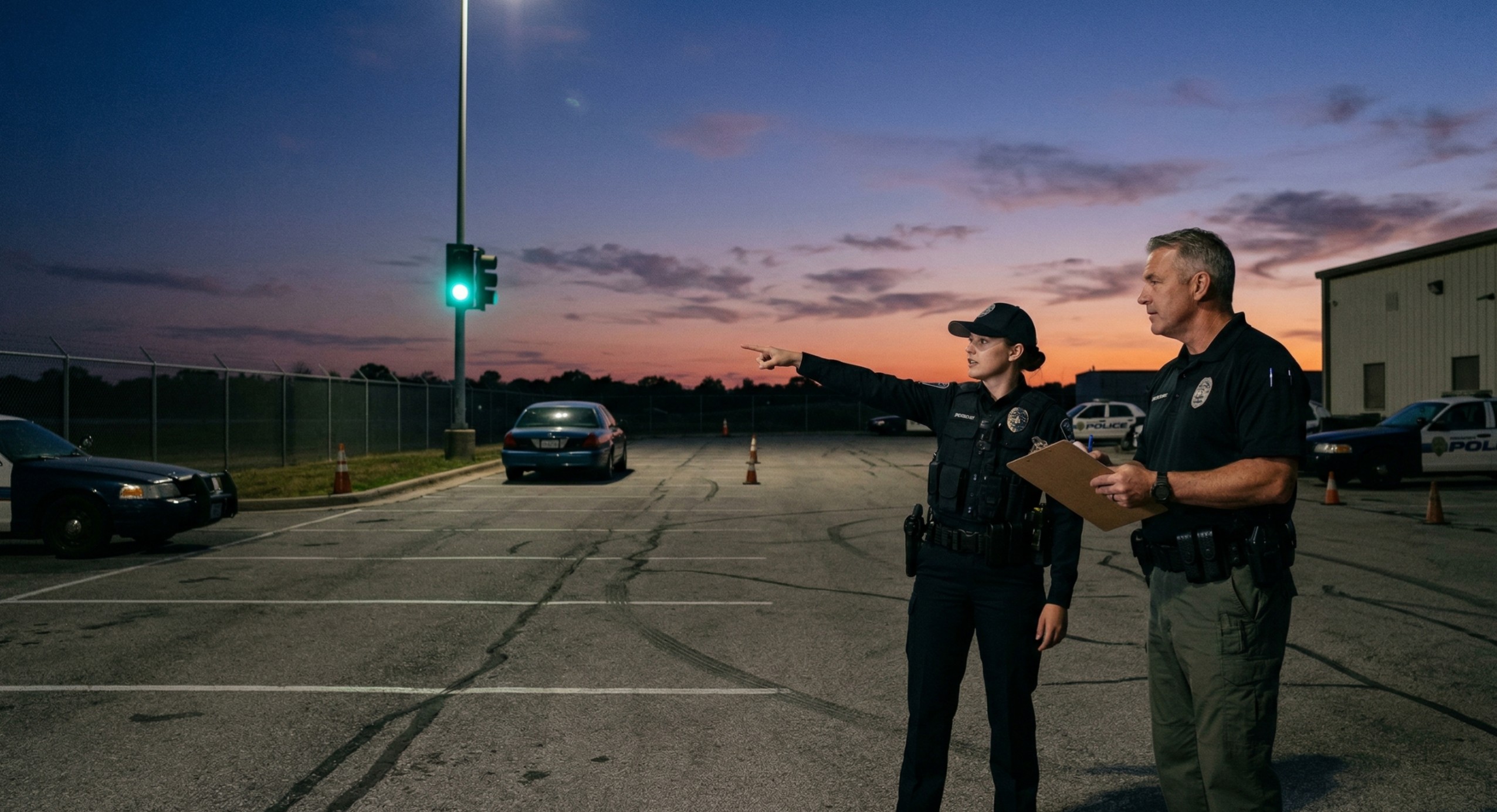
What if you fail the D-15? In many progressive states (such as Oregon, New York, and parts of California), you can formally petition your hiring agency for a police field test for color blindness.
A field test removes the clinic entirely. An agency instructor or medical officer will take you to a real-world environment—often a dimly lit parking lot or a shooting range—to test your functional, occupational vision.
How to prepare for your field test:
- Nighttime Vehicle Identification: Practice standing 100 feet away from cars in a dark parking lot. Have a friend quiz you on the color of the vehicles. Focus on telling the difference between dark blue, black, and dark red.
- Clothing Descriptions: Practice identifying clothing colors under harsh, yellow streetlights.
- Traffic Signals: You will be asked to identify the color of a traffic light instantly, without relying on the position of the light (top, middle, bottom).
The “Cheat Sheet”: State-by-State Police Colorblind Standards
One of the most frustrating aspects of becoming a police officer is that standards are not federally unified. What disqualifies you in one county might be perfectly acceptable one town over.
Here is a general breakdown of how agencies handle color vision in 2026:
Zero Tolerance Agencies
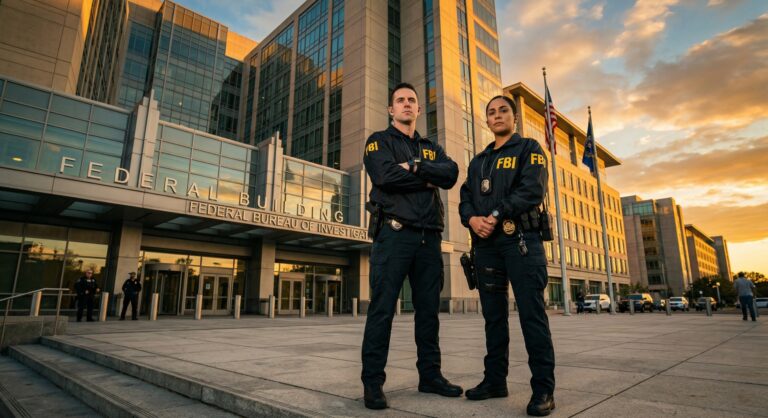
Some agencies offer no alternative testing. If you fail the Ishihara, you are out. This typically applies to highly competitive State Highway Patrol agencies in certain jurisdictions, and almost all Federal Law Enforcement agencies (FBI, DEA, ATF).
Agencies that Allow Alternative Testing
The good news is that the majority of municipal and county departments are flexible.
- California POST: Officially allows the Farnsworth D-15 as a secondary test.
- Massachusetts Civil Service: Allows the Farnsworth D-15. If a candidate fails, they can file a formal medical appeal.
- Oregon DPSST: Explicitly allows applicants who fail clinical tests to demonstrate their ability via a practical field test approved by an examining physician.
- Texas TCOLE & Florida: Many large city departments (like Houston PD) have specific medical waivers in place for mild color deficiencies, provided the D-15 is passed.
To navigate the exact medical codes for your state, check our complete guide to law enforcement color vision requirements.
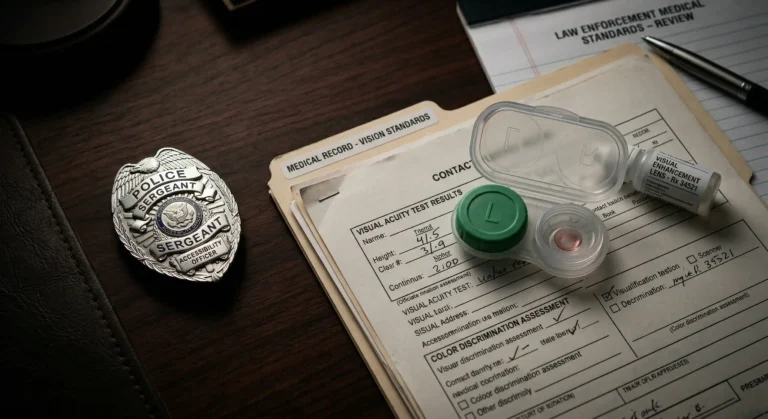
Can You Wear Colorblind Contacts for the Police Medical Exam?
As you research solutions, you will inevitably ask: can police wear colorblind contacts to pass the medical exam? We need to address this with absolute transparency.
The Strict Ban During Medical Testing
No. You cannot wear color-correcting lenses to your police medical exam.
Police medical boards and Civil Service Commissions strictly prohibit the use of ColorKinds lenses, tinted glasses, or colorblind contacts during official vision screening. Your medical examiner will check your eyes. If you are caught attempting to hide corrective lenses to beat the Ishihara test, you will be permanently disqualified for integrity violations.
How to Legally Use Lenses for Academy Training
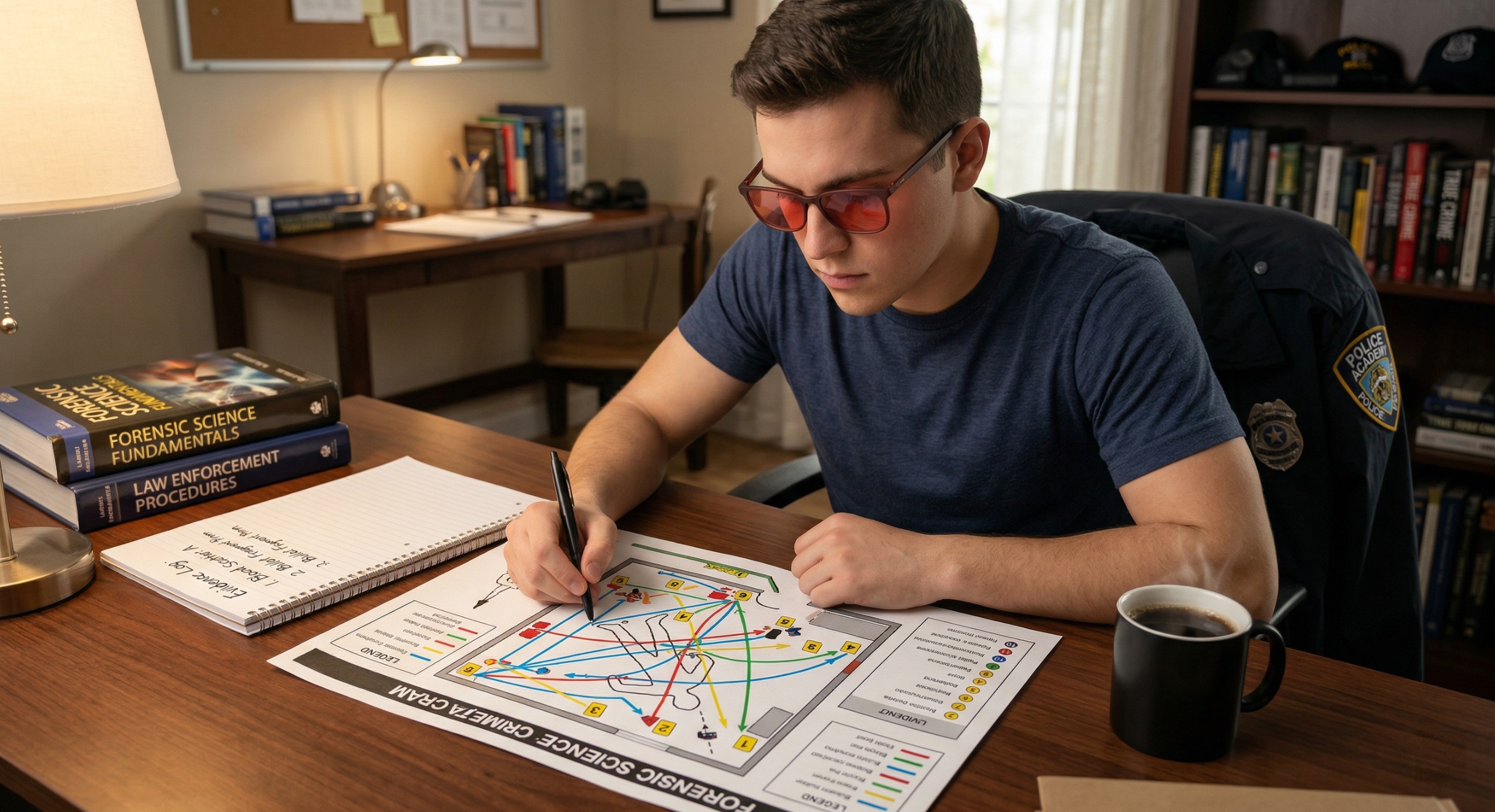
Just because you cannot wear them during the medical exam or on active patrol does not mean colorblind lenses are useless. In fact, they are one of the most powerful study tools a recruit can own.
The police academy is academically grueling. You will spend hundreds of hours in ground school and tactical training where color recognition is heavily tested. This is where Colorkinds colorblind glasses and contacts provide a massive, legal advantage:
- Studying Forensics & Crime Scene Diagrams: Academy textbooks rely heavily on color-coded charts to explain blood spatter analysis and chemical drug-testing kits. Wearing your lenses while studying ensures you grasp the theory perfectly.
- Target Acquisition at the Range: Many recruits use color-enhancing lenses during their private, off-duty firearms practice to better distinguish the colored scoring zones on paper targets.
- Brain Training: By intensely studying the real world with the lenses on, you can train your brain to recognize subtle contrasts. This mental preparation is invaluable when you take the lenses off for your official naked-eye field test.
Prepare for the Academy with Confidence
Don’t let a color vision deficiency hold you back from mastering the academic theory of law enforcement. Use the ultimate ground-school study hack.
Shop Colorblind Lenses for TrainingAlternative Career Pathways in Law Enforcement
What happens if your color blindness is severe, and you cannot pass the D-15 or the field test? Do not throw away your passion for justice.
There are incredibly rewarding, high-paying, non-sworn roles within law enforcement that keep you close to the action but do not require perfect color vision:
High-Paying Non-Sworn Roles
- 911 Dispatcher / Emergency Telecommunicator: You are the lifeline of the police department. While some agencies test color vision for reading digital maps, the requirements are vastly more lenient than for patrol officers.
- Criminal Intelligence Analyst: Work with detectives to map out organized crime syndicates, track digital footprints, and analyze gang activity.
- Crime Scene Technician (CSI): Depending on the state, many civilian evidence collection roles rely more on high-tech chemical analysis tools than raw naked-eye color perception.
- Cybercrime Investigator: The fastest-growing field in law enforcement. Tracking down hackers and financial fraudsters happens in code, not in color.
A color vision deficiency is a hurdle, but it is rarely a dead end. By understanding the testing procedures, advocating for alternative field tests, and utilizing legal training tools, you can successfully navigate the medical bureaucracy and earn your badge.
Frequently Asked Questions (FAQ)
Is complete color blindness an automatic disqualification for police officers?
Yes. Complete color blindness, known as monochromacy (seeing only in shades of gray), is universally considered an automatic disqualification across all local, state, and federal law enforcement agencies due to severe safety risks.
What is the standard police color blind test called?
The primary screening tool used by almost all police academies is the Ishihara Plate Test. This involves looking at a booklet of circular plates filled with colored dots to identify hidden numbers.
What happens if I fail the Ishihara color vision test during my police medical exam?
Failing the Ishihara test is rarely the end of the road. Most agencies will immediately offer a secondary, more forgiving diagnostic test, such as the Farnsworth D-15 color arrangement test or a practical field test.
What is the Farnsworth D-15 test?
The Farnsworth D-15 is an alternative color vision test where candidates must arrange 15 colored caps in a smooth gradient sequence. It is designed to screen out severe color blindness while allowing individuals with mild red-green deficiencies to pass.
Can I wear colorblind contacts or glasses to the police medical exam?
Absolutely not. The use of X-Chrom lenses, tinted glasses, or color-correcting contact lenses during an official law enforcement medical exam is strictly prohibited. Attempting to use them is grounds for immediate disqualification and removal from the hiring process.
Can I appeal a police medical disqualification for color vision?
Yes. If you are disqualified, you usually have the right to appeal the decision through your local Civil Service Commission. You will typically need to hire an independent eye specialist to provide evidence that your color vision is sufficient for the job.
What is a police field test for color blindness?
A field test is a practical exam conducted by the police department. An applicant is taken to an outdoor environment (often at night) and asked to identify the makes, models, and colors of vehicles, read license plates, and describe clothing colors under poor lighting conditions.
Do all police departments have the same color vision standards?
No. Standards vary wildly. While federal agencies (like the FBI) have strict zero-tolerance policies, many municipal departments and state POST (Peace Officer Standards and Training) commissions are highly flexible and offer multiple backup tests.
Are colorblind glasses useful for police recruits?
Yes. While you cannot wear them on patrol or during the medical exam, colorblind glasses are excellent training aids. Recruits use them to study color-coded forensic charts, improve target contrast at the shooting range, and train their brains for the naked-eye field test.
Can I join the FBI or SWAT if I am colorblind?
Generally, no. Federal law enforcement agencies (FBI, DEA, ATF) and specialized tactical units (SWAT, Bomb Squad) maintain extremely strict color vision requirements due to the high-stakes nature of the work, such as identifying tactical lasers or disarming explosives.