The Complete Guide to SWAT Color Vision Requirements: Tests, Waivers, and Tactical Reality
For an ambitious law enforcement officer, making the SWAT (Special Weapons and Tactics) team is the pinnacle of a tactical career. It requires elite physical fitness, impeccable marksmanship, and split-second decision-making. But what happens when the only thing standing between you and the “stack” is a book of colored dots?
Color vision deficiency (CVD), commonly known as color blindness, is one of the most frustrating barriers for tactical recruits. While many patrol divisions have modernized their medical standards to accommodate mild color blindness, the SWAT color vision requirements remain incredibly strict.
In the high-stakes environment of a hostage rescue or an active shooter scenario, misidentifying a colored wire, a chemical smoke plume, or the safety indicator on a suspect’s weapon can result in catastrophic consequences.
In this comprehensive guide, we will break down exactly what the medical gatekeepers are looking for, the tactical realities of why these standards exist, the controversy surrounding optical workarounds, and the actionable steps you can take to appeal a medical disqualification.
Can You Be on a SWAT Team if You Are Colorblind? (The Short Answer)
The short answer is: It depends entirely on the severity of your deficiency and the specific agency you are applying to.
There is a massive distinction between the medical requirements for a standard patrol officer and an elite tactical operator. While a mild anomalous trichromat (someone with a slight red-green weakness) might easily pass a standard police medical screening, that same deficiency can be an automatic disqualifier for a specialized unit.
To understand your chances, you must look at the jurisdictional differences:
- Local Municipal and County SWAT: These teams often follow their state’s Peace Officer Standards and Training (POST) guidelines. Many local departments operate on a waiver system. If you fail the initial dot test, you may be granted a secondary functional field test to prove you can perform the job safely.
- State Police/Highway Patrol SRTs: State-level tactical teams usually have more rigid, codified medical standards. Waivers are harder to obtain, and a failure on a secondary clinical test (like the D-15) is typically a hard stop.
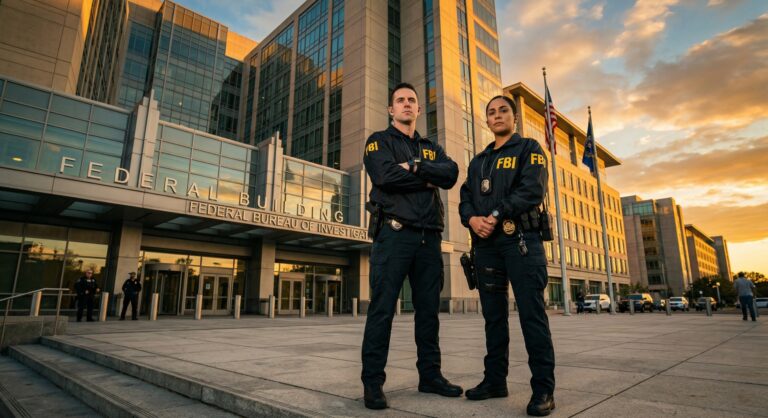
- Federal Tactical Teams (FBI HRT, DEA FAST, BORTAC): Federal agencies operate under zero-tolerance medical policies for their elite tactical units. While the FBI might allow a mildly colorblind applicant to become a standard Special Agent, specialized roles like the Hostage Rescue Team (HRT) or Bomb Techs require flawless, uncorrected color discrimination.
Expert Insight
Do not assume that because you are cleared for street patrol, you are medically cleared for SWAT. Tactical team tryouts usually trigger a completely new, rigorous medical workup with stringent sensory baselines.
The Medical Screening: Understanding the Gatekeeper Tests
Before you ever breach a door or fire a rifle in selection, you must survive the clinical eye exam. Understanding the tests you will face is your first tactical advantage.
The Primary Screen: Ishihara Pseudoisochromatic Plates
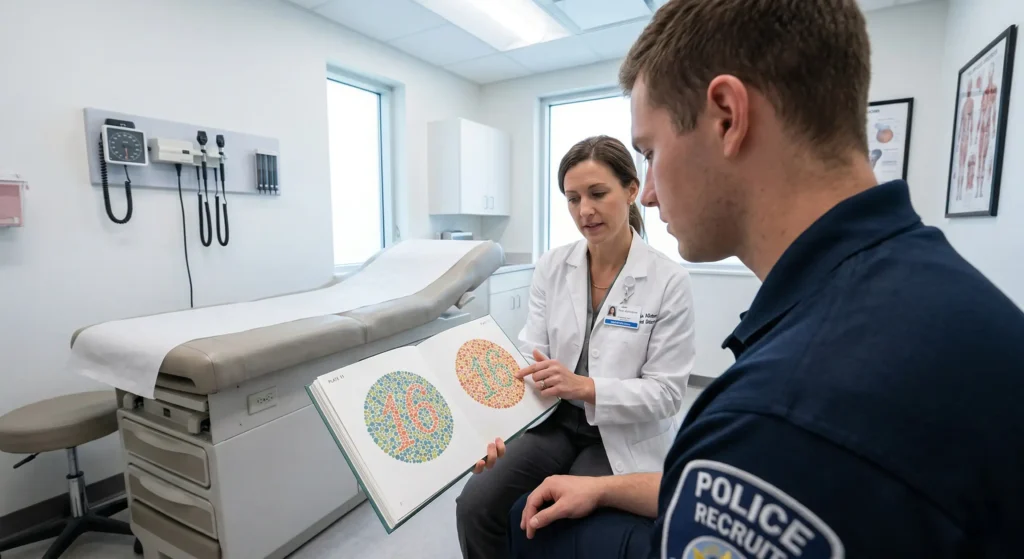
The most common initial barrier is the Ishihara test. You will be asked to look at a series of plates filled with colored dots and identify the numbers hidden within. Most police departments require a candidate to correctly identify at least 9 out of 13 (or 10 out of 14) plates.
The problem? The Ishihara is highly sensitive. It operates as a binary gatekeeper—it identifies that you have a deficiency, but it is notoriously bad at determining the severity. A candidate who struggles slightly with certain shades of green will fail just as spectacularly as someone with severe red-green blindness.
The Secondary Lifeline: Farnsworth D-15 Panel Test
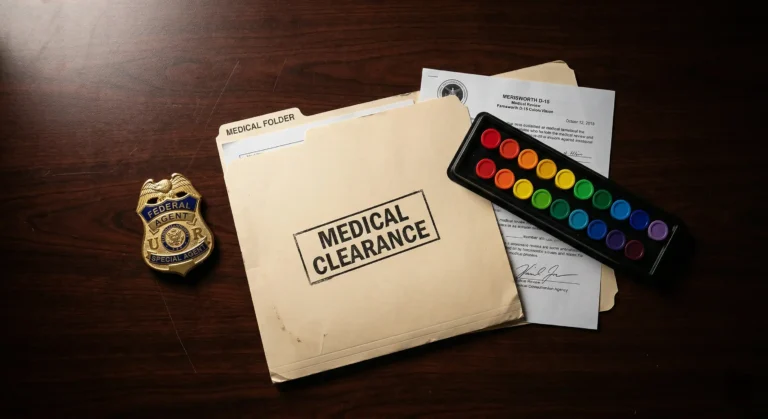
If you fail the Ishihara, your SWAT dreams are not necessarily dead. Progressive agencies will move you to a secondary assessment, most commonly the Farnsworth D-15 test.
Instead of reading hidden numbers, the D-15 requires you to arrange 15 colored caps in a smooth chromatic gradient. This test is designed specifically for occupational screening. It filters out severe deficiencies (dichromacy) while allowing individuals with mild deficiencies to pass. Passing the D-15 proves you possess “functional color vision”—often enough to satisfy a medical board.
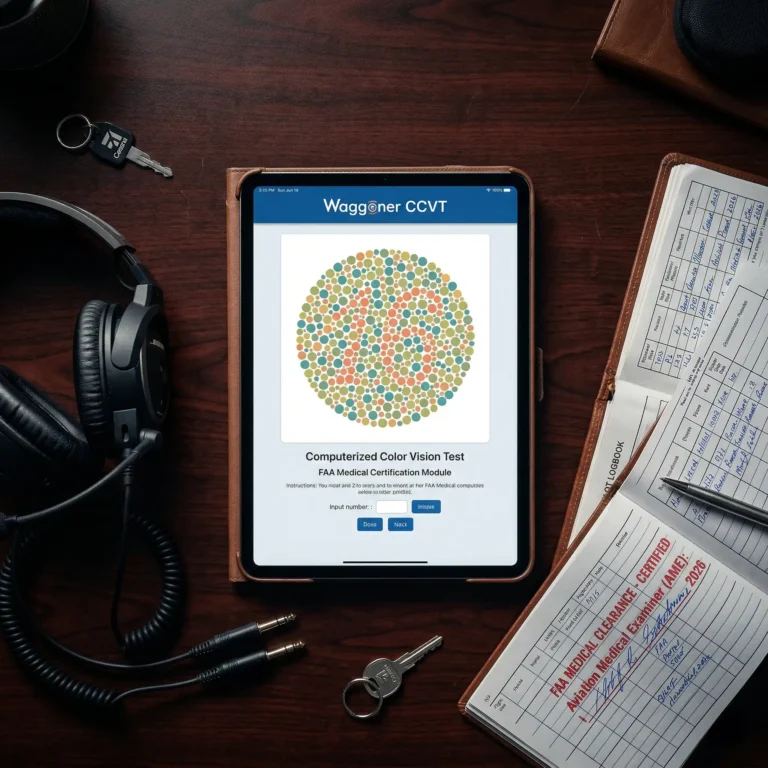
Increasingly, agencies are moving toward digital testing, such as the Waggoner Computerized Color Vision Test (WCCVT), which precisely quantifies the exact type and severity of your deficiency using an interactive tablet.
The “EnChroma Illusion”: Why Color-Correcting Glasses Are Banned
A common question on police forums is: “Can I just wear EnChroma glasses or colorblind contacts to pass the medical exam?”
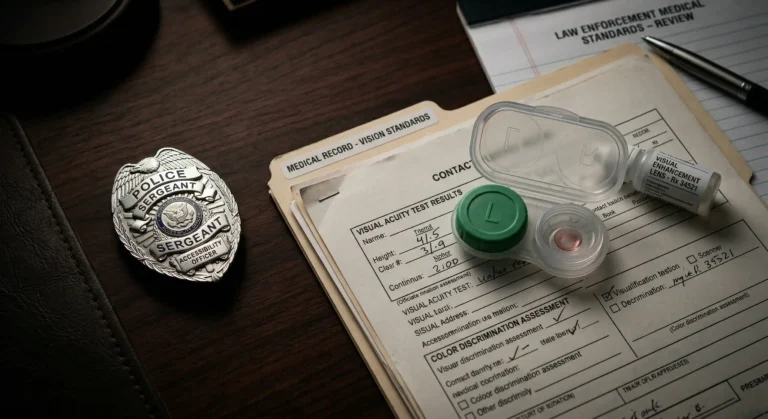
The answer is a definitive and absolute no. Every major law enforcement agency, including the FBI, NYPD, and LAPD, strictly prohibits the use of Colorkinds lenses, tinted contacts, or color-correcting glasses during medical evaluations.
Critical Warning
Attempting to secretly wear tinted contact lenses to cheat a police medical exam is considered a severe integrity violation. If caught, you will not only be disqualified from SWAT, but you may be permanently blacklisted from law enforcement altogether.
The operational logic behind the ban is sound: tactical operators cannot rely on specialized eyewear that may fall off, fog up, or become incompatible with essential gear like Night Vision Goggles (NVGs) or CBRN gas masks.
Why Are SWAT Color Vision Standards So Strict? (The Tactical Justification)
It is easy to view these medical hurdles as bureaucratic red tape, but the justifications are forged in blood. In tactical operations, color vision is not an aesthetic luxury; it is a life-saving occupational requirement.
Surviving the “Kill House”: Low-Light Threat Identification
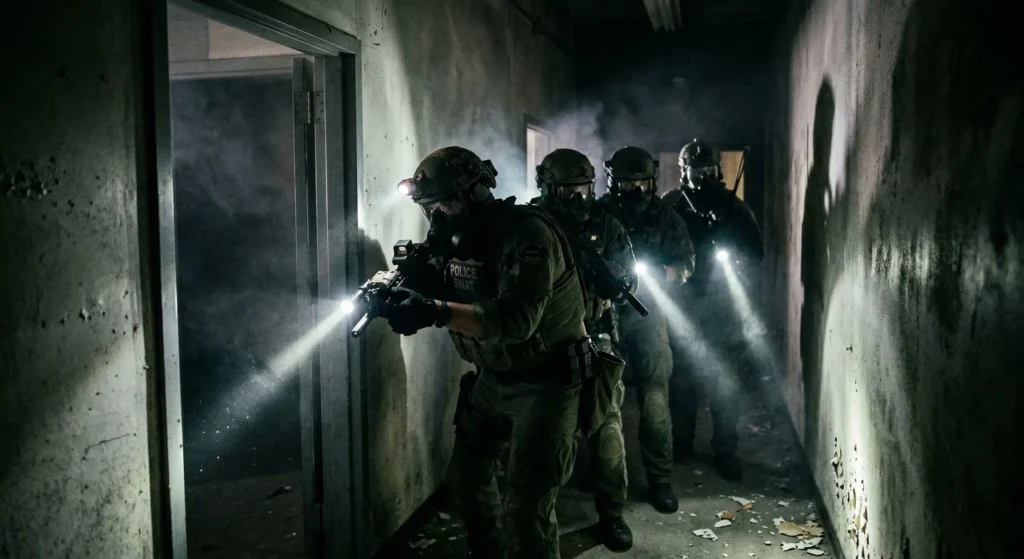
Statistics show that a vast majority of officer-involved shootings occur in diminished light. When human beings operate in the dark, color perception naturally drops as the eye shifts from cone cells to rod cells. For a color-deficient officer, this contrast sensitivity degrades even faster.
In a split-second shoot/no-shoot scenario, an operator must instantly determine if the dark object in a suspect’s hand is a black pistol or a dark blue cell phone. Poor color contrast in low light drastically increases the risk of “mistake-of-fact” tragedies.
The Hidden Danger: Tactical Combat Casualty Care (TCCC)
While most people associate color blindness in SWAT with cutting the wrong bomb wire, combat medicine is actually the more prevalent danger. Tactical operators are trained in TCCC to treat massive trauma under fire.
A medic must be able to visually distinguish between bright red, oxygenated arterial blood (which requires an immediate tourniquet) and dark red venous blood. Furthermore, during a mass casualty event, victims are sorted using color-coded triage tags (Red for immediate, Yellow for delayed, Green for walking wounded, Black for deceased). Misreading a tag in the chaos of an active scene costs lives.
EOD Cross-Training and Chemical Smoke Recognition
Tactical teams frequently cross-train with Explosive Ordnance Disposal (EOD) units. Identifying the correct color-coded wiring is the classic cinematic example, but real-world scenarios also involve interpreting HAZMAT placards. Additionally, operators use colored smoke to communicate silently over long distances—for example, deploying green smoke to mark a safe extraction zone versus red smoke to indicate hostile chemical agents.
Tactical Optics: The Red Dot vs. Green Dot Dilemma
One of the most highly debated topics among color-deficient shooters involves modern weapon optics.
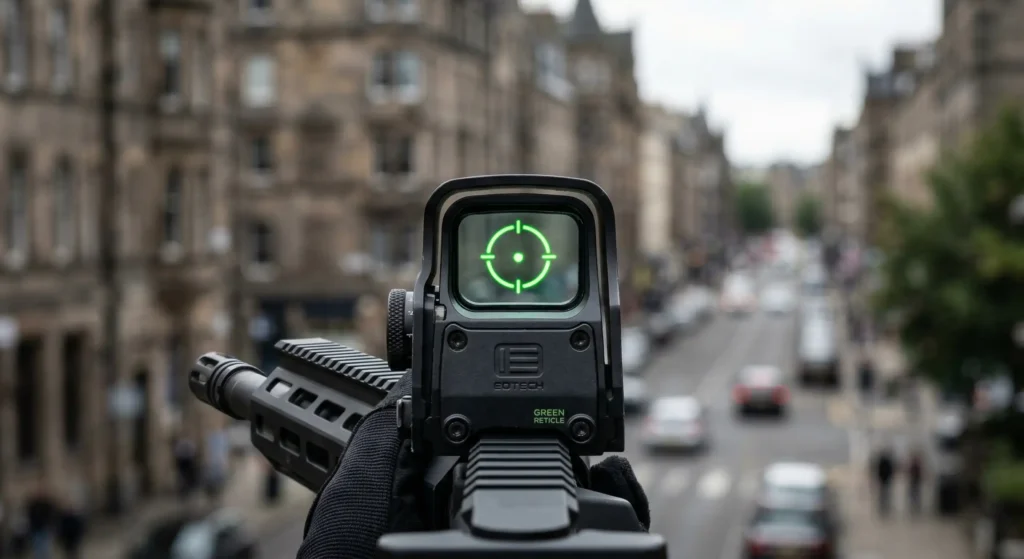
A significant portion of colorblind individuals suffer from Protanomaly (a weakness in perceiving red light). For these operators, standard red-dot sights—like those made by Aimpoint or EOTech—are highly problematic. In bright daylight, or against certain backgrounds like brick or brown vegetation, the red dot completely “washes out” and becomes invisible.
The Tactical Workaround: To compensate, many affected officers advocate for the use of Green-Dot sights (such as specific models from Holosun or Trijicon). Because the human eye is highly sensitive to the green spectrum, even those with red-green deficiency can acquire a green reticle significantly faster. If you are aiming for a tactical role, it is vital to research your department’s specific SOPs regarding approved, personally purchased optics.
How to Appeal a SWAT Medical Disqualification
Failing the initial medical exam is a crushing blow, but it is not always the end of the road. Many agencies have an administrative appeals process. To win, you must shift the conversation from “clinical deficiency” to “functional capacity.”
The Operator’s Guide to the “Functional Field Test” Waiver
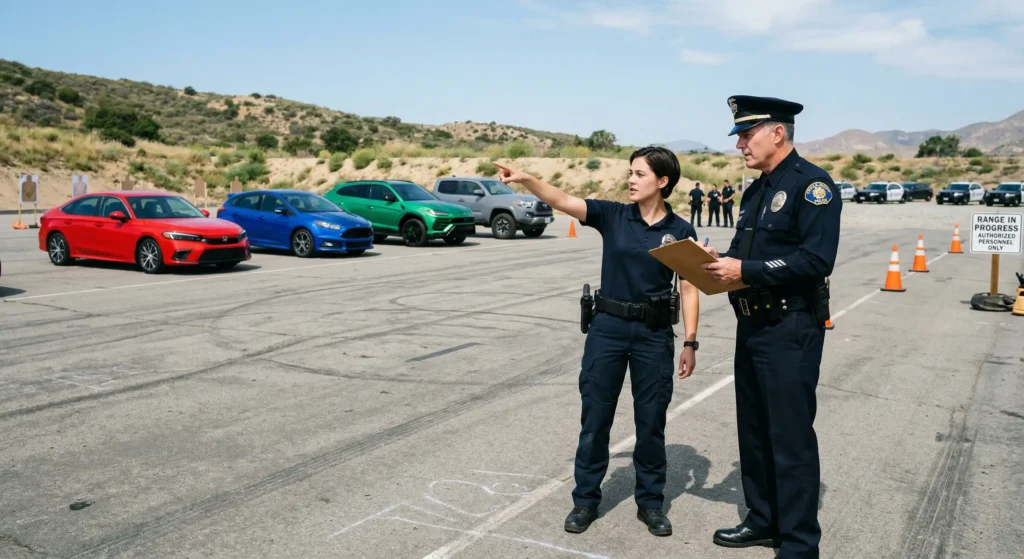
If you are disqualified based on the Ishihara or D-15, your immediate next step should be requesting a Functional Field Test. This is a live-action, practical exam designed to prove you can perform the exact duties required of a SWAT officer.
A standard tactical field test might require you to:
- Identify the specific color of a suspect vehicle at 50 to 100 yards.
- Accurately describe the clothing of role-players acting as suspects in a shoot-house.
- Successfully identify color-coded wiring or HAZMAT placards under stressful, low-light conditions.
- Pass a live-fire qualification using your duty optic without hesitation.
Appeal Strategy
Do not fight the medical science; fight the job relevance. When submitting an appeal, provide documentation from an independent ophthalmologist confirming your deficiency is “mild.” Combine this with letters of recommendation from firearms instructors proving your tactical proficiency is unaffected.
Is a SWAT Disqualification an ADA Violation?
Candidates often wonder if they can sue under the Americans with Disabilities Act (ADA) if they are denied a spot on the team. The legal reality is grim for applicants. Under cases like Diffey v. Riverside County, courts have consistently ruled that strict color vision requirements for law enforcement (and specifically tactical units) are a Bona Fide Occupational Qualification (BFOQ). Because the inability to distinguish color poses a “direct threat” to public safety, departments are generally legally protected when disqualifying colorblind SWAT applicants.
For more details on how courts view this, read our comprehensive guide on ADA regulations and color blindness.
Alternatives: High-Speed Units for Color-Deficient Officers
If the medical board denies your appeal and SWAT is firmly off the table, do not let it derail your entire law enforcement career. The modern police force relies on highly specialized units where color vision is not a strict BFOQ. High-speed alternatives include:
- K-9 Handling: Working with apprehension or detection dogs requires immense physical capability and tactical awareness, but is rarely restricted by color vision.
- Drone (UAS) Operations: Tactical drone pilots provide critical aerial overwatch during barricaded suspect situations. Many camera systems use thermal or high-contrast monochromatic displays, making color vision less vital.
- Undercover Narcotics & Vice: Thriving in plainclothes operations is based on interpersonal skills, street smarts, and situational awareness.
- Digital Forensics: Investigating cybercrime is currently one of the most elite and sought-after specialties in federal and local policing.
To explore more of these roles and how to align them with your vision capabilities, check out our Occupational Solutions for Law Enforcement Professionals.
First-Hand Account: “I’m Colorblind and I Made the Team”
To provide real-world perspective, we spoke with “Officer M.”, a seven-year veteran of a county Sheriff’s Special Response Team (SRT) who operates successfully despite a mild deuteranomaly (green-weakness).
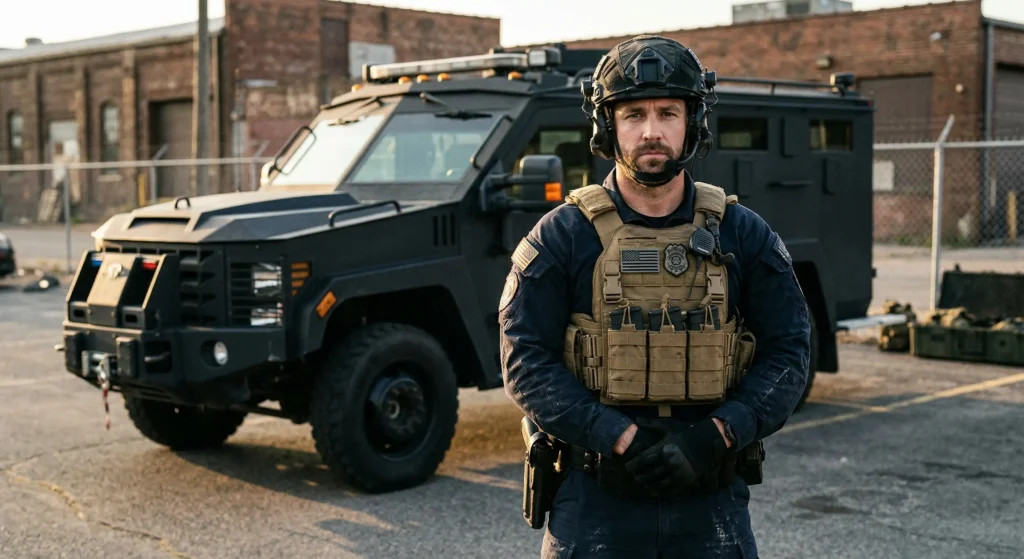
“When I failed the dot test at the academy, my heart dropped,” Officer M. recalls. “But I passed the D-15 secondary test. Four years later, when I tried out for the SRT, the medics flagged me again. I didn’t accept the ‘no.’ I drafted a memo to the tactical commander requesting a field evaluation. They put me in the shoot-house, turned the lights down, and ran me through a gauntlet of threat-identification drills. I shot a perfect score and called out every target accurately. They signed my medical waiver the next day. You have to be your own advocate. Know your exact limits, train twice as hard, and prove your worth on the range.”
Train Smarter Off-Duty
While you cannot wear color-correcting lenses during your official police medical exam, you can use them to enhance your daily life, off-duty range training, and civilian tactical courses.
Shop ColorKinds® Colorblind Contacts TodayFrequently Asked Questions About Police & SWAT Vision Standards
Can a police officer or SWAT candidate be color blind?
Yes, in many local and state agencies, a police officer can have a mild color vision deficiency (such as anomalous trichromacy) if they pass a secondary assessment like the Farnsworth D-15. However, highly specialized tactical units like SWAT or Federal HRT often have much stricter, zero-tolerance standards.
What is the primary color blind test for SWAT teams?
The primary screening tool is the Ishihara Pseudoisochromatic Plate test, which requires candidates to identify numbers hidden within colored dots. Many departments now also use computerized versions like the Waggoner CCVT for precision.
Can I use color blind contacts or glasses to pass the police vision test?
No. Almost all law enforcement agencies strictly prohibit the use of color-correcting lenses, including ColorKinds contacts or EnChroma glasses, during official medical evaluations. Wearing them covertly is considered an integrity violation.
What is the Farnsworth D-15 test?
The Farnsworth D-15 is a color arrangement test used as a secondary evaluation. It requires candidates to arrange 15 colored caps in chromatic order. It is designed to distinguish between mild and severe color blindness, allowing mildly deficient candidates to pass.
Does the FBI Hostage Rescue Team (HRT) allow colorblind agents?
Federal tactical teams like the FBI HRT have notoriously strict medical standards. While standard Special Agents may be granted waivers if they pass the D-15, tactical deployments usually require perfect or near-perfect uncorrected color vision.
What is a functional color vision field test?
A functional field test is a practical waiver exam where an officer must prove they can distinguish colors in real-world scenarios, such as identifying vehicle paint colors, suspect clothing, or traffic signals at a distance.
Why is color vision so important for SWAT?
SWAT operators must make split-second, life-or-death decisions in low-light environments. Color vision is critical for identifying weapon safety indicators, interpreting chemical smoke colors, reading triage tags during medical care, and utilizing illuminated red-dot sights.
Is a SWAT disqualification for color blindness an ADA violation?
Generally, no. Courts have consistently ruled that strict color vision requirements for tactical law enforcement units constitute a Bona Fide Occupational Qualification (BFOQ) necessary for public and officer safety.
What is the Red Dot vs. Green Dot dilemma for colorblind shooters?
Officers with Protanomaly (red-weakness) often struggle to see standard red-dot weapon sights against certain backgrounds, as the dot washes out. As a tactical workaround, many switch to green-dot optics, which are much easier for their eyes to acquire rapidly.
How do I appeal a medical disqualification for a tactical team?
You can appeal by obtaining an independent evaluation from an ophthalmologist utilizing advanced diagnostic tools (like the Rabin Cone Contrast Test) and formally petitioning your department’s medical board or Civil Service Commission for a practical field test.