Can a Colorblind Person Be a Forensic Scientist? Navigating Careers, Exams, and Lab Work
The field of forensic science stands at a critical intersection of sensory perception, technological objectivity, and legal mandates. For decades, the image of a forensic practitioner was that of a “generalist criminalist”—a lone investigator capable of processing a chaotic crime scene, analyzing biological fluids, and matching trace evidence. In that legacy framework, “normal color vision” was viewed as a non-negotiable prerequisite.
But the discipline has rapidly evolved. Today’s crime labs are highly specialized. If you have recently discovered you have a color vision deficiency (CVD) and are panicking about your career prospects, take a deep breath. The contemporary professional landscape is vastly different than it was twenty years ago. The answer to whether you can succeed in this field is no longer a simple binary “yes” or “no.”
In this guide, we will break down the exact criminalist color vision requirements used by major agencies, explore the “wet lab vs. dry lab” career matrix, discuss how to survive university histology courses, and reveal the actionable workarounds employed by successful colorblind scientists today.
The Short Answer: Can You Work in a Crime Lab if You Are Colorblind?
Yes, a colorblind person can absolutely be a forensic scientist. However, your success depends entirely on which forensic discipline you choose to pursue.
Modern forensics has moved away from the generalist model. As a result, color vision is no longer a strict Bona Fide Occupational Qualification (BFOQ) for every role in the laboratory. While you may be disqualified from analyzing chemical spot tests or matching paint chips, thriving fields like digital forensics, latent print analysis, and forensic accounting offer incredible career trajectories that rely on structural morphology and data rather than chromatic perception.
If you are also considering sworn field roles, review our comprehensive guide on law enforcement career opportunities for the colorblind to understand how different agencies handle medical waivers.
The “Wet Lab” vs. “Dry Lab” Career Matrix: Specialization Over Generalization
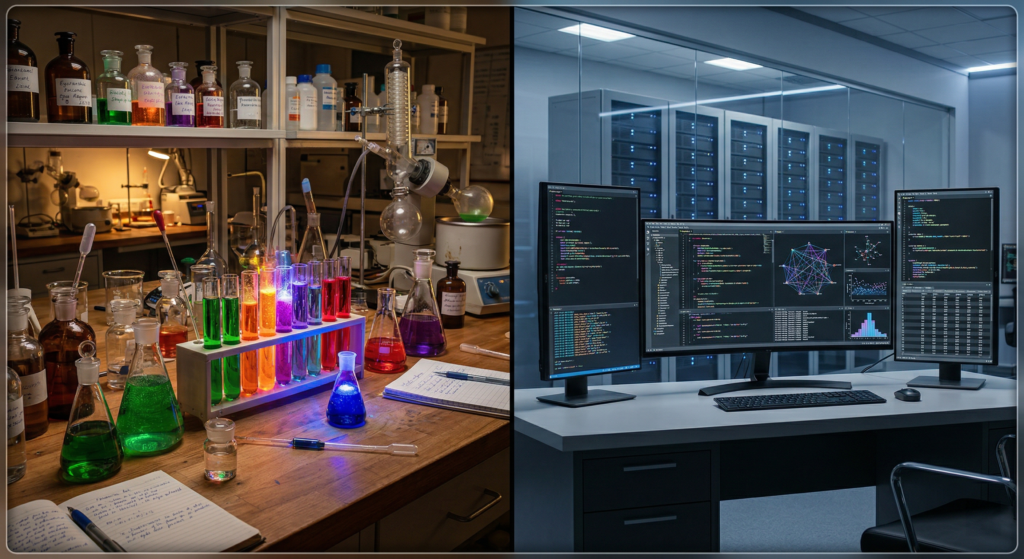
The biggest mistake colorblind applicants make is applying blindly to generalized “Criminalist I” positions at county agencies without checking the medical requirements. Many municipal job postings explicitly state that candidates must be free of “uncorrected colorblindness.” To avoid devastating disqualifications, you must understand the difference between wet and dry lab disciplines.
“Wet Lab” Challenges: Where Color is Critical
Certain forensic disciplines fundamentally rely on human color perception to interpret evidence. If you have a severe Protan (red-blind) or Deutan (green-blind) deficiency, these fields will present massive, often insurmountable, roadblocks:
- Seized Drugs (Toxicology): Analysts frequently use colorimetric spot tests (like the Marquis reagent) which change color to indicate the presence of specific narcotics. Misinterpreting a purple vs. dark blue shift can alter the course of an investigation.
- Trace Evidence: Matching automotive paint chips, dyed textile fibers, and soils requires acute color discrimination.
- Forensic Biology/Serology: Identifying bodily fluids and estimating the age of bloodstains based on oxidation (the shift from bright red to brown/green) is highly color-dependent.
“Dry Lab” Opportunities: Tech-Centric and Analytical Roles
If you have a color vision deficiency, you should pivot your academic and professional focus toward “dry” disciplines. These tech-centric and pattern-recognition fields represent the fastest-growing sectors in criminal justice:
- Digital Forensics & Cybercrime: Digital forensics visual impairment accommodations are highly effective. Analyzing hard drives, network intrusions, and mobile devices requires zero color discrimination.
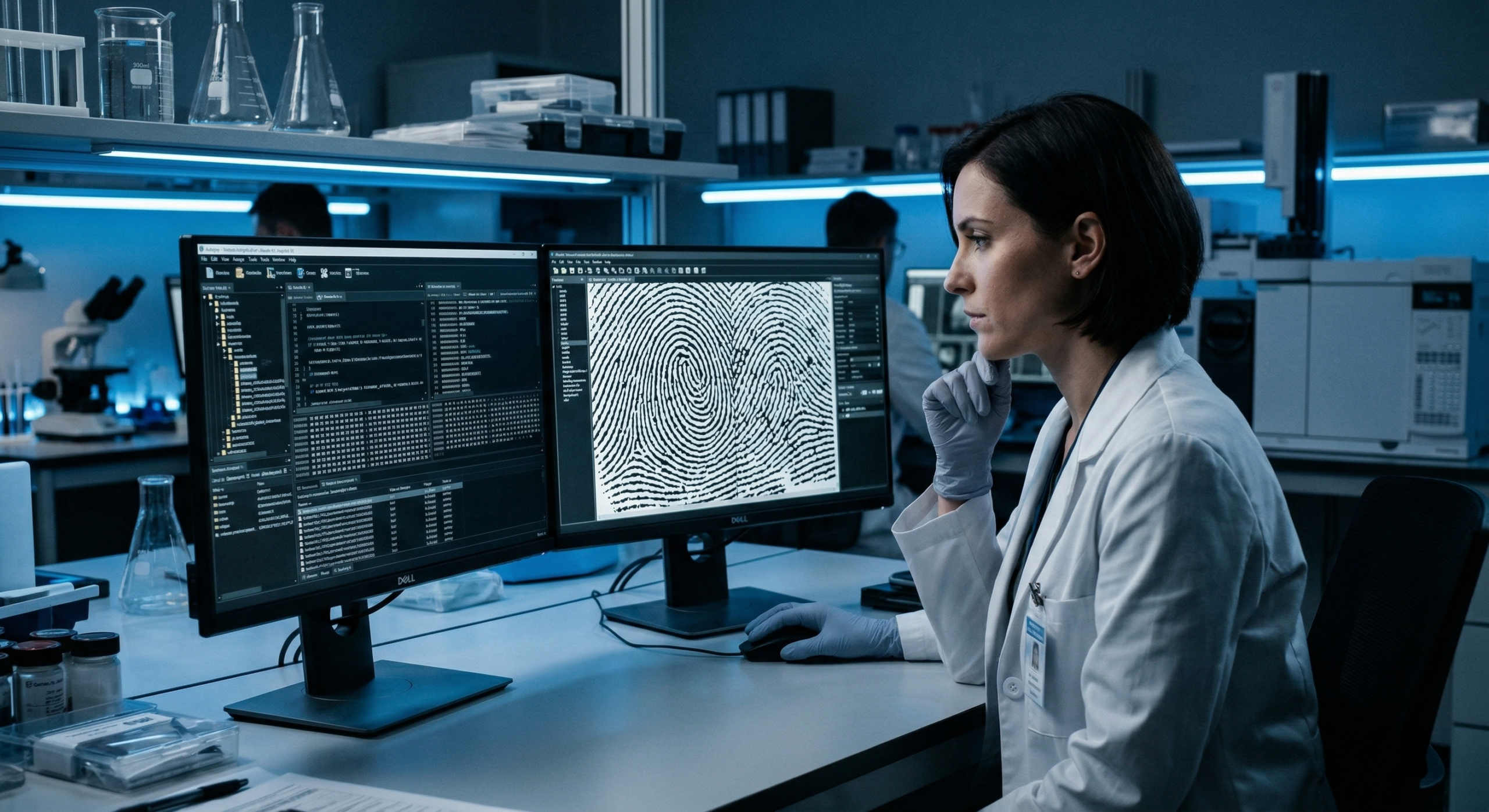
- Latent Prints (Fingerprints): Analysts compare ridge details, bifurcations, and whorls. This is an exercise in high-contrast pattern recognition (light vs. dark), not hue.
- Forensic Accounting: Following the money in organized crime or fraud cases is entirely data-driven.
- Firearms and Toolmarks: Matching the striations on a fired bullet to a specific gun barrel relies on analyzing 3D topography and shadows under a comparison microscope.
| Forensic Discipline | Color Vision Dependency | Career Viability for CVD Candidates |
|---|---|---|
| Digital Forensics / Cyber | None | Highly Recommended |
| Latent Fingerprints | Low | Highly Recommended |
| Forensic Accounting | None | Highly Recommended |
| Firearms & Toolmarks | Low to Moderate | Possible with minor workarounds |
| Forensic Serology / DNA | Moderate to High | Difficult; requires collaboration |
| Seized Drugs / Toxicology | Very High | Generally Disqualified |
| Trace Evidence (Paint/Fiber) | Very High | Generally Disqualified |
Academic Accommodations: Surviving University Histology
Before you ever reach the job market, you must survive a rigorous university science curriculum. For many colorblind students, the ultimate roadblock is the microscopy and histology lab.
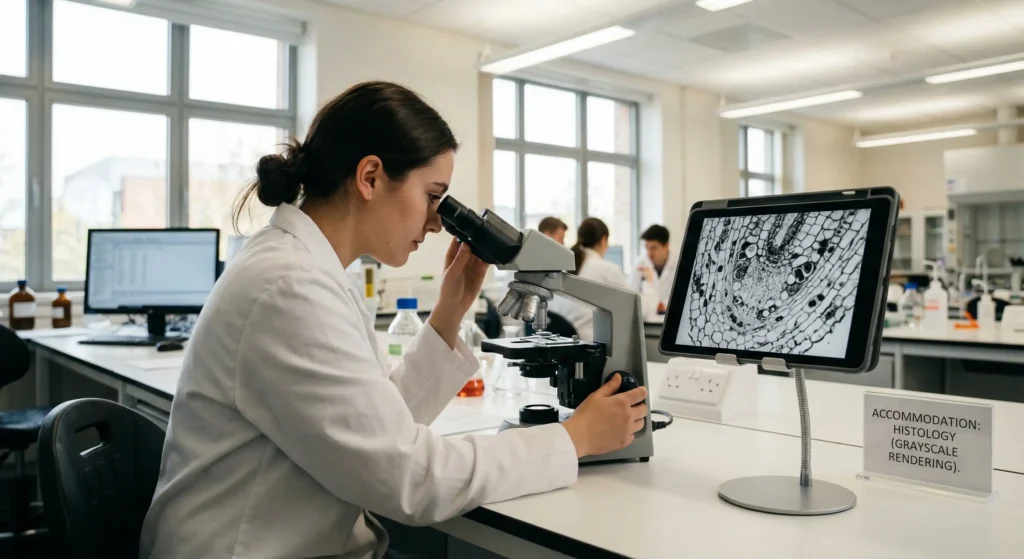
In histology, the standard H&E (Hematoxylin and Eosin) stain dyes cell nuclei purple and cytoplasm pink. For a student with a red-green deficiency, looking through a microscope at these slides often looks like a uniform, muddy gray wash, making it seemingly impossible to identify tissues.
Strategies for Forensic Histology Colorblind Accommodations
Do not suffer in silence. Work immediately with your university’s disability services office and your professor to implement the following strategies:
- Focus on Morphology, Not Hue: Train your eyes to identify cellular architecture, density, and shape. A skilled histologist can often identify tissue types by structure alone, ignoring the color of the stain.
- Adjust the Condenser: Tinker with the light level and the condenser on your microscope. Increasing the contrast (making shadows deeper and highlights brighter) can make structural differences pop out.
- Digital Slide Software: Request to view digitized slides on a computer monitor. You can use accessibility software to convert the images to high-contrast grayscale or apply digital filters that separate the purple and pink stains into distinct, recognizable patterns.
Navigating the Civilian Crime Lab Medical Exam
If you apply for a civilian criminalist position, you will likely face a pre-employment medical physical. This is where many qualified candidates encounter unexpected heartbreak.
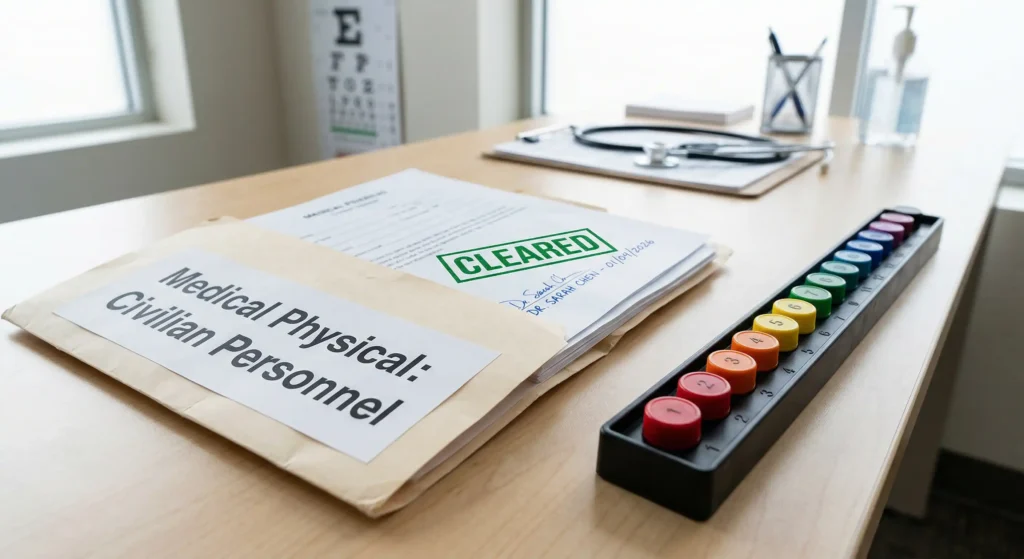
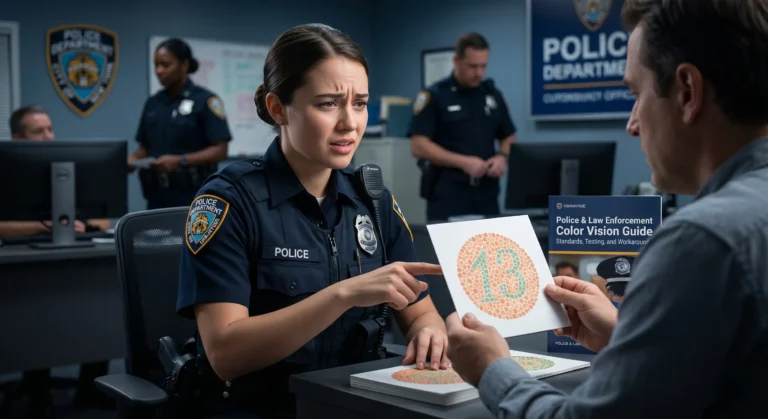
Most clinics use the Ishihara plate test (the book of colored dots) as a blanket screening tool. The problem? The Ishihara is hyper-sensitive. It is designed to detect even the slightest genetic anomaly, meaning it routinely fails individuals who possess perfectly functional, everyday color vision.
Requesting the Farnsworth D-15 Test
If you fail the Ishihara test during your physical, do not accept immediate disqualification. You must advocate for yourself.
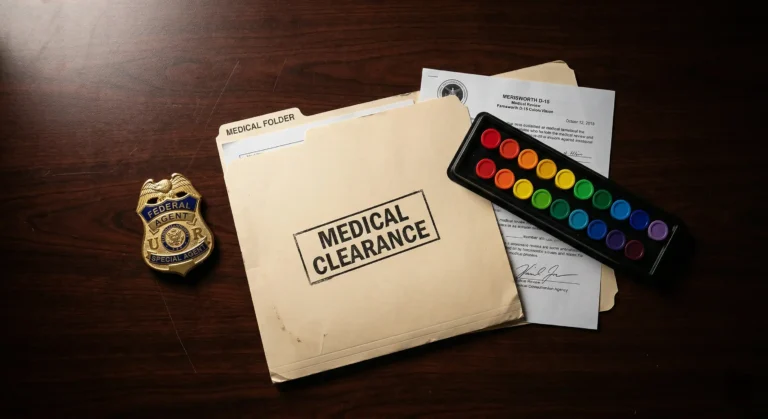
Formally request that the agency or the examining physician administer the Farnsworth D-15 or a computerized equivalent (like the Waggoner CCVT). The Farnsworth D-15 is an occupational panel test designed specifically to determine if a color vision defect is functionally debilitating. It separates candidates with mild anomalies from those with severe dichromacy. Passing the Farnsworth D-15 crime lab secondary test is the primary method used to secure medical waivers for laboratory personnel.
Real-World Experiences: Colorblind Scientists in the Field
To truly understand how this plays out, we can look at the real-world experiences shared by working professionals in the forensic and scientific communities.
“I have a severe color deficiency that boils down to practically black and white. I struggled a lot with histology and anatomy… My advice: Tell as many people as soon as you can. Give them specific examples of what you can’t differentiate between. They were happy to switch to a different pointer or adjust lighting for me.”
“I’m in the biotech industry in a screening lab. I ran into some histology stains I struggled with in school, but run into no real problems in the industry. Worst comes to worst, it shouldn’t be too tough to just ask a colleague to verify or double-check, as most lab environments I’ve been in have been extremely collaborative.”
“I am legally blind with limited vision that continues to worsen. I’m a forensic accountant for the FBI… I conduct analysis of banking and financial records as a part of the investigative team. I’ve always had great support from my supervisors when it comes to purchasing the magnifying equipment and screen filters I need to do my job.”
In-Lab Workarounds for the Mildly Colorblind Scientist
As the user experiences above highlight, surviving in the lab is about collaboration and modern technology.
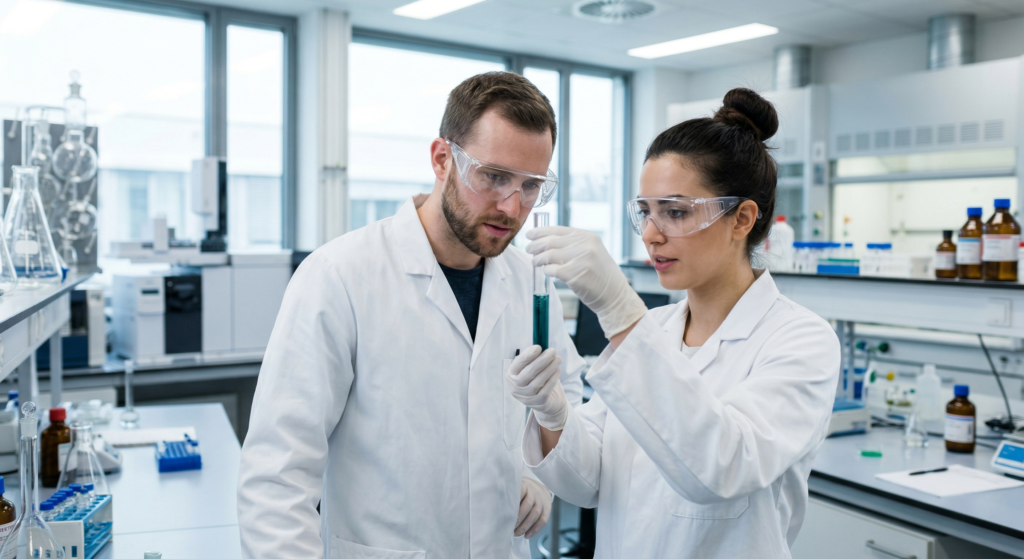
If you find yourself in a situation where you must perform a subjective colorimetric test, the industry standard workaround is simple: The Two-Person Verification Rule. Asking a colleague with normal color vision to act as a “second pair of eyes” to verify a Marquis reagent color shift is completely acceptable in collaborative lab environments and does not compromise the chain of custody if properly documented.
Furthermore, the forensic industry is actively transitioning away from human subjectivity. Advanced instrumental analysis—such as UV-Vis and near-infrared microspectrophotometry—measures the exact wavelength of color objectively, providing digital readouts that eliminate the need for perfect human chromatic perception.
Are Colorblind Glasses Allowed in the Crime Lab?
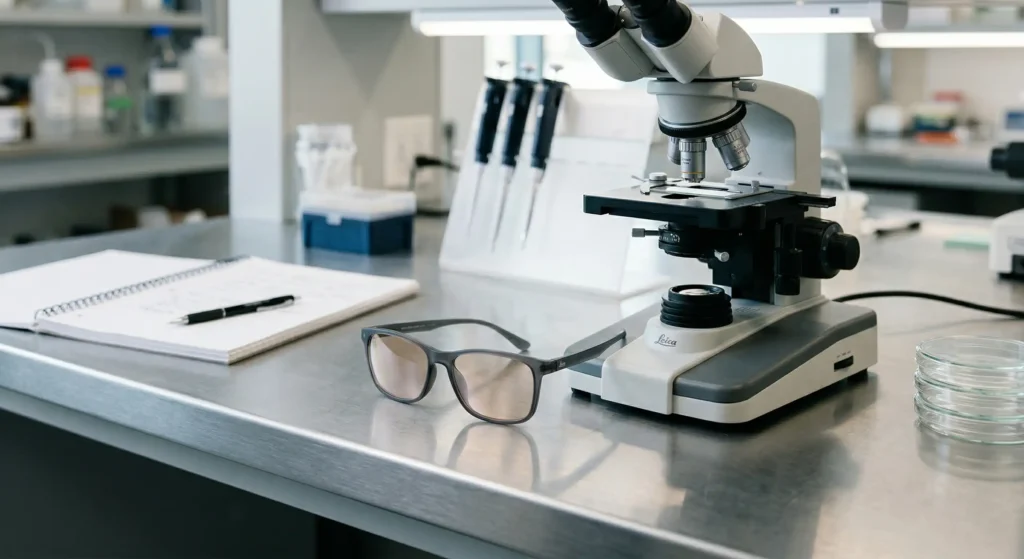
The marketing around color-enhancing eyewear (like EnChroma) and tinted contact lenses (like the ColorKinds) has led to significant confusion regarding their legality in law enforcement and forensic settings.
Pre-Employment Testing vs. Daily Lab Work
It is vital to separate the hiring process from daily operations.
- During the Medical Exam: The use of colorblind glasses in the lab medical physical is strictly prohibited. Federal guidelines and state commissions explicitly forbid wearing color-altering lenses to pass the Ishihara or Farnsworth tests. Attempting to do so is considered an integrity violation.
- On the Job: Once hired into a civilian capacity, the rules change. Under the Americans with Disabilities Act (ADA) , civilian lab technicians can often request to use digital screen filters, high-contrast monitors, or even wear color-correcting lenses during routine bench work as a “reasonable accommodation.”
A Word of Caution
While lenses can help you differentiate contrast, they do not “cure” colorblindness. Therefore, you should never rely solely on optical aids to make definitive, legally binding forensic conclusions in subjective color tests. Always utilize instrumental analysis or a peer review.
Master Your Visual Environment
Are you navigating the complexities of university labs or preparing to apply for forensic roles? While you cannot wear color-correcting lenses during an official medical physical, training with them off-duty can help you build vital contrast-recognition habits.
Experience the world with enhanced clarity and step into your career with confidence.
Shop ColorKinds® LensesFrequently Asked Questions About Forensics and Color Blindness
Can a colorblind person be a forensic scientist?
Yes, a colorblind person can be a forensic scientist. However, success depends heavily on the chosen discipline. While wet-lab roles like trace evidence and seized drugs require strict color discrimination, dry-lab roles like digital forensics, latent prints, and forensic accounting do not consider color vision a Bona Fide Occupational Qualification (BFOQ).
Are there criminalist color vision requirements for crime labs?
Yes. Most state and municipal crime labs require applicants to pass a medical physical exam that includes a color vision screening, typically the Ishihara dot test. Candidates who fail may be disqualified from generalist criminalist roles unless they can pass a secondary test.
What happens if I fail the Ishihara test for a forensic job?
If you fail the initial Ishihara test, you should formally request a secondary functional test, such as the Farnsworth D-15. This test determines if your deficiency is functionally debilitating for laboratory work or mild enough to be granted a medical waiver.
Does the FBI hire colorblind forensic scientists?
Yes, the FBI hires colorblind individuals for civilian forensic roles, such as forensic accountants and digital forensic examiners. The federal government offers robust ADA accommodations for civilian analytical roles, including digital magnifiers and screen filters.
How can colorblind students pass forensic histology classes?
Forensic histology colorblind accommodations include adjusting microscope condenser lighting to enhance contrast, utilizing digital slide software, and training students to identify cellular structures by morphology, texture, and density rather than relying solely on hue (like pink/purple H&E stains).
Can I wear colorblind glasses in the crime lab?
While color-correcting glasses and contacts are strictly banned during pre-employment medical exams, civilian lab technicians can often utilize these optical aids during routine bench work as a reasonable accommodation to assist with general color contrast.
Is colorblindness a disability under the ADA for forensic scientists?
Under the ADA, colorblindness is generally not considered a protected disability for sworn law enforcement or generalist criminalist roles where color identification is a BFOQ. However, for civilian roles where color identification is not essential, reasonable accommodations must be considered.
Can I work in digital forensics with a visual impairment?
Absolutely. Digital forensics visual impairment accommodations are highly effective. Since the work relies on analyzing digital data, code, and networks rather than chemical color changes, individuals with color blindness or even severe visual impairments can thrive in this field.
Do forensic labs use machines instead of human color vision?
Increasingly, yes. Modern forensic laboratories rely on instrumental objectivity. Devices like UV-Vis and near-infrared microspectrophotometers measure color spectra digitally and objectively, drastically reducing the field’s reliance on subjective human color perception.
Can I perform chemical spot tests if I am colorblind?
Performing subjective colorimetric spot tests (like the Marquis reagent for drugs) is highly challenging for colorblind scientists. The standard in-lab workaround is to implement a “two-person verification” rule, asking a colleague with normal color vision to verify the result.