Colorblind Contacts for Police Officers: Complete Career Guide (2026)
If you’re a police officer or aspiring to become one, and you have color blindness, you’ve likely faced a frustrating contradiction: you can do the job, but a color vision test might block your career. The question is — can colorblind contacts help?
Here’s the direct answer: Yes, colorblind contacts can help police officers pass occupational color vision screenings and perform color-dependent tasks on the job. Colorkinds spectral notch filter contacts are designed to help red-green colorblind individuals distinguish the colors that matter most in law enforcement — traffic signals, evidence markers, suspect descriptions, and safety indicators.
This guide covers how colorblind contacts work for police officers, what department policies say about their use, how they help with testing and daily duties, and what you need to know before ordering.
Key Takeaways:
- Colorkinds colorblind contacts help red-green colorblind officers pass Ishihara and secondary color vision tests
- Department policies on corrective aids vary — check with your agency’s medical examiner before testing
- Contacts are more practical than glasses for police work: they fit under duty gear, won’t fog up, and are discreet
- Federal, state, and local agencies have different policies on color vision waivers and corrective aids
- Colorblind contacts can be used as an off-duty training tool to build color identification skills
- Colorkinds offers a 60-day guarantee — try them risk-free for your specific testing needs
Can Police Officers Wear Colorblind Contacts?
The short answer is yes — but with important caveats.
Many police departments allow officers to wear corrective aids during color vision testing. The key distinction is whether the department considers colorblind contacts a corrective device (like glasses or regular contact lenses) or a prohibited aid (like specialized equipment not available to all candidates).
What Most Departments Allow
| Scenario | Typical Policy |
|---|---|
| Pre-employment screening | Some departments allow, some prohibit — varies by agency |
| Post-offer medical exam | Most allow if the contacts are disclosed to the examiner |
| Promotional testing | Generally allowed if already on the force |
| Annual/periodic screening | Usually allowed within department policy |
| On-duty daily wear | Generally allowed — no different from wearing corrective glasses |
The Key Principle: Transparency
The most important rule across all agencies: be transparent with your examiner. If you’re wearing colorblind contacts during a color vision test, disclose it. Examiners who are aware of an auxiliary aid can properly assess your color vision and determine whether you meet the department’s standards.
Related reading: For specific state policies, see our police officer color vision career guide.
How Colorblind Contacts Help on the Job
Beyond test-passing, colorblind contacts provide practical benefits for daily police work.
Daily Law Enforcement Color Tasks
| Task | Color Dependence | How Contacts Help |
|---|---|---|
| Traffic signal identification | Red, yellow, green | Clear distinction between signal colors |
| Evidence description | Color of objects, clothing, vehicles | Accurate color reporting in incident reports |
| Suspect identification | Eye color, hair color, clothing colors | Correct descriptions for BOLOs and warrants |
| Tactical gear identification | Color-coded equipment, wires, markings | Proper identification under stress |
| Body camera footage review | Color-critical evidence assessment | Accurate interpretation of recorded color data |
| Traffic stop safety | Identifying vehicle color, signal lights | Quick, confident color recognition |
| Crime scene processing | Color-coded evidence markers, labels | Correct evidence chain documentation |
Why Contacts Beat Glasses for Police Work
| Factor | Colorkinds Contacts | Colorblind Glasses |
|---|---|---|
| Discretion | Invisible — no one knows you’re wearing them | Visible to everyone on duty |
| PPE compatibility | Fits under duty glasses, ballistic eyewear, gas masks | Cannot be worn under most protective gear |
| Physical activity | No risk of slipping off during foot pursuits | Risk of falling off during physical activity |
| Fogging | Never fogs up, regardless of conditions | Fogs in rain, temperature changes, or exertion |
| Uniform compliance | No conflict with department appearance standards | May conflict with uniform policies |
| Weapon handling | No interference with cheek weld on rifle/shotgun | Frames may interfere with shooting posture |
Department Policies on Colorblind Contacts
Police department policies on colorblind contacts vary significantly by agency type, jurisdiction, and level of government.
| Agency Type | Colorblind Contacts Policy | Testing Flexibility |
|---|---|---|
| Federal (FBI, DEA, ATF, USSS) | Case-by-case — disclosed and approved in advance | Some secondary testing available |
| State police / highway patrol | Varies by state — many allow with disclosure | Mixed — some allow alternative tests |
| Local/county police | Most flexible — many allow with examiner approval | Generally more accommodating |
| Sheriff’s departments | Usually follow local police policies | Similar to local police |
What to Ask Your Recruiter
Before your medical exam, ask these specific questions:
- “Does the department allow corrective aids during the color vision test?”
- “Are colorblind contacts considered a corrective aid or a prohibited device?”
- “What alternative tests are available if I fail the initial Ishihara screening?”
- “Does the department have a secondary testing or waiver process for color vision?”
- “Are officers currently serving with colorblind contacts on the force?”
Related reading: For federal-specific policies, see our 1811 medical guide.
Testing with Colorblind Contacts: What to Expect
Pre-Employment Testing
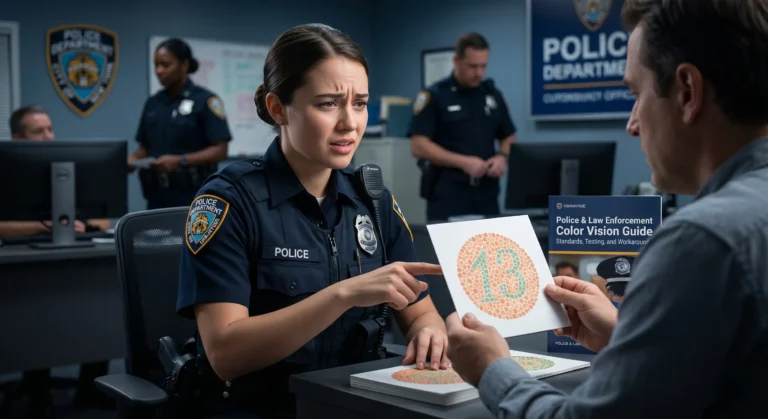
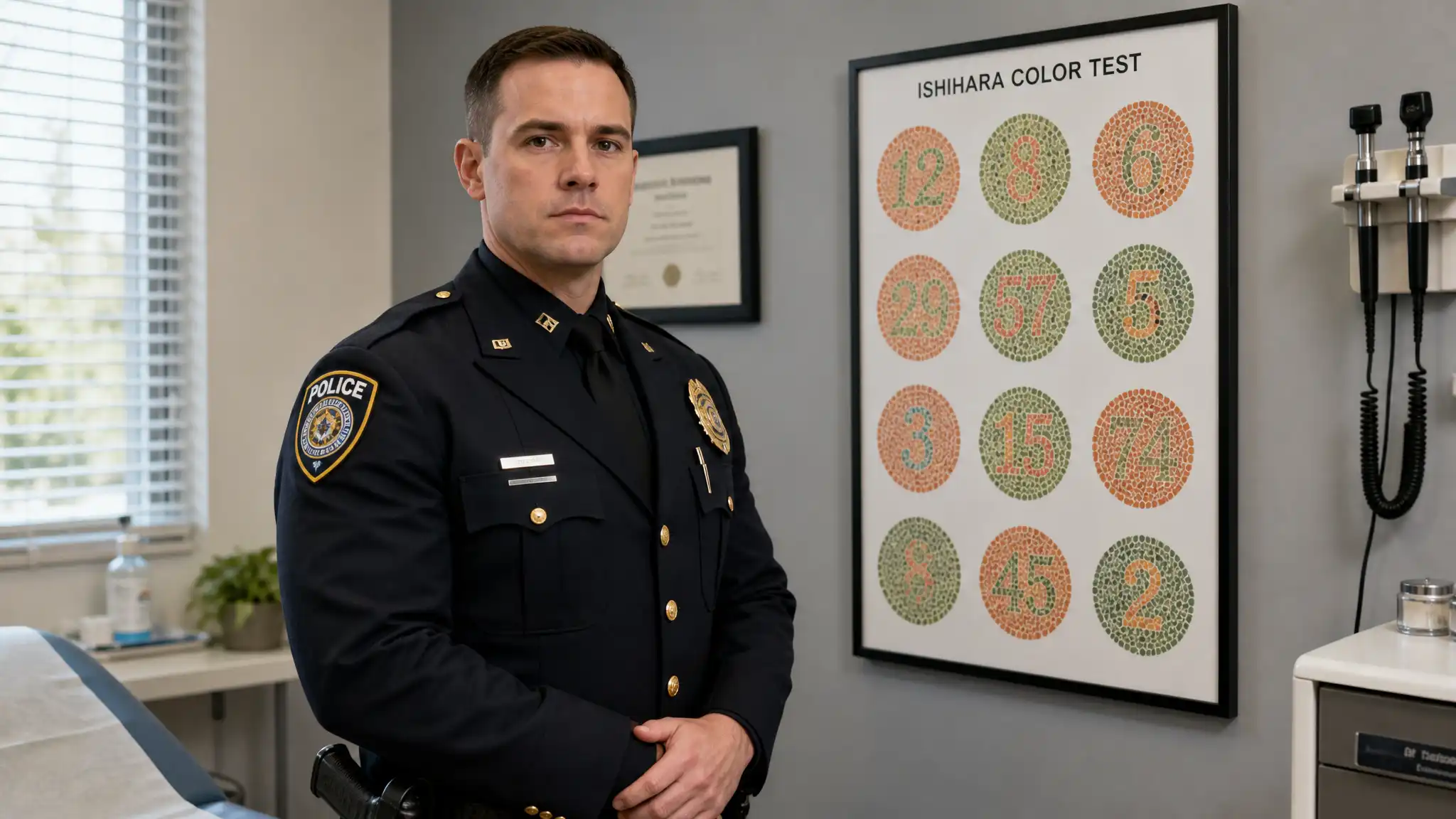
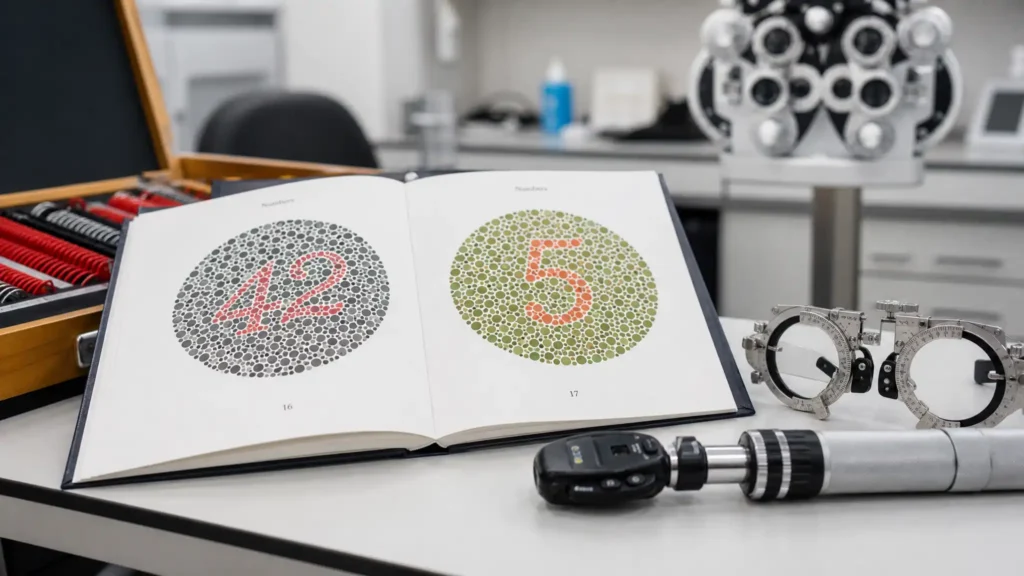
Most police departments use the Ishihara color plate test as the initial screening during the medical examination phase of the hiring process.
| Test Stage | Typical Test | What Happens |
|---|---|---|
| Medical exam | Ishihara 14-plate or 24-plate | Initial color vision screening |
| If Ishihara failed | Farnsworth D-15 or Waggoner CCVT | Secondary test to determine severity |
| If secondary failed | Department review | May include waiver, restriction, or disqualification |
If You Plan to Use Contacts During Testing
| Step | Action |
|---|---|
| 1 | Confirm the department allows corrective aids during testing |
| 2 | Disclose to the medical examiner before the test begins |
| 3 | Insert contacts 30+ minutes before the exam for proper adjustment |
| 4 | Take the test as directed — the contacts do the rest |
| 5 | If you pass, document what was used for your personnel file |
On-Duty Use After Hiring
Once hired, wearing Colorkinds contacts during daily duty is typically straightforward:
- No different from wearing corrective contact lenses or glasses
- No requirement to disclose to every supervisor
- No impact on uniform, equipment, or duty gear
- No restrictions on physical activities or tactical operations
Federal vs. State vs. Local Law Enforcement Policies
Federal Law Enforcement Agencies
Federal agencies (FBI, DEA, ATF, USSS, USMS, CBP) generally have the strictest color vision standards but also offer the most structured alternative testing pathways.
| Agency | Initial Test | Secondary Options | Contacts Policy |
|---|---|---|---|
| FBI | Ishihara | D-15, Rabin CCT, anomaloscope | Case-by-case with medical director approval |
| DEA | Ishihara | D-15, alternative tests | Varies by division |
| ATF | Ishihara | Alternative tests available | Requires pre-approval |
| USSS | Ishihara | Limited alternatives | Strict — contact medical office |
| CBP | Ishihara | D-15, Waggoner CCVT | Generally allowed with disclosure |
State and Local Agencies
State and local agencies tend to be more flexible, particularly if you’re already serving in a related capacity or have demonstrated color vision ability on the job.
| Agency Level | Typical Flexibility | Notes |
|---|---|---|
| State police | Moderate | Often follow POST commission standards |
| County sheriff | Moderate to high | More flexible, especially for experienced candidates |
| Municipal police | High | Most likely to allow corrective aids |
| Campus police | Very high | Often most flexible on vision standards |
Related reading: For full details on federal employment, see our federal law enforcement 1811 medical guide.
How to Prepare for Police Color Vision Testing with Contacts
Before You Order
- Confirm your color blindness type: Colorkinds contacts work for protan and deutan (red-green) — they do not help with tritan (blue-yellow) deficiency
- Check your department’s policy: Contact the recruiting office or medical examiner
- Understand the testing protocol: Know which tests your department uses
Ordering and Adjustment Period
| Timeline | Action |
|---|---|
| Before exam | Order Colorkinds contacts at least 2 weeks before your test |
| Days 1–3 | Practice inserting, removing, and wearing contacts for increasing durations |
| Days 4–7 | Wear contacts for full-day sessions to confirm comfort |
| Day of exam | Insert contacts 30+ minutes before your test; allow eyes to adjust |
What to Tell Your Examiner
- “I wear colorblind contacts as a corrective aid”
- “They are spectral notch filter contacts from Colorkinds”
- “I’ve been wearing them for [X] days and they are comfortable”
Being straightforward with your examiner builds trust and ensures the test results accurately reflect your color vision with correction.
Similar Posts:
- How to Pass the Police Color Vision Test (2026)
- Can a Police Officer Be Color Blind? Career Guide
- Federal Law Enforcement 1811 Medical Guide
- Police Color Vision Test Preparation Guide
- Colorblind Solutions for Police Officers
- Colorblind Contacts: Complete Guide
FAQ: Colorblind Contacts for Police Officers
Yes. Wearing colorblind contacts on duty is generally permitted in most police departments. They are considered no different from wearing corrective contact lenses or glasses. However, it’s always best to check your specific department’s policy on corrective eyewear.
Colorkinds contacts are designed to help you distinguish red from green, which is exactly what the Ishihara test measures. Many officers have used them to pass their screening. However, department policies on wearing corrective aids during the test vary — always check with your specific agency.
This varies by academy and department. Some allow corrective aids with disclosure to the medical examiner, while others test natural color vision only. Contact your academy’s medical office before your exam to confirm their policy on colorblind contacts.
No. Wearing colorblind contacts is a personal corrective choice, similar to wearing prescription contacts or glasses. You are not required to disclose this to your supervisor unless your department has a specific policy requiring disclosure of all corrective eyewear.
Yes. Colorkinds contacts sit directly on your eye and fit comfortably under all types of eyewear — including prescription duty glasses, ballistic sunglasses, tactical goggles, and gas masks. This is one of their key advantages over colorblind glasses.
The most common test is the Ishihara color plate test (14-plate or 24-plate version). If a candidate fails the Ishihara, departments may administer a secondary test such as the Farnsworth D-15 or Waggoner Computerized Color Vision Test (CCVT) to determine the severity of the deficiency.
Yes. Many police departments hire colorblind officers. The key factors are the severity of your color vision deficiency, whether you can pass the department’s color vision test (with or without correction), and the specific policies of the agency you’re applying to.
Federal agencies (FBI, DEA, ATF, USSS, CBP) evaluate corrective aids on a case-by-case basis. The policies vary by agency. You should contact the specific agency’s medical office to inquire about their policy on colorblind contacts before your medical exam.
Contacts are discreet (no one can tell you’re wearing them), fit under all duty gear and ballistic eyewear, never fog up, and won’t slip off during physical activity. Glasses are visible, may conflict with uniform policies, fog up in weather changes, and can be dislodged during physical confrontations.
Colorkinds contacts are designed for red-green color blindness (protan and deutan), which covers approximately 99% of all color vision deficiency cases. They do not work for blue-yellow (tritan) color blindness. If you are unsure of your type, check with an eye care professional before ordering.