Ishihara Test: Complete Guide to the Color Blindness Test (2026)
If you’ve been told you need to pass an Ishihara test for your career — or you’re simply curious about color blindness — the Ishihara color vision test is the world’s most widely used screening tool for red-green color vision deficiency.
Here’s the direct answer: The Ishihara test is a color vision screening that uses plates filled with colored dots to detect red-green color blindness. It’s the standard test used by the FAA, police departments, military, and employers worldwide to determine if your color vision meets occupational requirements.
This comprehensive guide covers everything about the Ishihara test — how it works, the different plate types, scoring, how to prepare, what your results mean for your career, and what options exist if you don’t pass.
Key Takeaways
– The Ishihara test uses pseudoisochromatic plates to detect red-green color blindness with 97% sensitivity
– There are 5 plate types: demonstration, vanishing, transformation, hidden digit, and diagnostic
– Passing typically requires 12 out of 14 red-green plates correct under standardized lighting
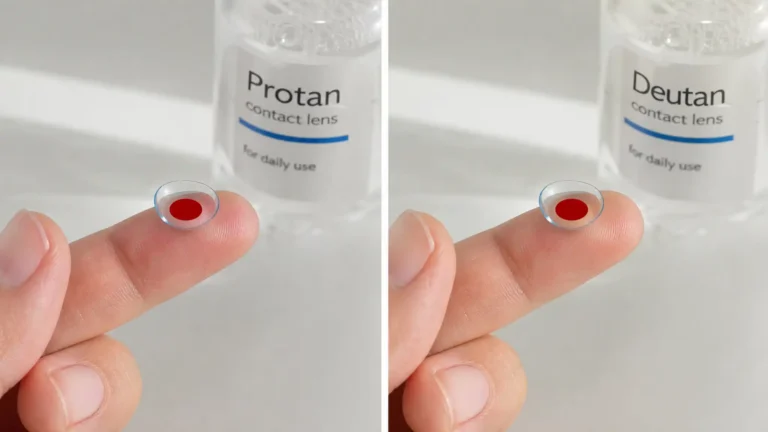
– The test screens for protan and deutan deficiencies but does NOT detect blue-yellow (tritan) color blindness
– Failing the Ishihara isn’t the end — alternative tests like the Farnsworth D-15, CAD, and Waggoner CCVT are accepted by many agencies
What Is the Ishihara Test?
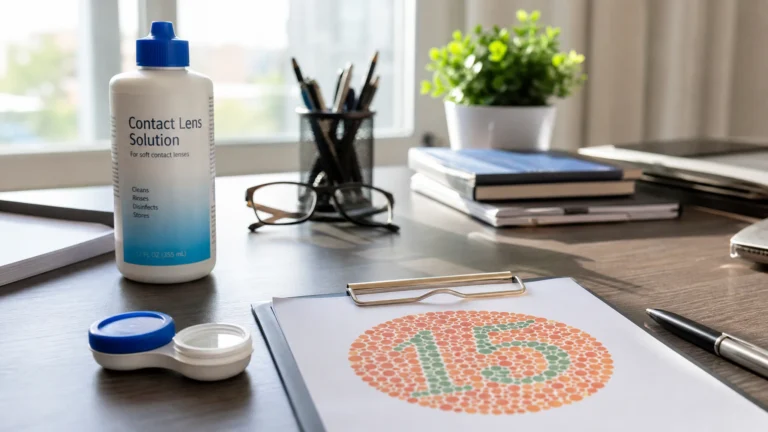
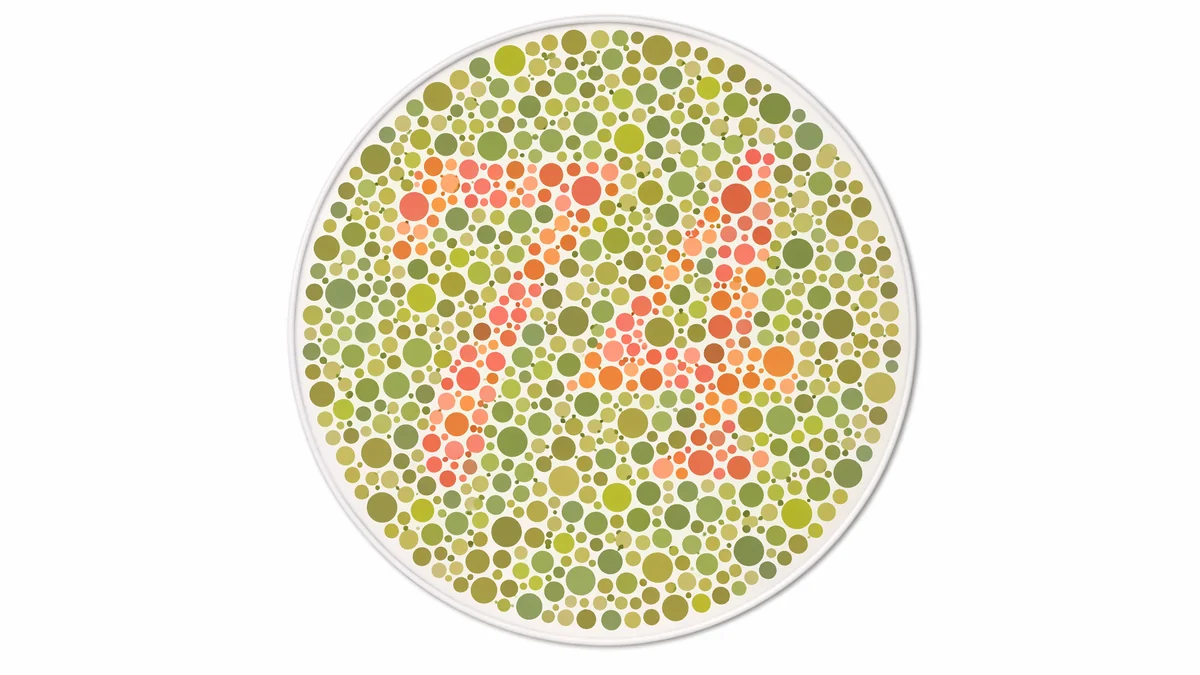
The Ishihara color vision test is a screening tool developed in 1917 by Dr. Shinobu Ishihara, a Japanese ophthalmologist. It consists of a series of plates, each filled with colored dots of varying sizes and colors. Within the dot pattern, a number or shape is embedded in dots of a slightly different color.
People with normal color vision can see the number clearly. People with red-green color vision deficiency may see a different number, a distorted shape, or nothing at all — depending on the plate type and the severity of their deficiency.
The test’s brilliance lies in its simplicity. It takes less than two minutes to administer, requires no special equipment beyond the plate book and proper lighting, and delivers highly accurate results for red-green deficiency detection.
Why It’s the Gold Standard
After more than a century of use, the Ishihara test remains the primary color vision screening tool worldwide for three reasons:
- Speed: A full screening takes 1-2 minutes
- Accuracy: 97% sensitivity, nearly 100% specificity for red-green deficiency
- Standardization: Used uniformly by aviation, law enforcement, military, and employers globally
How the Ishihara Test Works
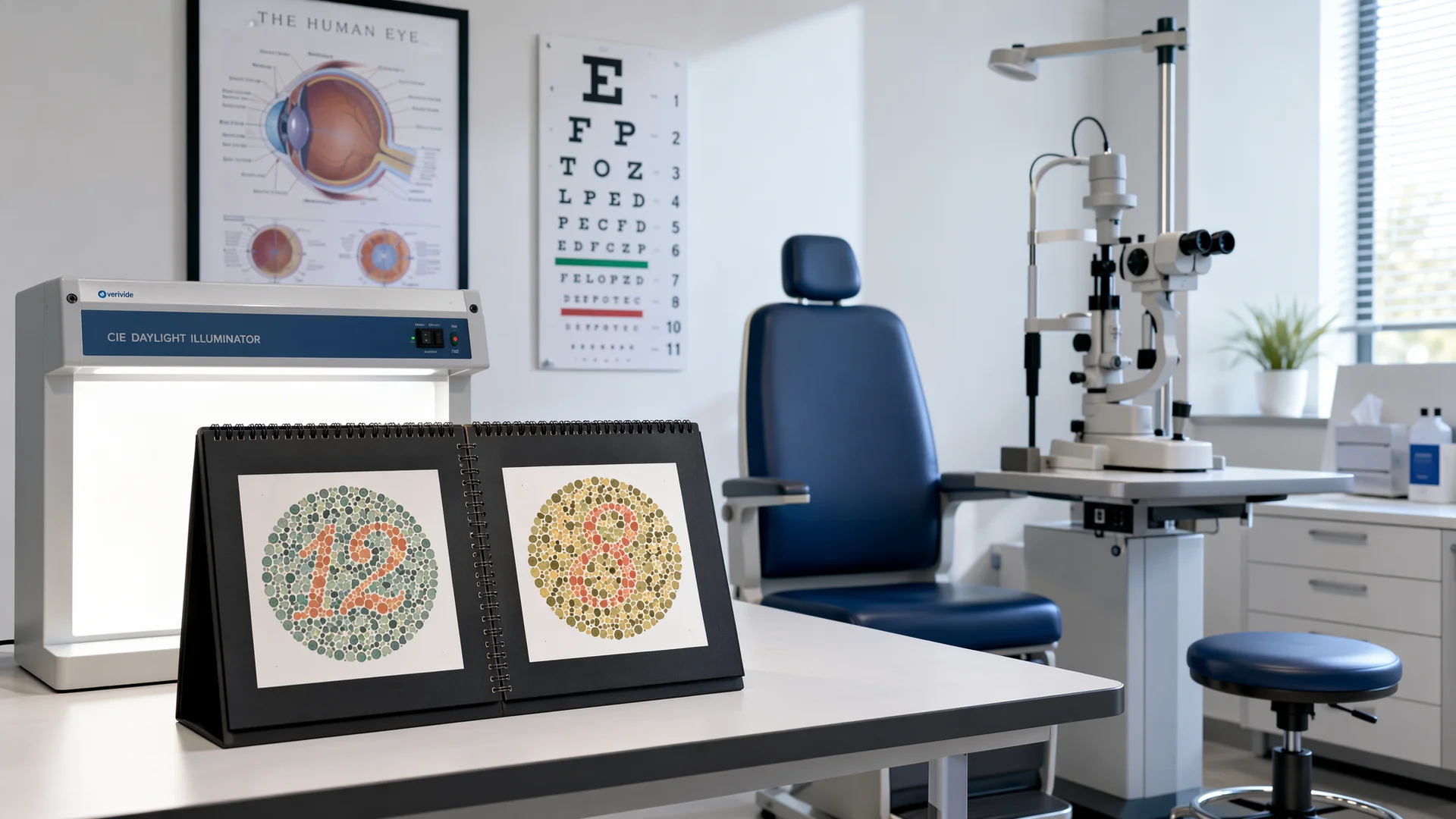
The Ishihara test works on a principle called pseudoisochromatic plate design. The dots on each plate are carefully chosen to differ only in hue — not in brightness or saturation — making the number invisible to someone who cannot distinguish the specific colors used.
The Science Behind the Dots
Each plate is constructed using two classes of dots:
- Background dots: One color/hue that forms the overall field
- Foreground dots: A different hue that forms the number or shape
To someone with normal color vision, the foreground dots “pop out” because their cone cells can distinguish the hue difference. To someone with red-green deficiency, the two colors blend together because the affected cone cells cannot separate them.
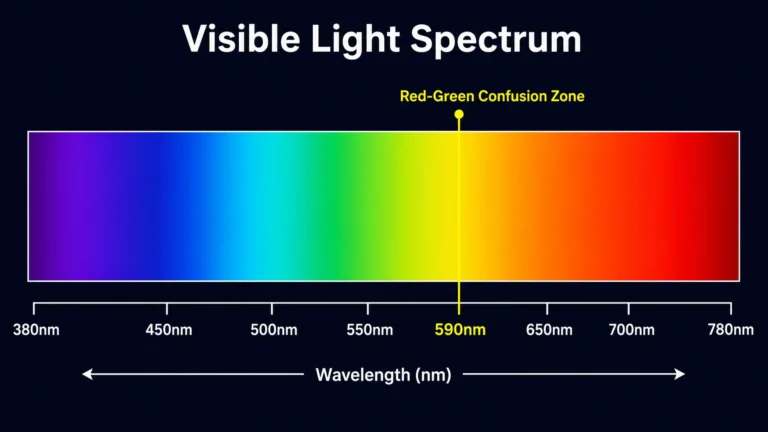
This is why the test works specifically for red-green color blindness (protan and deutan types). The plates are designed around the specific wavelength confusion zones where L-cone (red) and M-cone (green) sensitivity overlaps.
Lighting Requirements
For accurate results, the Ishihara test must be administered under specific lighting:
| Requirement | Standard |
|---|---|
| Light source | CIE Illuminant C or D65 (simulated daylight) |
| Color temperature | 6000K to 7000K |
| CRI (Color Rendering Index) | 90 or higher |
| Angle | Light at 45 degrees to minimize glare |
| Viewing distance | 75 cm (30 inches) |
| Response time | 3 seconds per plate |
Important: Standard office LED lighting often has poor color rendering in the red spectrum, which can produce inaccurate results. If you’re taking an Ishihara test for a career qualification, the lighting must meet these standards.
Ishihara Plate Types Explained
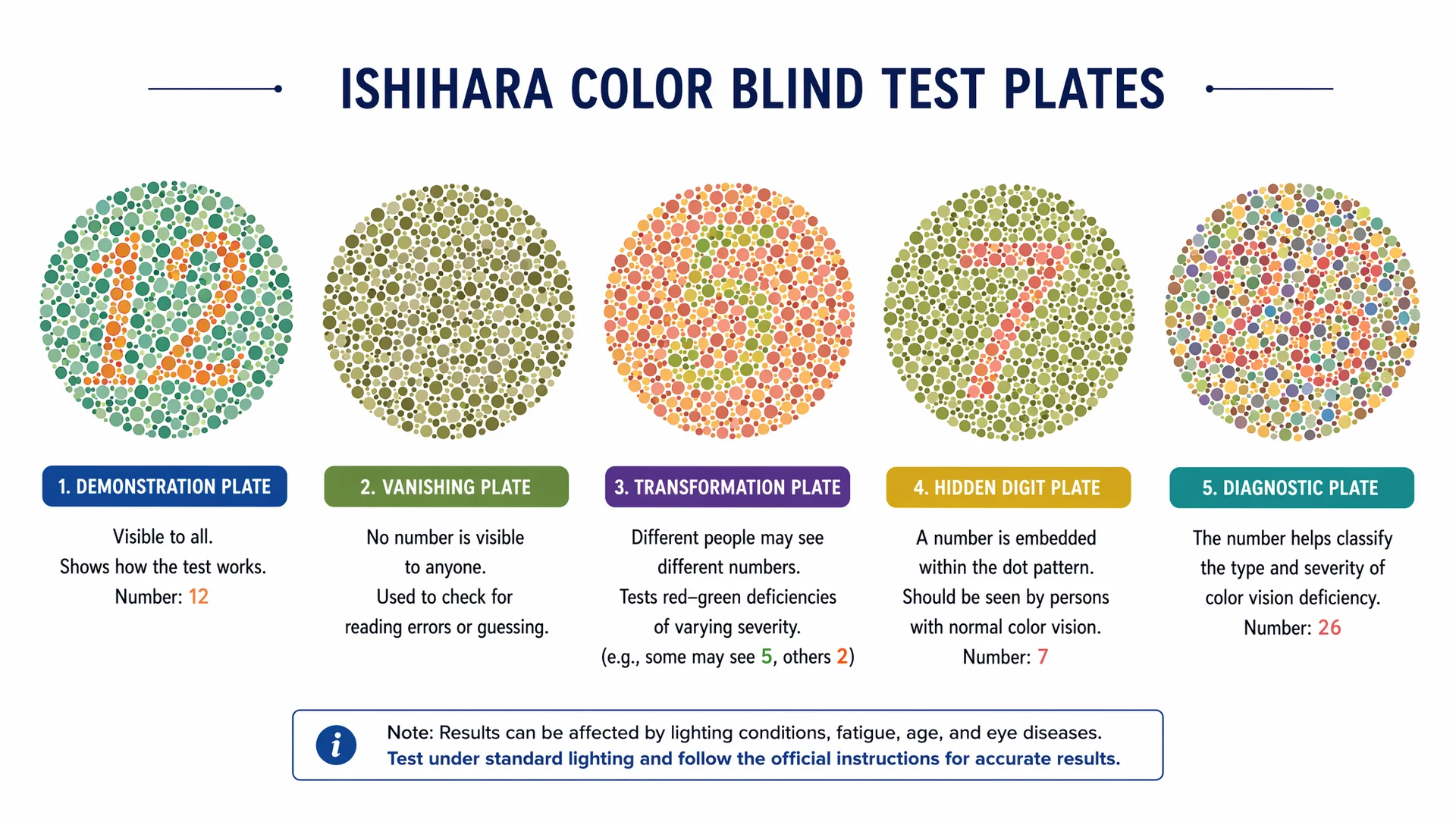
A standard Ishihara test contains 38 plates, though shorter versions (14, 24, or 10 plates) are also common for occupational screening. The plates fall into five design categories.
1. Demonstration Plate
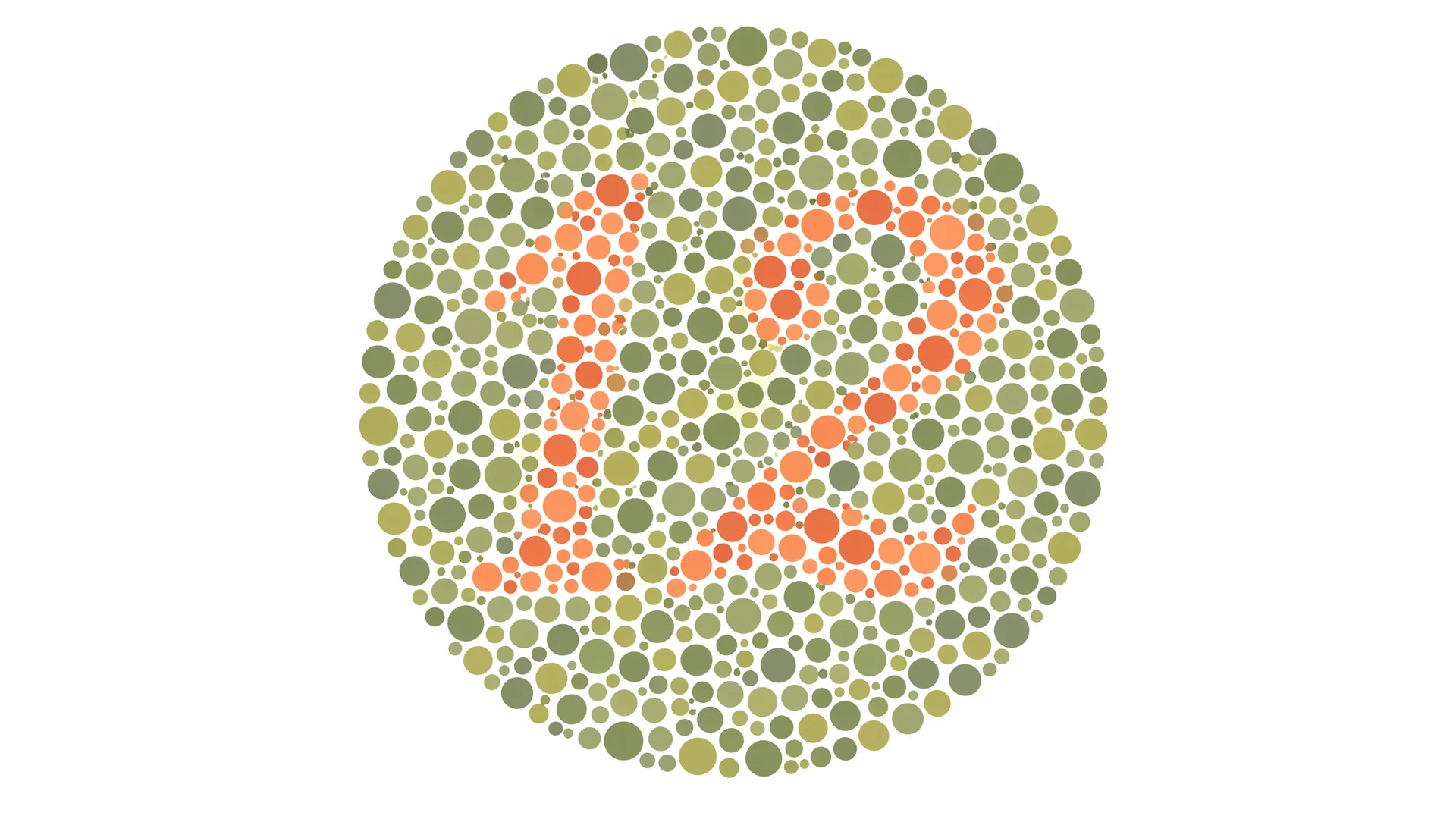
The first plate (typically showing the number “12”) is visible to everyone regardless of color vision. It’s used to demonstrate the test format and is not scored.
2. Vanishing Plates
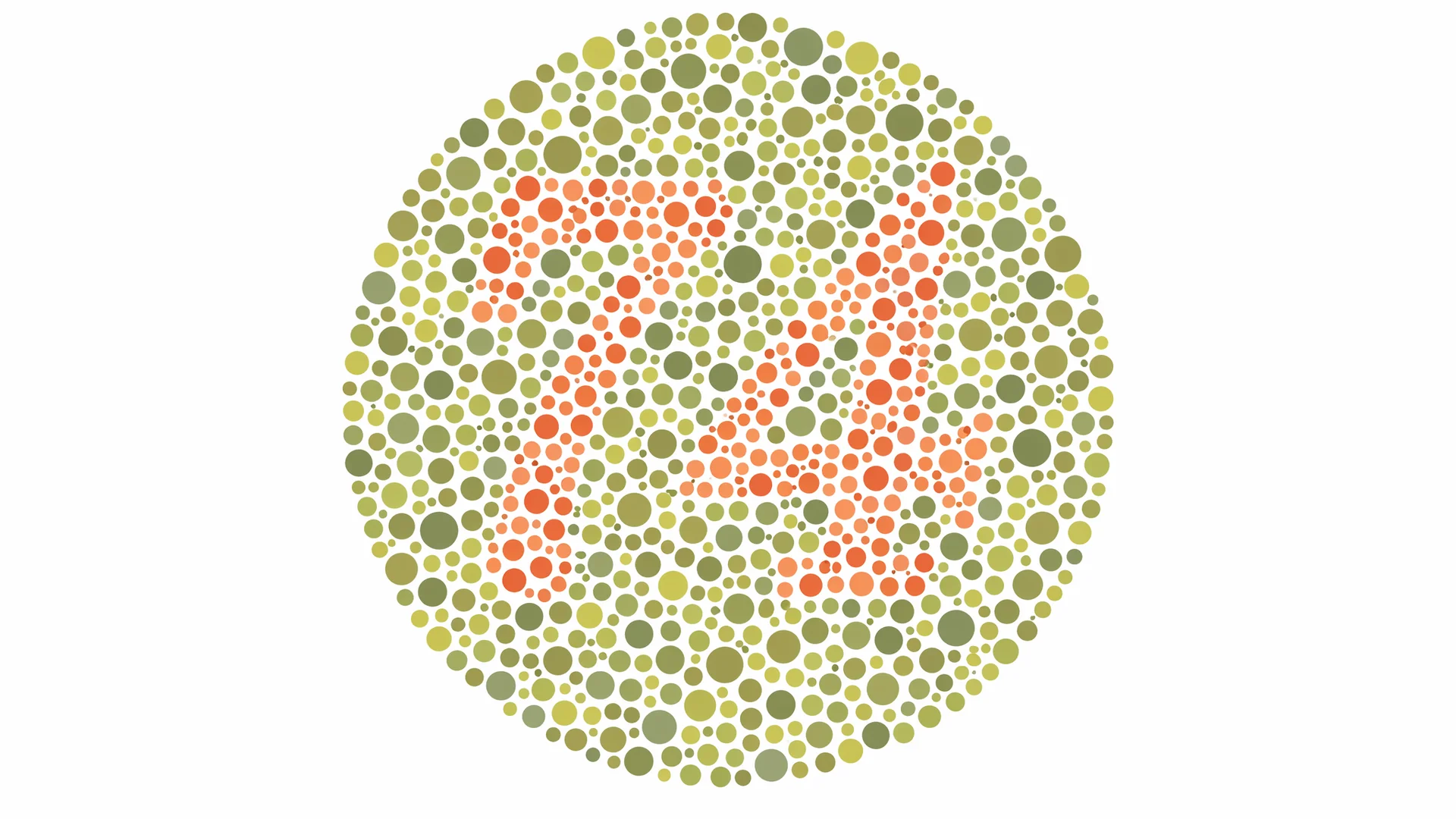
These plates show a number that is visible only to people with normal color vision. Someone with red-green deficiency sees only random dots with no discernible pattern.
3. Transformation Plates
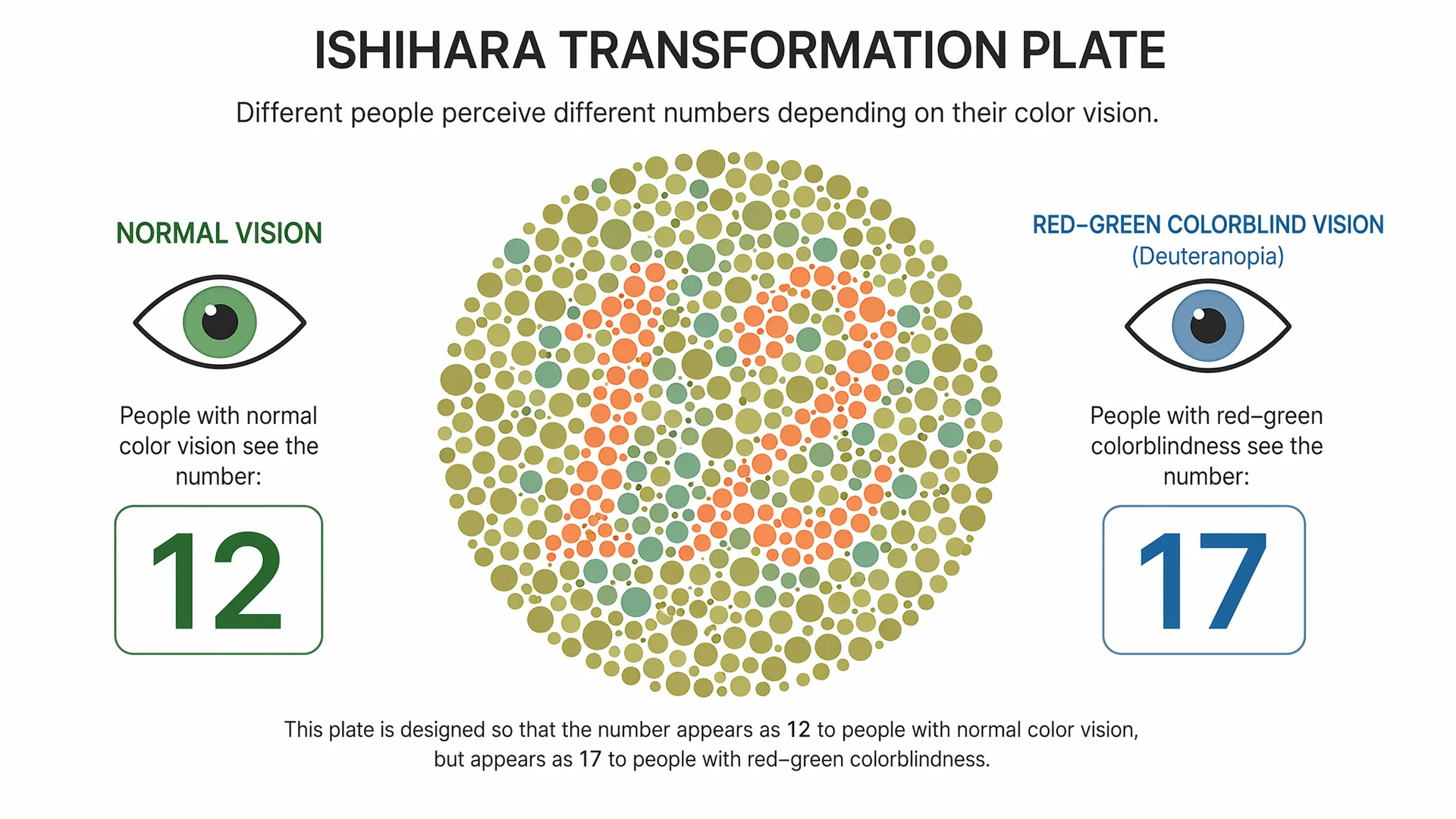
These clever plates show different numbers to different viewers. People with normal vision see one number, while those with color deficiency see a different number. This design helps identify the presence of color vision deficiency.
4. Hidden Digit Plates
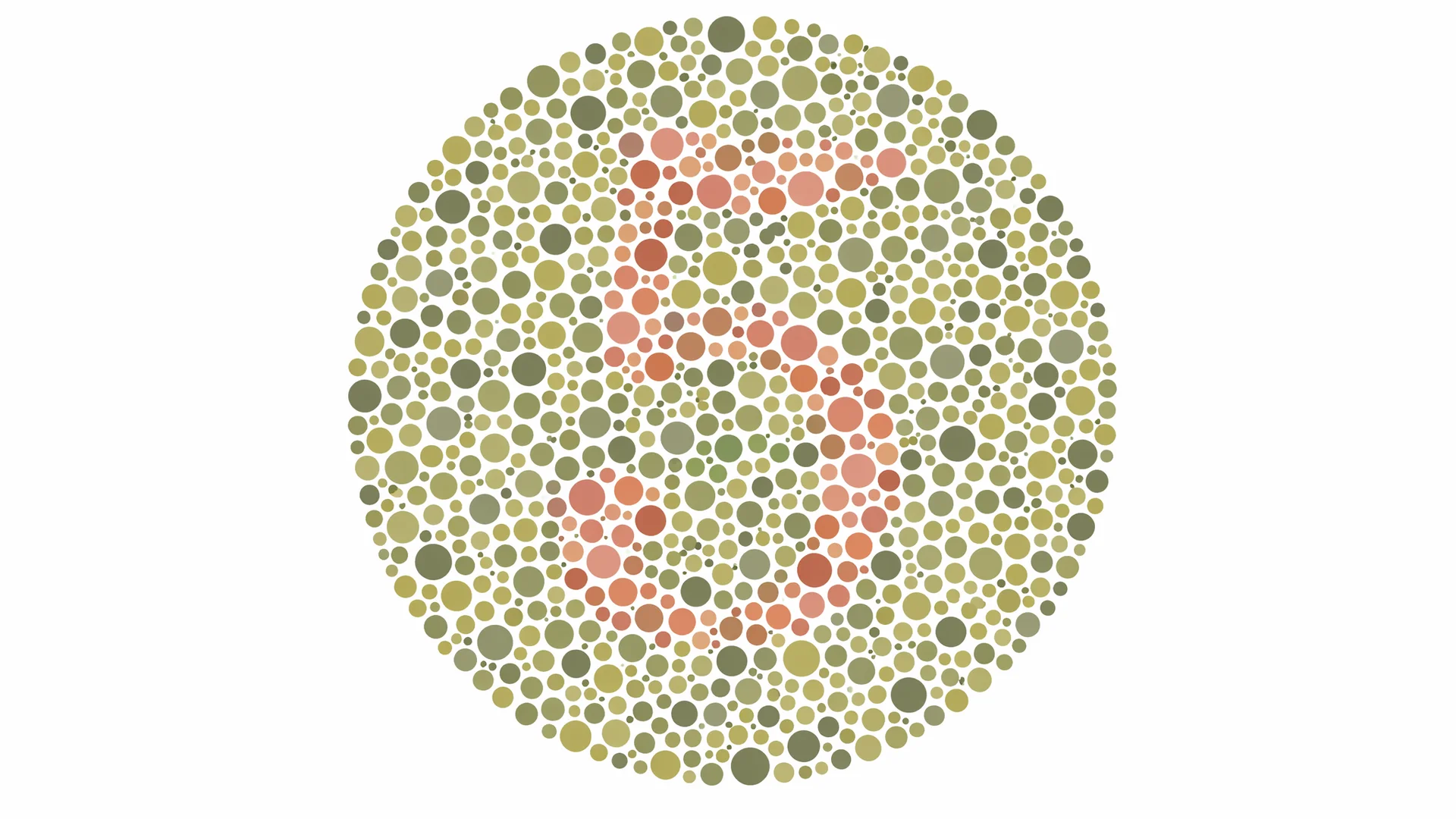
The reverse of vanishing plates — these show a number that is visible ONLY to people with color vision deficiency. People with normal vision see only random dots. These plates help confirm the diagnosis.
5. Diagnostic Plates
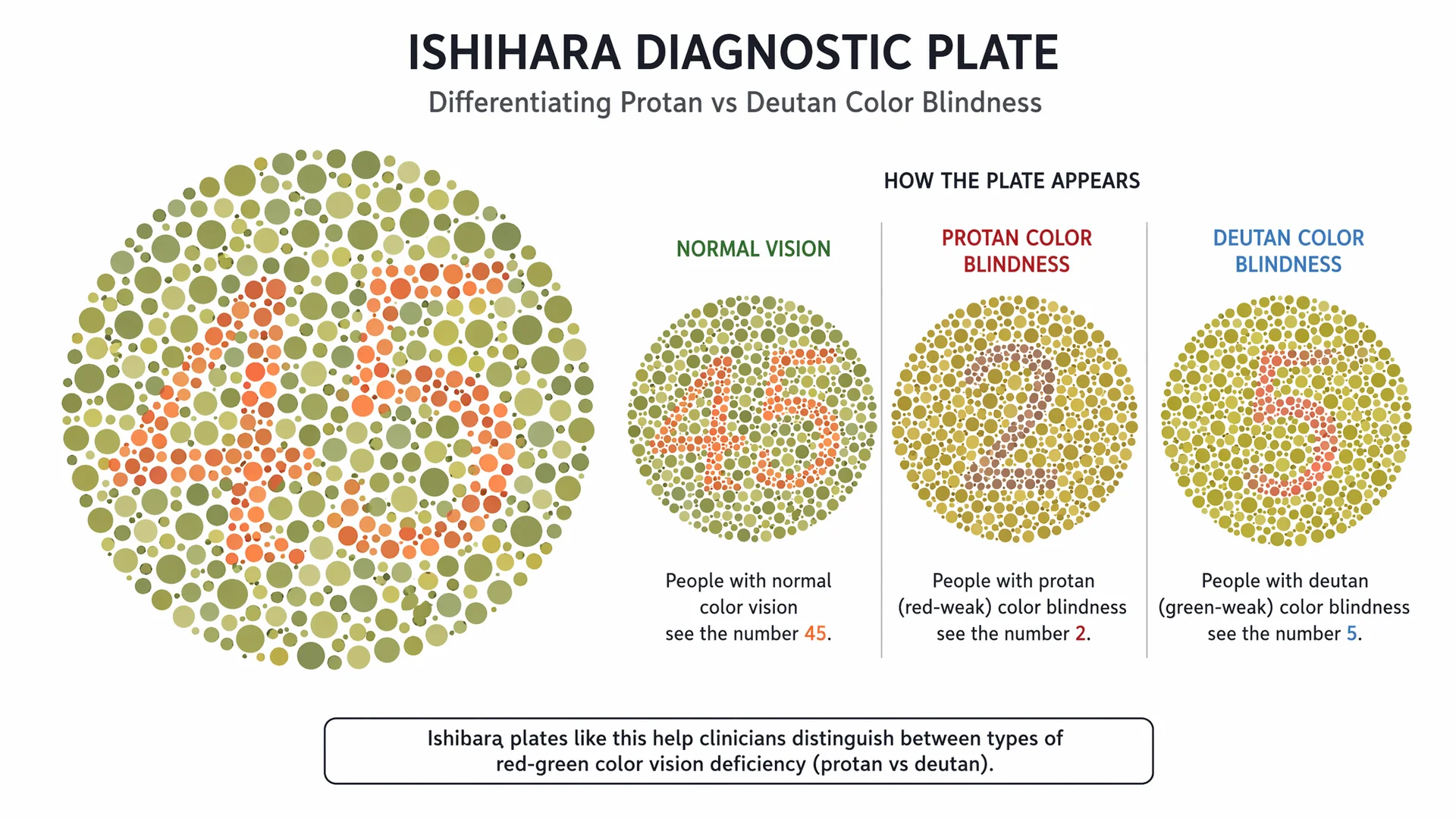
These plates are specifically designed to differentiate between protan (red-deficient) and deutan (green-deficient) types. They help the examiner classify the type of color vision deficiency.
Plate Type Summary
| Plate Type | Normal Vision Sees | Color-Deficient Sees | Purpose |
|---|---|---|---|
| Demonstration | “12” | “12” | Introduction, not scored |
| Vanishing | Number | Random dots | Detects deficiency |
| Transformation | Number A | Number B | Identifies deficiency |
| Hidden Digit | Random dots | Number | Confirms deficiency |
| Diagnostic | Varies | Varies | Classifies type (protan vs deutan) |
Ishihara Test Scoring
Scoring methodology depends on the version of the test being administered and the organization’s requirements.
Common Scoring Standards
| Test Version | Total Plates | Passing Score | Used By |
|---|---|---|---|
| 14-plate | 14 | 12/14 correct | U.S. Navy, many employers |
| 24-plate | 24 | Varies by organization | Clinical settings |
| 38-plate (full) | 38 | Varies | Clinical research, complete diagnosis |
| 10-plate | 10 | Varies | Quick screening |
Understanding Your Results
Pass: If you correctly identify 12 or more of the 14 red-green plates, your color vision is classified as normal for screening purposes.
Fail: If you correctly identify 11 or fewer plates, you have some degree of red-green color vision deficiency. The next step is usually a diagnostic evaluation to determine the type (protan vs deutan) and severity.
Severity Classification:
| Category | Score Range | Interpretation |
|---|---|---|
| Normal | 76-100% | Passes standard screening |
| Mild deficiency | 46-75% | May pass some occupational tests with alternative assessments |
| Moderate deficiency | 36-45% | Likely requires alternative testing |
| Strong/severe deficiency | 0-35% | Significant color vision deficiency |
What the Test Does NOT Detect
The Ishihara test has important limitations:
- Does NOT detect blue-yellow (tritan) color blindness: The plates are specifically designed for red-green confusion. If you have tritan deficiency, you will likely pass the Ishihara test.
- Does NOT detect achromatopsia (complete color blindness): Different testing methods are needed.
- Screening, not diagnostic: The Ishihara is a screening tool. A comprehensive diagnosis requires additional testing.
- Memorizable: Because the same plates are used worldwide, some people attempt to memorize answers. Professional examiners use random plate selection to prevent this.
How to Prepare for the Ishihara Test
Whether you’re taking the Ishihara test for a career qualification or personal knowledge, preparation can help you perform at your best.
Before Test Day
Know what to expect: Familiarize yourself with the test format. The plates show numbers, and you’ll have about 3 seconds per plate. There’s no penalty for guessing — always give your best answer.
Test your lighting: If possible, confirm that the testing location uses daylight-standard lighting (6000-7000K, CRI 90+). Poor lighting is one of the most common causes of inaccurate results.
Rest your eyes: Get adequate sleep before the test. Eye fatigue can temporarily reduce color discrimination ability.
Practice with Colorblind Contacts
Spectral notch filter contacts, like Colorkinds, are designed to help you distinguish the red-green contrast that the Ishihara test measures. While they are prohibited during most official occupational exams, they can be an effective training tool for:
- Practicing with sample Ishihara plates at home
- Building confidence in your ability to distinguish test patterns
- Understanding how the test works before exam day
Important: Most agencies — including the FAA, police departments, and federal employers — strictly prohibit wearing color-correcting lenses during the official exam. Using them covertly is an integrity violation that can result in disqualification.
On Test Day
- Arrive well-rested and hydrated
- Remove any tinted contact lenses before the test
- Wear clear prescription glasses if needed
- Take your time on each plate (but don’t exceed 3 seconds)
Ishihara Test Requirements by Career
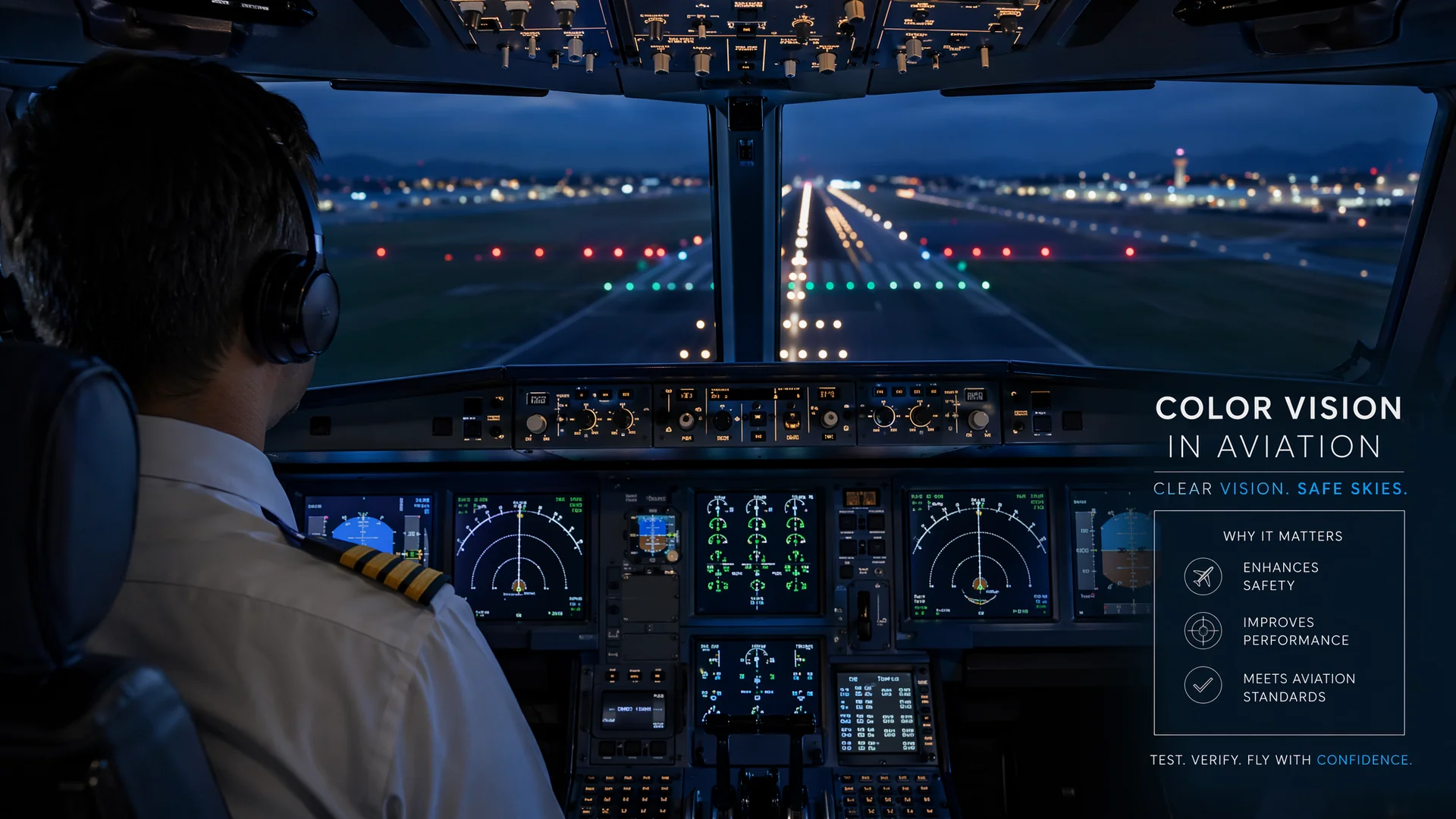
Different careers have different Ishihara test requirements and different options if you don’t pass.
Aviation
The FAA uses the Ishihara test as the initial screening for pilot medical certificates. First, second, and third-class medicals all require color vision screening.
If you fail: Pilots can take alternative tests including the OCVT (Operation Color Vision Test), CAD test, or Rabin Cone Contrast Test. Passing an alternative test removes the night flying restriction.
Learn more about FAA color vision testing →
Law Enforcement
Most police departments use the Ishihara test as part of the pre-employment medical evaluation. Requirements vary significantly by agency.
If you fail: Many departments offer secondary testing using the Farnsworth D-15 or Waggoner CCVT. Some agencies accept a letter from an optometrist confirming functional color vision.
Learn more about color vision requirements for police →
Electrical Trades
Electricians must distinguish color-coded wiring. OSHA and licensing boards often require passing the Ishihara test.
If you fail: Alternative assessments and practical demonstrations of wire identification may be accepted in place of the Ishihara.
Learn more about color vision requirements for electricians →
Military
The U.S. military uses the Ishihara test for all branches. Standards are stricter than civilian requirements, especially for pilot and specialized roles.
If you fail: The military offers alternative testing through the Rabin Cone Contrast Test for some roles.
Learn more about color vision requirements for military →
Career Comparison Table
| Career | Initial Test | If You Fail | Alternative Options |
|---|---|---|---|
| Airline pilot | Ishihara 14-plate | Referred to alternative test | OCVT, CAD, Rabin CCT |
| Police officer | Ishihara 14-plate | Secondary screening | D-15, Waggoner CCVT |
| Electrician | Ishihara or wire test | Practical assessment | Wire identification test |
| Military pilot | Ishihara + Rabin CCT | Role-dependent | Rabin CCT, waiver |
| Firefighter | NFPA Ishihara standard | Varies by department | D-15, practical test |
Alternative Tests to the Ishihara
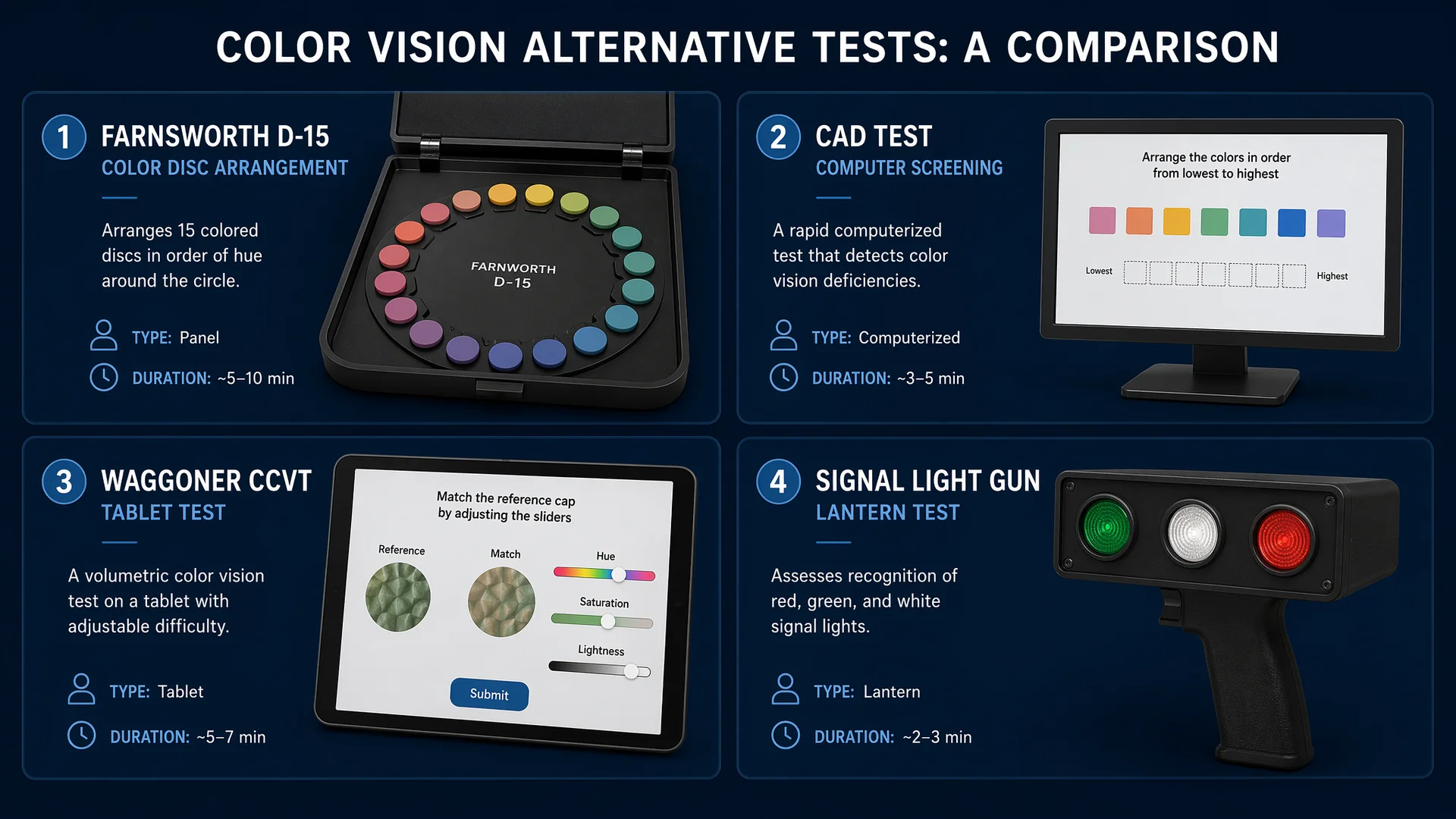
If you fail the Ishihara test, several alternative tests can assess your color vision for occupational purposes.
| Test | What It Measures | Time | Used By |
|---|---|---|---|
| Farnsworth D-15 | Hue arrangement, severity classification | 2-3 min | Police, many employers |
| CAD Test | Red-green and blue-yellow sensitivity | 10-15 min | FAA, UK CAA |
| Waggoner CCVT | Computerized plate testing | 5-10 min | Military, federal agencies |
| Rabin Cone Contrast | Individual cone cell testing | 5-10 min | U.S. military, FAA |
| OCVT (Signal Light Gun) | Real-world color signal identification | 15-20 min | FAA (pilots) |
Learn more about alternative color vision tests →
FAQ: Ishihara Test
The Ishihara test is a color vision screening that uses plates with colored dots to detect red-green color blindness. Developed by Dr. Shinobu Ishihara in 1917, it is the world’s most widely used color vision test.
The full Ishihara test contains 38 plates. Common shorter versions include 14-plate (used by the U.S. Navy and many employers), 24-plate (clinical), and 10-plate (quick screening).
On the standard 14-plate test, passing is typically 12 out of 14 red-green plates correct. The demonstration plate (usually number 12) is not counted in scoring.
Some people attempt to memorize Ishihara plate answers, but professional examiners use random plate selection and shorter presentation times to prevent this. The test is a screening tool, not a memory test.
Spectral notch filter contacts like Colorkinds can help you distinguish red-green contrast, making them useful for practice and familiarization. However, most official occupational exams prohibit wearing corrective lenses during the test.
Failing the Ishihara test doesn’t end your career prospects. Many employers offer alternative tests like the Farnsworth D-15, Waggoner CCVT, or CAD test. FAA pilots can take the OCVT. Police departments often accept secondary screening results.
No. The Ishihara test is specifically designed to detect red-green color vision deficiency (protan and deutan types). It does not reliably detect blue-yellow (tritan) deficiencies or achromatopsia (complete color blindness).
The test was invented by Dr. Shinobu Ishihara, a Japanese ophthalmologist and professor at the University of Tokyo. He developed it in 1917 while serving in a military medical role during World War I.
The Ishihara test has approximately 97% sensitivity and nearly 100% specificity for detecting red-green color vision deficiency when administered under proper lighting conditions with standard testing protocols.
The test requires daylight-standard lighting: CIE Illuminant C or D65, 6000-7000K color temperature, CRI of 90 or higher, with light at a 45-degree angle. Standard office LED lighting often produces inaccurate results.